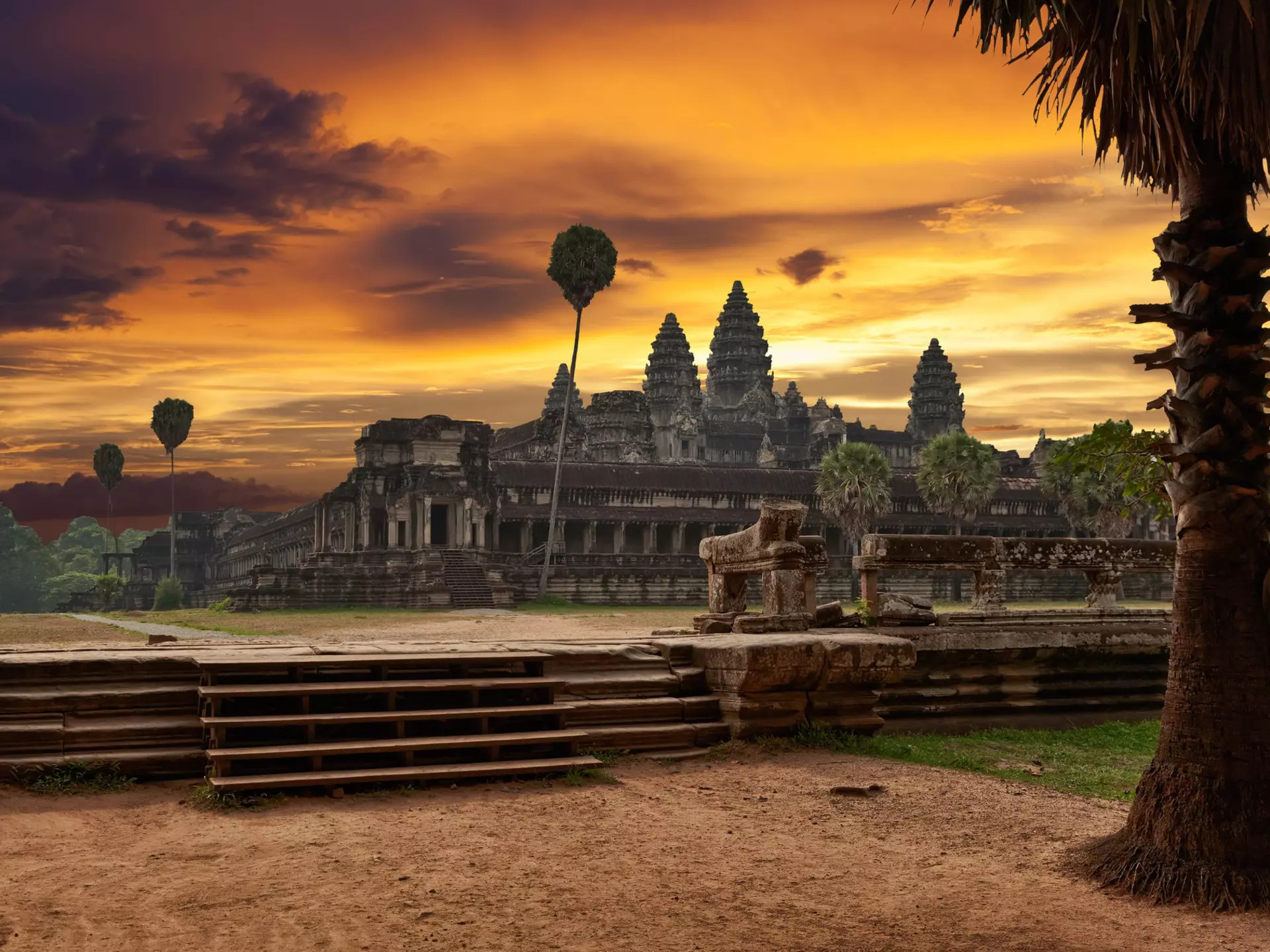
In the early 12th century, the Khmer Empire was at the height of its power, controlling much of what is now Cambodia, Thailand, Laos, and southern Vietnam from its capital at Angkor. Around 1113, a new king, Suryavarman II, took the throne after years of civil conflict, and set about commissioning a temple unlike anything built before or since. Construction ran roughly from 1113 to 1150, employing what scholars believe were tens of thousands of workers, artisans, and elephants over nearly four decades.
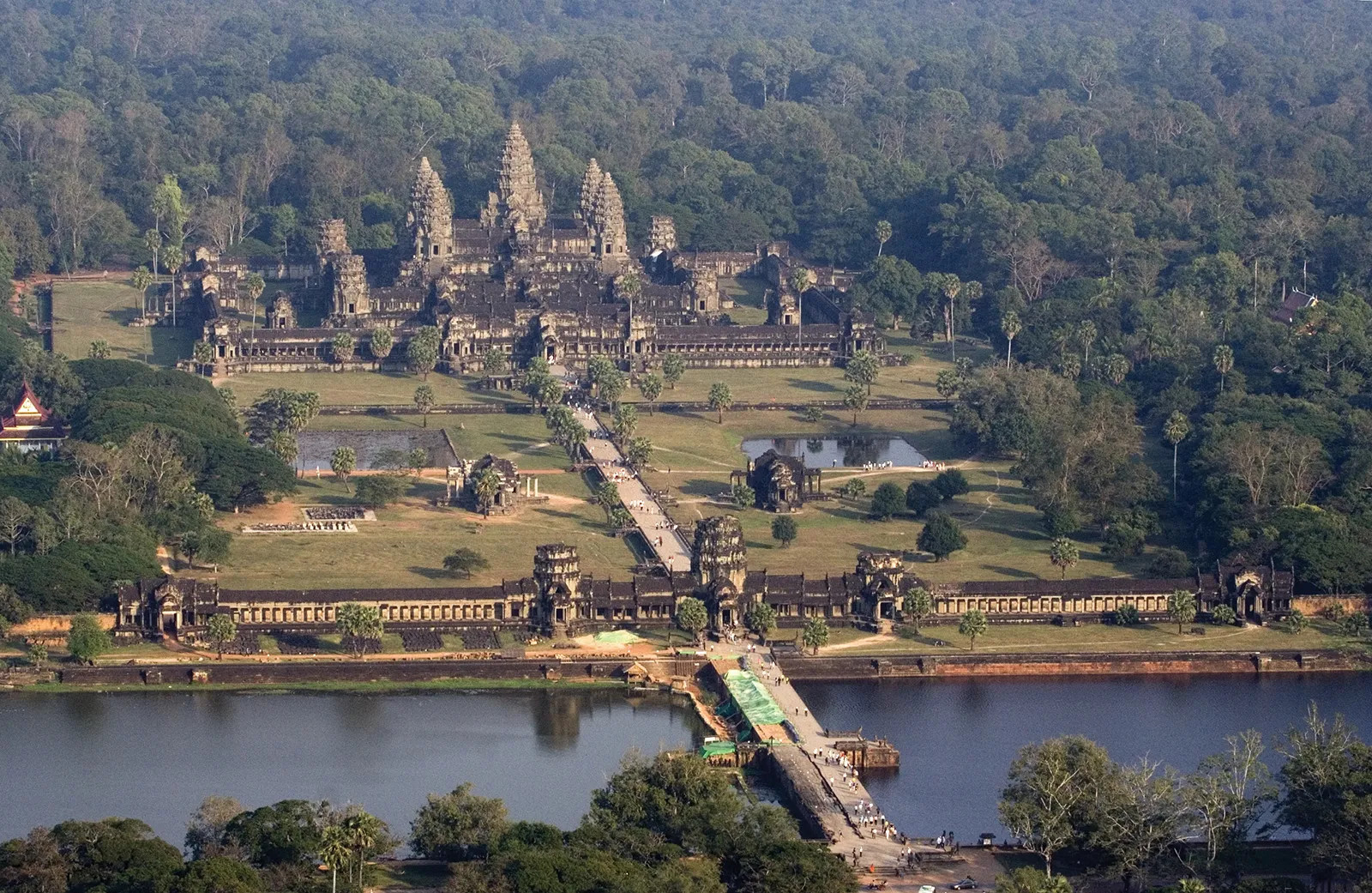
The temple was dedicated to Vishnu rather than Shiva, breaking from the pattern of most earlier Khmer state temples, and was almost certainly intended to double as Suryavarman's funerary temple and eventual mausoleum. Its design reproduces, in stone, the Hindu and Buddhist cosmology of Mount Meru, the mythical mountain at the center of the universe: a central tower rising 65 meters, ringed by four smaller towers, surrounded by successive galleries and a vast moat representing the cosmic ocean.
Nothing about the scale of the project was modest. The temple complex covers 162.6 hectares, making it, by Guinness World Records recognition, the largest religious structure on Earth. The moat alone is roughly 190 meters wide and more than 5 kilometers around, drawing water from the nearby Siem Reap River through a network of canals the Khmer engineers built specifically for the project.
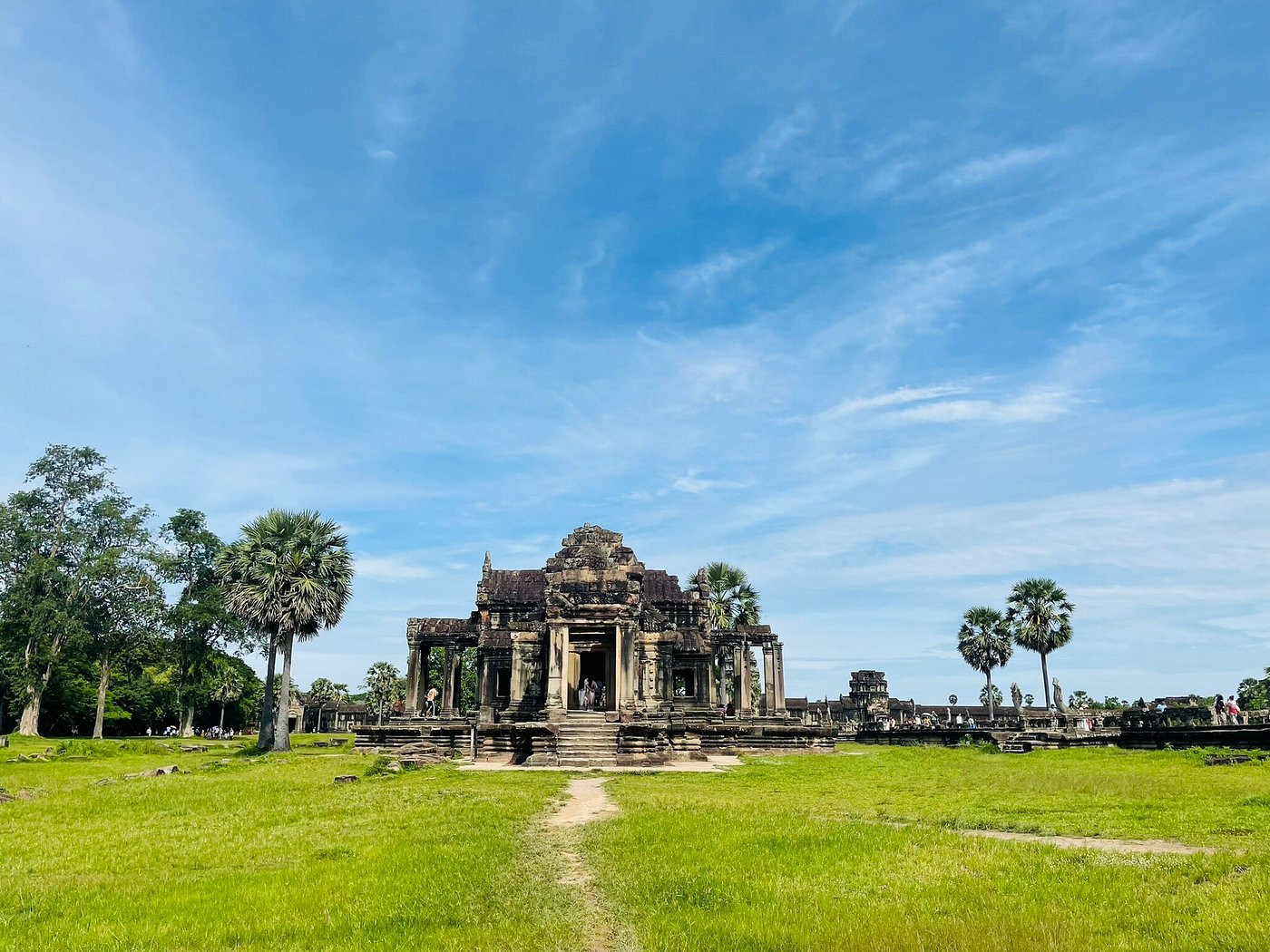
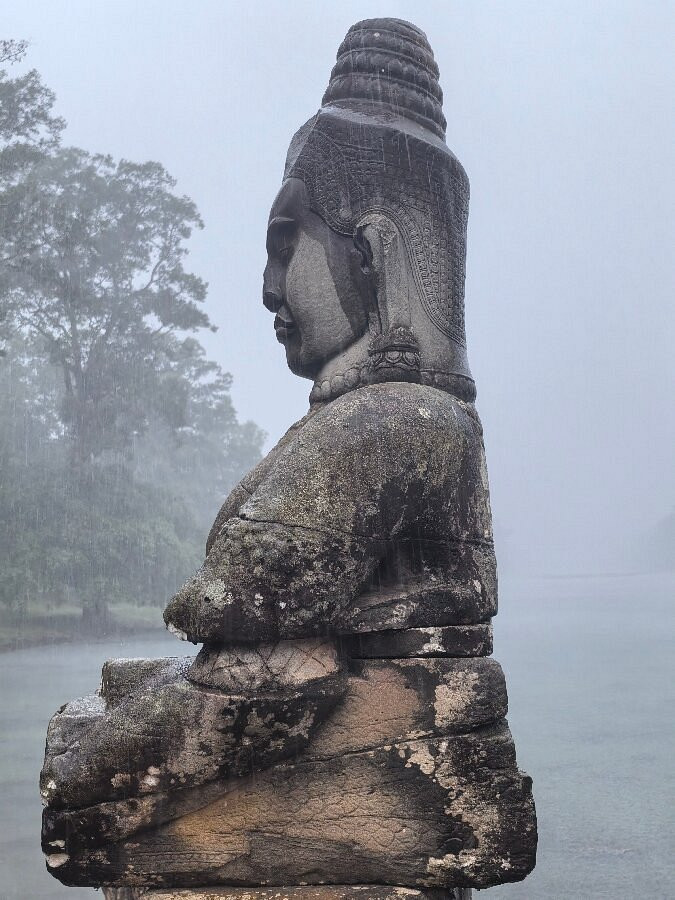
The sandstone used for the temple's surfaces was quarried from the Kulen Hills, over 30 kilometers away, and floated down river on rafts to the construction site — an immense logistical undertaking for a civilization without mechanized transport. Every surface tells a story: kilometers of bas-relief carvings wrap the outer gallery walls, depicting scenes from the Hindu epics the Ramayana and Mahabharata, historical battle processions of Suryavarman's own army, and, most famously, the Churning of the Sea of Milk — a creation myth rendered across nearly 50 meters of continuous relief.
The temple's religious identity did not stay fixed. Cham forces sacked Angkor in 1177, and in the reconstruction that followed under King Jayavarman VII, Khmer religious life gradually shifted toward Theravada Buddhism. By the late 13th century, Angkor Wat itself was being converted for Buddhist worship, and it has functioned continuously as a Buddhist site ever since — making it, unusually among the world's largest ancient religious monuments, a place that never stopped being used for the purpose it was built for, even as the faith attached to it changed.
That continuity likely helped preserve it. While many other Angkor-era temples were abandoned outright and swallowed by jungle after the Khmer capital shifted away from Angkor in the 15th century, monks maintained a presence at Angkor Wat, keeping the immediate temple grounds at least partially cleared even as forest reclaimed the wider region.
Angkor Wat was never truly "lost" to the world in the way the phrase implies — local Khmer communities and Buddhist monks knew the site continuously. But it was unknown to the West until Portuguese friar António da Madalena wrote an account of visiting in 1586, and it remained a curiosity rather than a fixture of Western scholarship until French naturalist Henri Mouhot's writings, published after his 1860 expedition, popularized the temple internationally and set off a wave of European fascination.
Cambodia's own relationship with the temple deepened over the 20th century into something closer to national identity: Angkor Wat's silhouette has appeared on every Cambodian national flag since 1863, the only national flag in the world to feature a building. The temple survived the turmoil of the Khmer Rouge era relatively intact compared to the human cost inflicted on the country around it, and restoration work accelerated after Cambodia stabilized in the 1990s.
UNESCO inscribed Angkor as a World Heritage Site in 1992, and in 1993 established the International Coordinating Committee for the Safeguarding and Development of Angkor, bringing together conservation teams from France, Japan, India, Germany, China, and others to work on different temples across the wider Angkor Archaeological Park, of which Angkor Wat is the centerpiece. Erosion, tree root damage, and the sheer age of the sandstone mean conservation is a permanent, ongoing project rather than a one-time restoration.
Tourism itself has become both the temple's lifeline and one of its greatest pressures. Visitor numbers climbed past 2.5 million a year before the COVID-19 pandemic collapsed international travel, dropping to roughly 280,000 in 2022 before beginning to recover — a swing that illustrated just how central the temple has become to Cambodia's economy, and how much strain sustained mass tourism puts on stone surfaces built for a medieval royal court, not modern crowds.
For most visitors today, the temple's defining image is its reflection in the moat or the nearby lily ponds at sunrise, when the five towers silhouette against a lightening sky and the crowds that gather before dawn fall largely silent. It is, by a wide margin, the most photographed moment at Angkor, and also the most crowded — visitors who prioritize a quieter experience over the classic photograph often choose sunset instead, when the light is nearly as dramatic and the grounds considerably emptier.
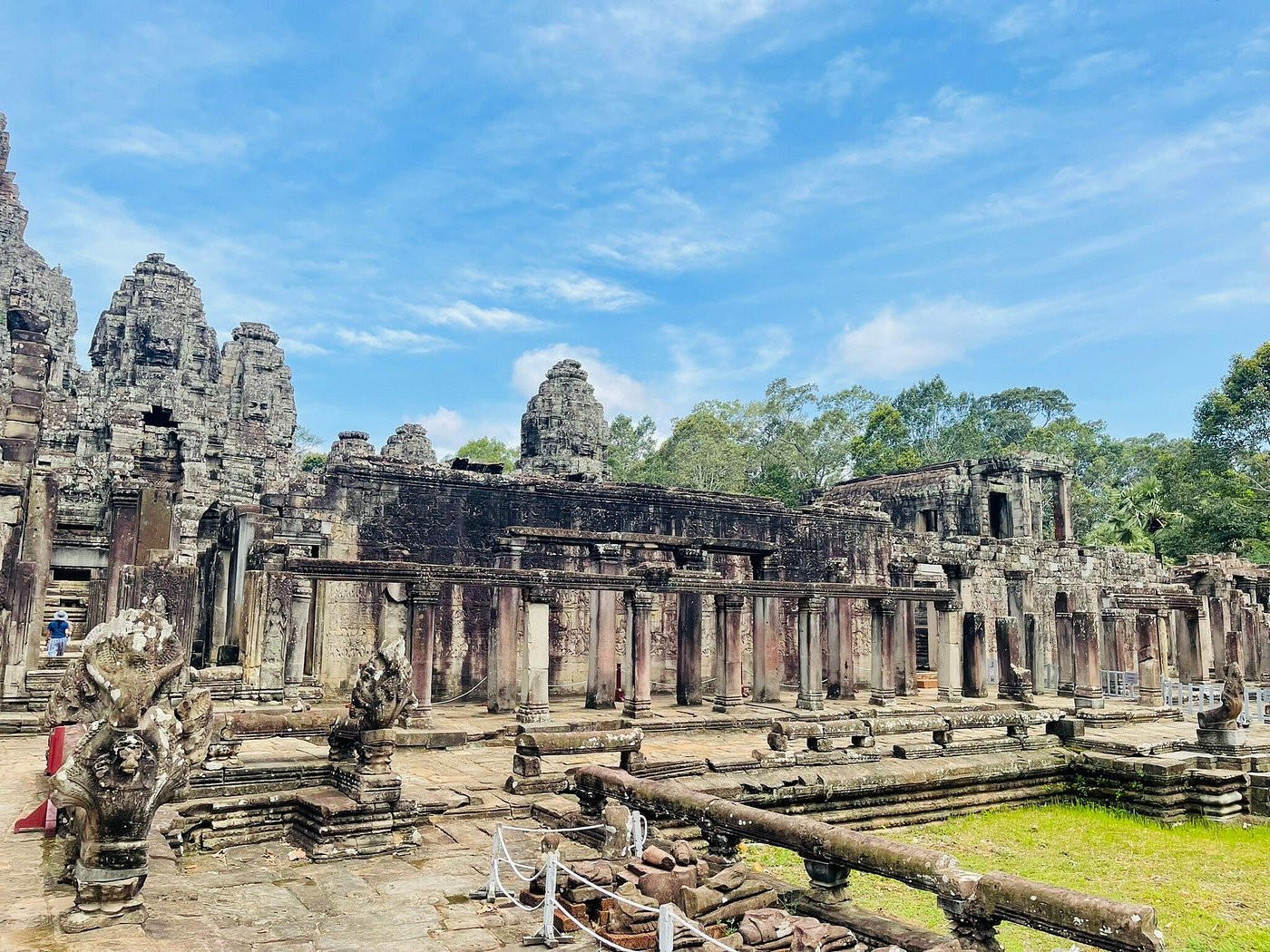
Angkor Wat sits at the heart of a much larger archaeological park containing hundreds of other temples, from the jungle-swallowed ruins of Ta Prohm to the enigmatic stone faces of the Bayon at Angkor Thom, meaning a single day rarely does the wider site justice even when it's enough time to properly see Angkor Wat itself.
Entry is ticketed and strictly enforced: a one-day pass costs around $37, a three-day pass (usable within any 10-day window) around $62, and a seven-day pass (usable within a month) around $72 — Cambodian citizens and children under 12 enter free. Tickets are sold at the main Angkor Ticket Office outside Siem Reap, which opens at 5:00 AM specifically to accommodate sunrise visitors, with the wider complex open until 5:30 PM.
Siem Reap, a short tuk-tuk or taxi ride from the temples, functions as the gateway town for the entire Angkor region, with the bulk of hotels, restaurants, and tour operators based there. Modest dress covering shoulders and knees is required to enter the temple's upper levels, and given the heat and walking involved, most guides recommend visiting in the cooler early morning or late afternoon hours rather than the middle of the day.
No reviews yet. Be the first to share your experience!
Share your experience and help other travelers