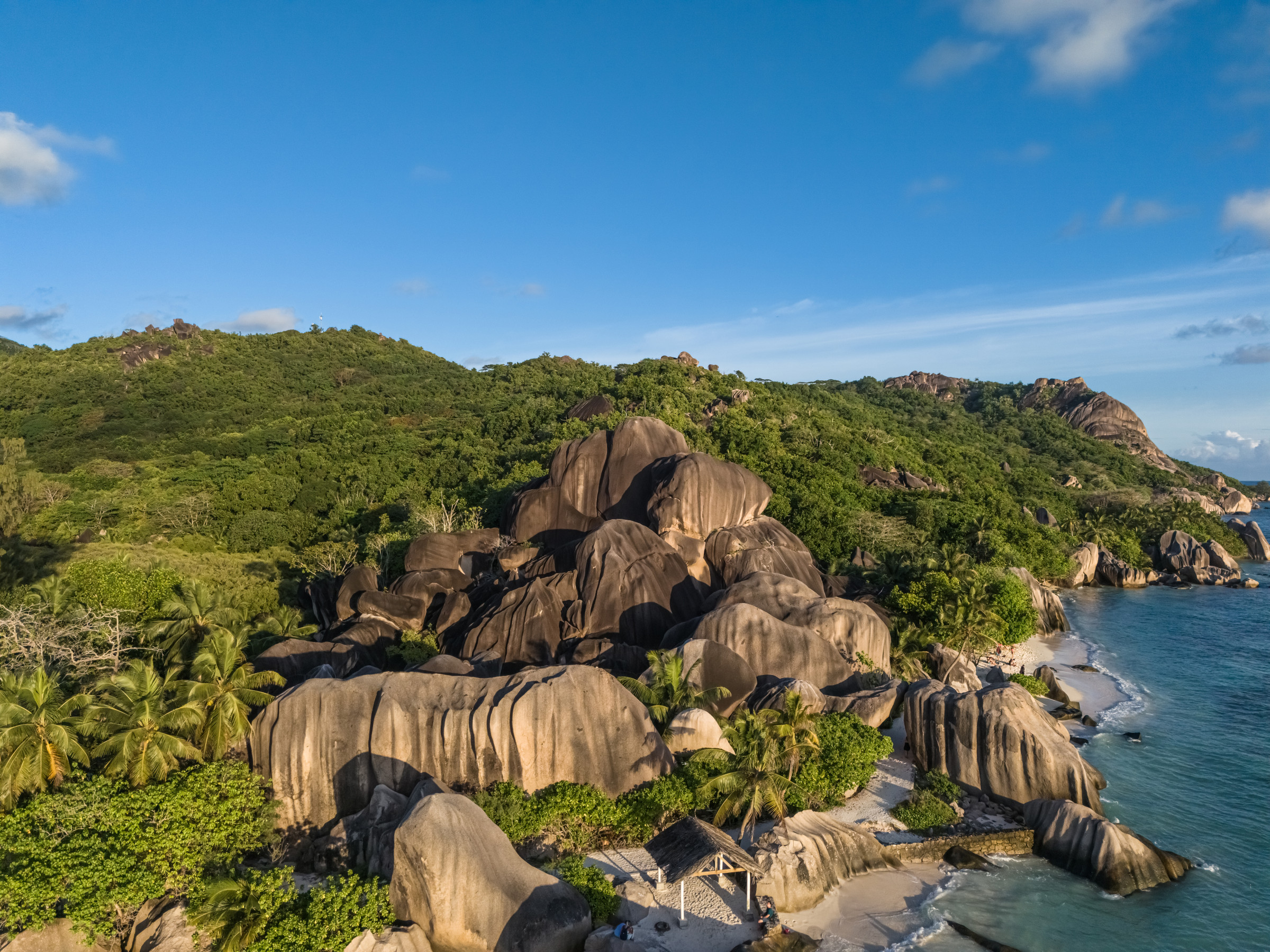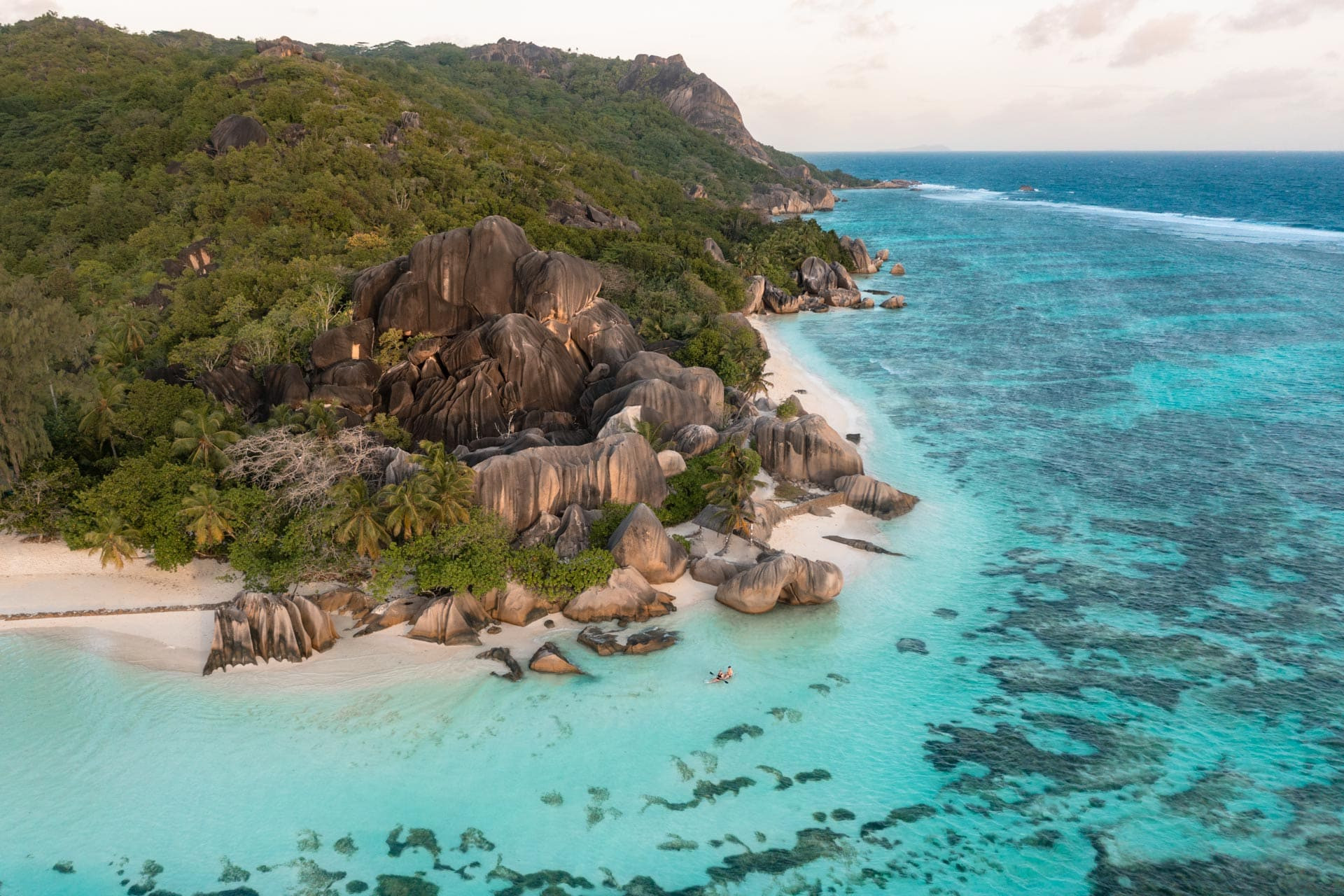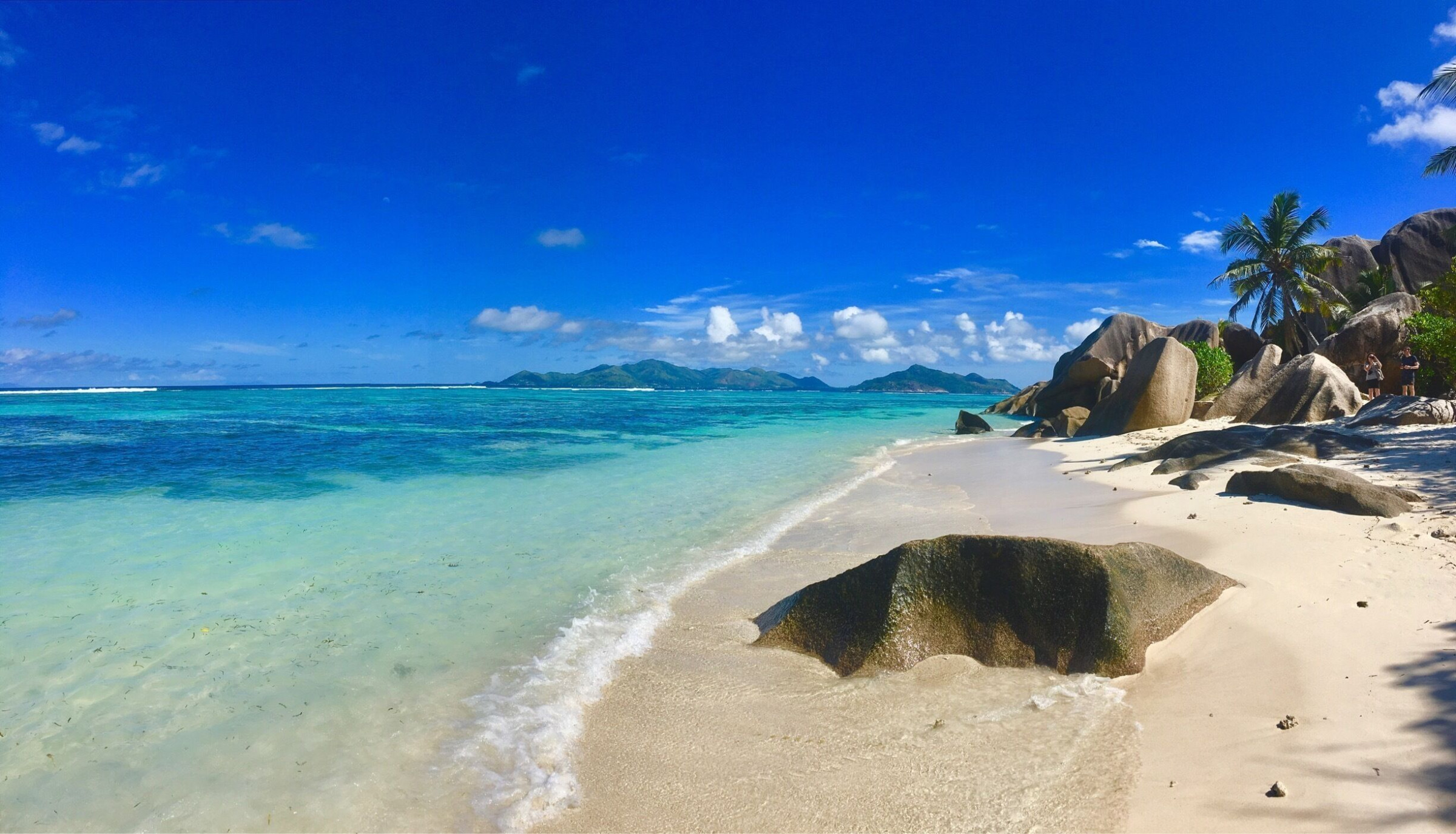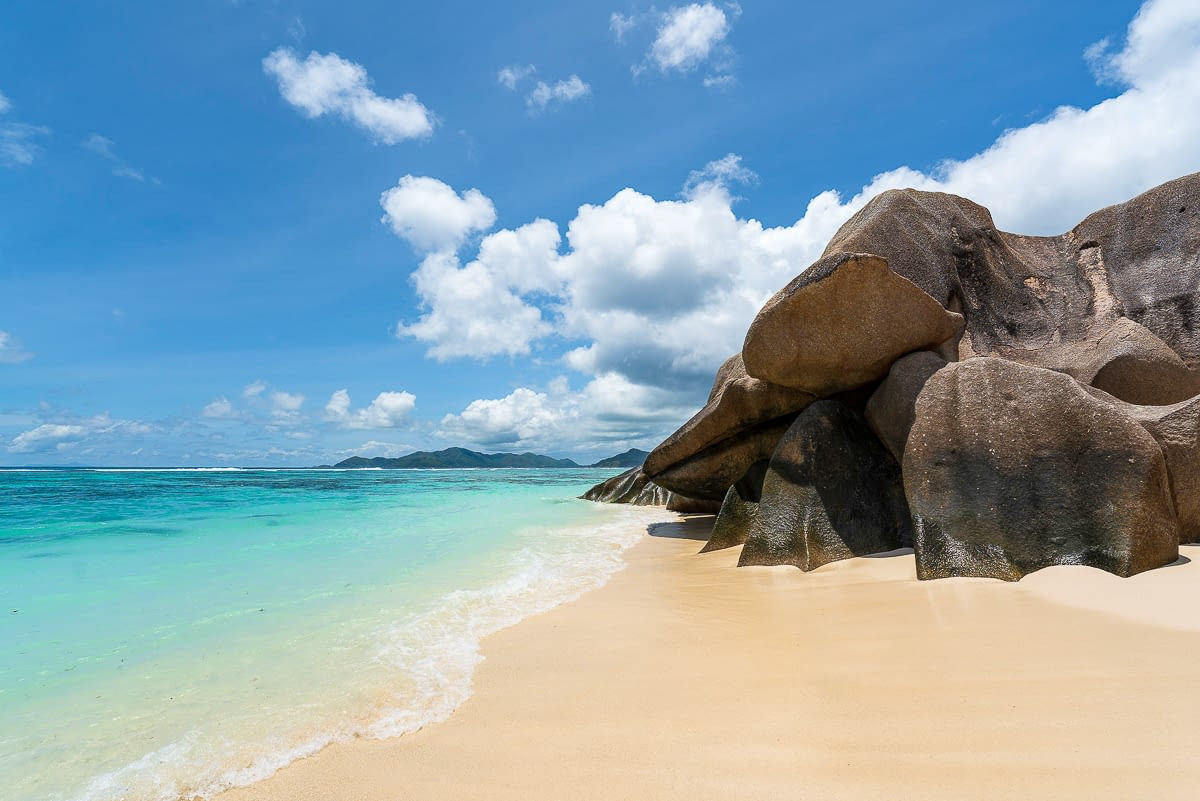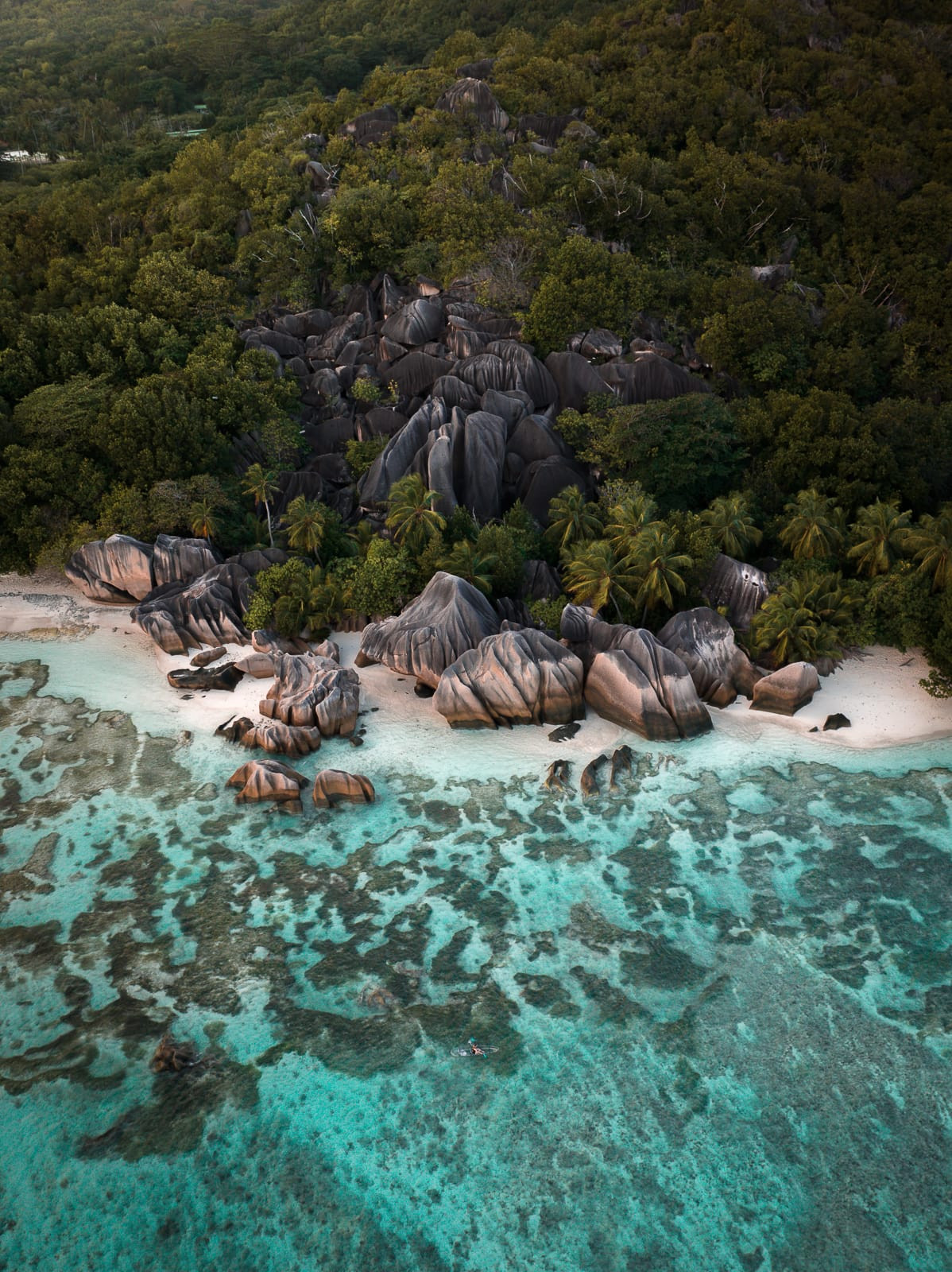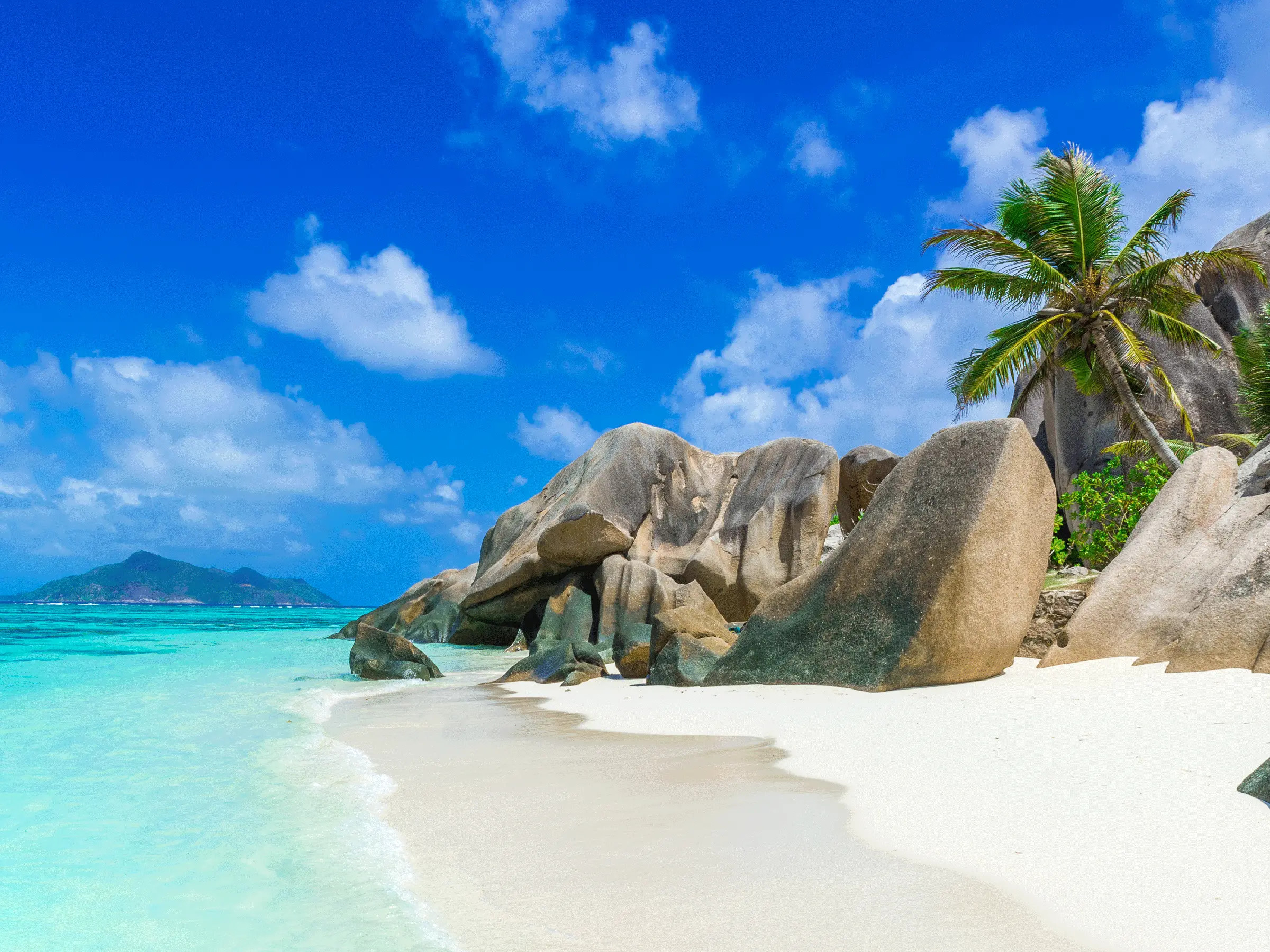
Anse Source d'Argent, on the small Seychelles island of La Digue, is routinely ranked among the most photographed beaches on Earth, its fame resting on a combination found in almost no other tropical beach setting: powder-fine white sand, shallow turquoise water protected by an offshore reef, and enormous, smoothly rounded pink granite boulders scattered across the shoreline and rising directly out of the shallows. These boulders are a geological signature of the inner Seychelles islands more broadly, remnants of granite that once formed part of the ancient supercontinent Gondwana, exposed and sculpted over millions of years by weathering rather than the volcanic or coral processes that shape most tropical islands. The result is a beach that looks less like a typical sandy coastline and more like a sculpture garden set against the sea, with boulders framing small private coves along the shore that visitors can walk between at low tide.
La Digue itself sits in the Seychelles' Inner Islands, east of the larger island of Praslin, and has no airport of its own, meaning visitors reach it only by boat, typically taking a ferry from Praslin or, for those arriving internationally, connecting through the main island of Mahé and its capital Victoria first. This lack of an airstrip has helped preserve a slower, quieter character on La Digue compared to more developed Seychelles islands, reinforced by the island's continued reliance on bicycles as the dominant form of local transport, along with a small number of traditional ox-carts that still occasionally carry goods and visitors along the island's few paved roads. Rental bicycles, available near the ferry pier in the main settlement of La Passe, remain the standard way for visitors to explore the island's beaches and interior, a deliberately unhurried mode of travel that suits an island where the main attractions are, almost without exception, better appreciated slowly.
La Digue is one of 115 islands that make up the Seychelles archipelago, an island nation scattered across the western Indian Ocean and divided broadly into granite-based Inner Islands, including La Digue, Mahé, and Praslin, and low-lying coral Outer Islands and atolls scattered much further from the group's geographic center. This geological split gives the Seychelles an unusual diversity for such a small nation: dramatic granite boulder coastlines on islands like La Digue sit within the same country as flat coral atolls elsewhere in the archipelago, each shaped by an entirely different geological history despite their shared modern national identity. Praslin, La Digue's larger neighbor and the usual gateway for ferry connections, is itself home to the Vallée de Mai, a protected palm forest and UNESCO World Heritage Site known for the coco de mer, a palm tree producing the largest seed of any plant in the world, making the wider island group a destination that rewards visitors who venture beyond a single beach.
Away from Anse Source d'Argent, La Digue supports a small resident population living in settlements along its western coast, with fishing, small-scale agriculture, and tourism forming the backbone of the local economy in a pattern common across the smaller Seychelles islands. Traditional Creole culture, shaped by centuries of French and later British colonial influence layered over an African, Asian, and European population, remains visible in the island's cuisine, architecture, and Seychellois Creole language, spoken alongside English and French as one of the country's three official languages. The island's interior, largely undeveloped and covered in coconut plantations and forest, offers a quieter contrast to its famous beaches, with a scattering of smaller, less-visited beaches around the coastline that draw considerably fewer visitors than Anse Source d'Argent while offering a similar combination of granite boulders and clear water.
International visitors to the Seychelles fly into Seychelles International Airport near Victoria on Mahé, the country's main island, before continuing their journey by air or sea to the smaller islands. From Mahé, most travelers to La Digue either take a domestic flight to Praslin followed by a short ferry crossing, or a direct high-speed ferry connection where schedules allow, with the crossing itself offering views of the granite coastline that characterizes much of the Inner Islands along the way. Because La Digue has no airport, this multi-stage journey is unavoidable, and travelers planning a Seychelles trip typically build in Mahé or Praslin as stops either side of a La Digue visit, treating the three main Inner Islands as a natural multi-island itinerary rather than a single destination.
The Seychelles sit close enough to the equator that temperatures remain warm and relatively stable year-round, but rainfall follows a clearer seasonal pattern, with the months from October through March generally bringing the heaviest rain as the northwest monsoon dominates, while the drier season from April through September offers more consistently sunny conditions and calmer seas better suited to beach days and snorkeling around Anse Source d'Argent's reef-protected shallows. The shift between monsoon seasons in April and October can bring especially calm conditions and clearer water, making these transitional months a favorite window for photographers and divers, while the peak dry season months from June through September also coincide with the most reliable weather for exploring the island by bicycle without interruption from sudden tropical downpours.
Anse Source d'Argent's fame has brought a level of visitor traffic that Seychelles conservation authorities actively manage, with measures in some areas of the beach restricting swimming near the boulders during certain tide and current conditions, and ongoing efforts across the Inner Islands to balance tourism revenue against the fragility of coral reef systems already under pressure from rising ocean temperatures. The Seychelles more broadly has positioned itself internationally as a leader in marine conservation, having established large marine protected areas covering a substantial share of its territorial waters, a policy stance that shapes how beaches like Anse Source d'Argent are managed even as they remain open and genuinely accessible to ordinary visitors rather than restricted to a small number of permit holders, unlike some comparably famous natural sites elsewhere in the world.
Anse Source d'Argent's distinctive combination of boulders, pale sand, and turquoise shallows has made it a recurring backdrop for fashion shoots, films, and advertising campaigns well beyond ordinary travel photography, a level of commercial visibility unusual for a beach on an island as small and lightly developed as La Digue. This fame has occasionally created a gap between expectation and experience for visitors: the beach's calmest, most photogenic sections are relatively compact, and the fine sand can grow crowded around midday as day-trippers arrive from Praslin, leading many repeat visitors to recommend an early morning or late afternoon visit when the light is softer and the crowds have thinned. Despite the volume of images the beach has generated worldwide, La Digue's own pace has changed comparatively little, and the walk from the ferry pier to the beach, past small guesthouses, fruit stalls, and grazing giant tortoises kept in a protected reserve near the island's south, remains as much a part of the experience as the beach itself for visitors willing to slow down to the island's own rhythm. A small colony of giant Aldabra tortoises, relocated here as part of a wider Seychelles conservation effort, can often be seen grazing quietly in the shade near the reserve entrance, offering visitors a look at one of the archipelago's other signature species alongside the granite coastline that draws most people to the island in the first place.
No reviews yet. Be the first to share your experience!
Share your experience and help other travelers