Borobudur went up in the 9th century under the Sailendra dynasty, a Buddhist ruling family on the island of Java, in a construction process that unfolded across roughly five stages between 780 and 833 CE. Tradition credits the design to an architect named Gunadharma, though almost everything known about him comes from local folklore rather than historical record — a fitting gap for a monument whose builders left behind an extraordinary structure and almost no names.
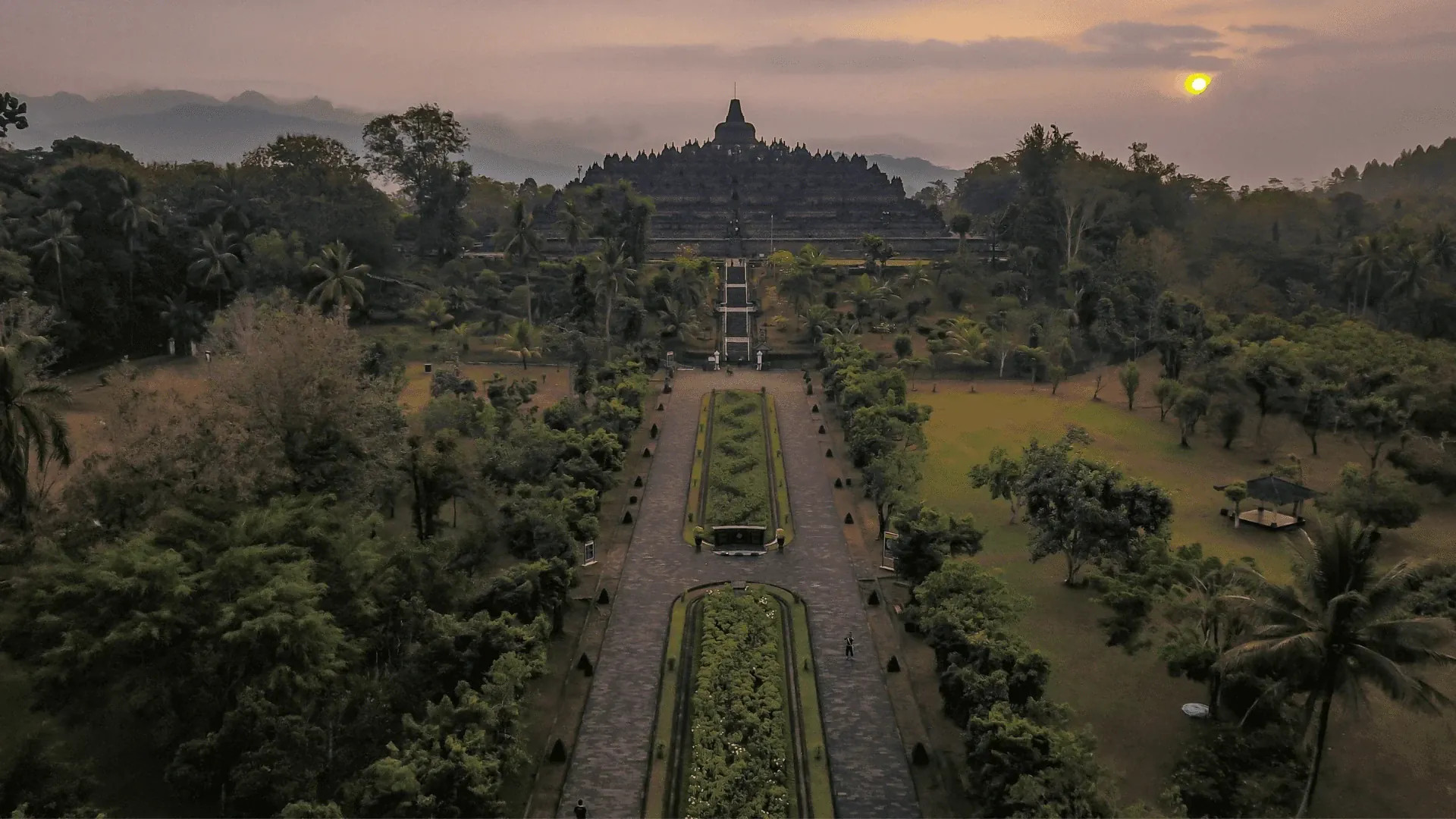
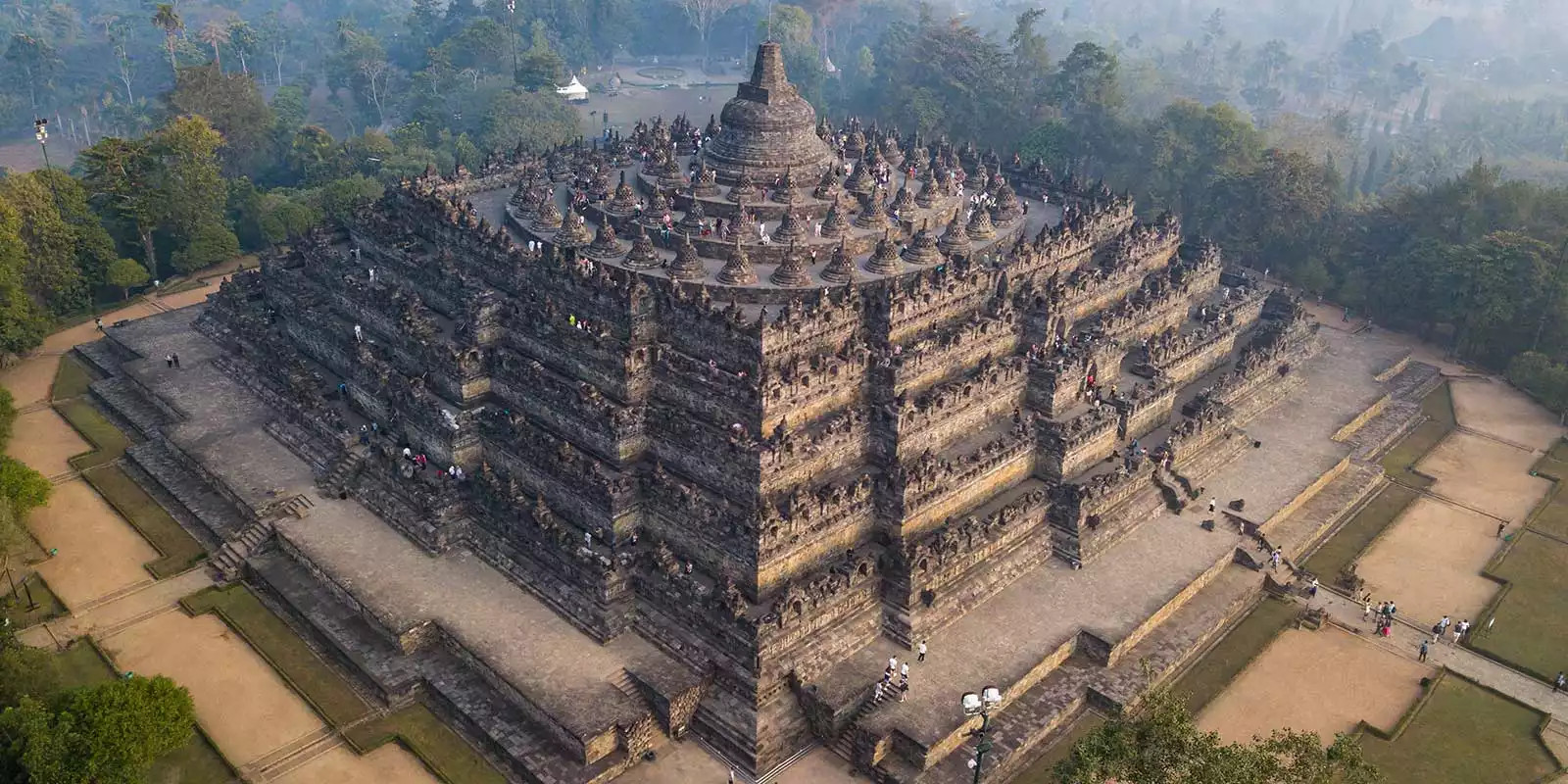
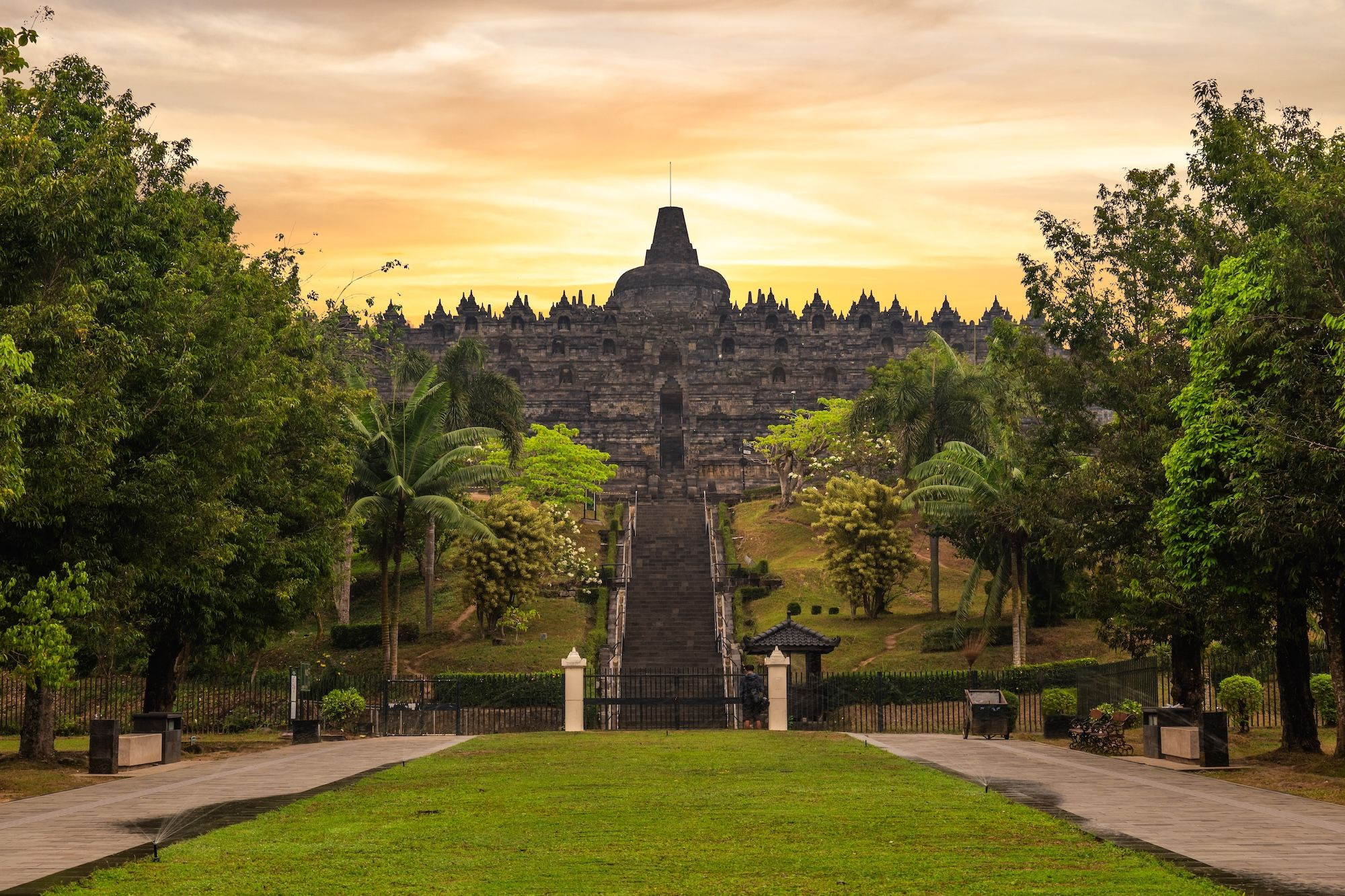
What they built was less a single temple than a stepped mountain: nine stacked platforms, six square and three circular, rising to a central dome 35 meters above the ground on a base roughly 118 meters to a side. Around 55,000 cubic meters of andesite, a volcanic stone quarried from the surrounding Kedu Plain, went into the structure — cut, carried, and fitted without mortar, interlocked block by block in a region where earthquakes are routine.
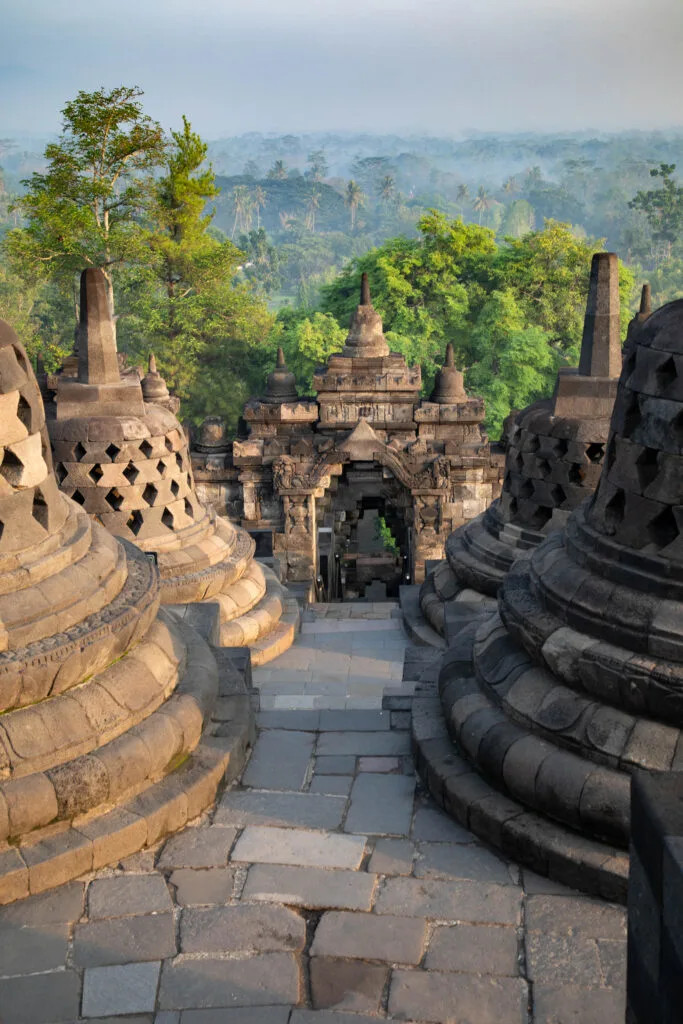
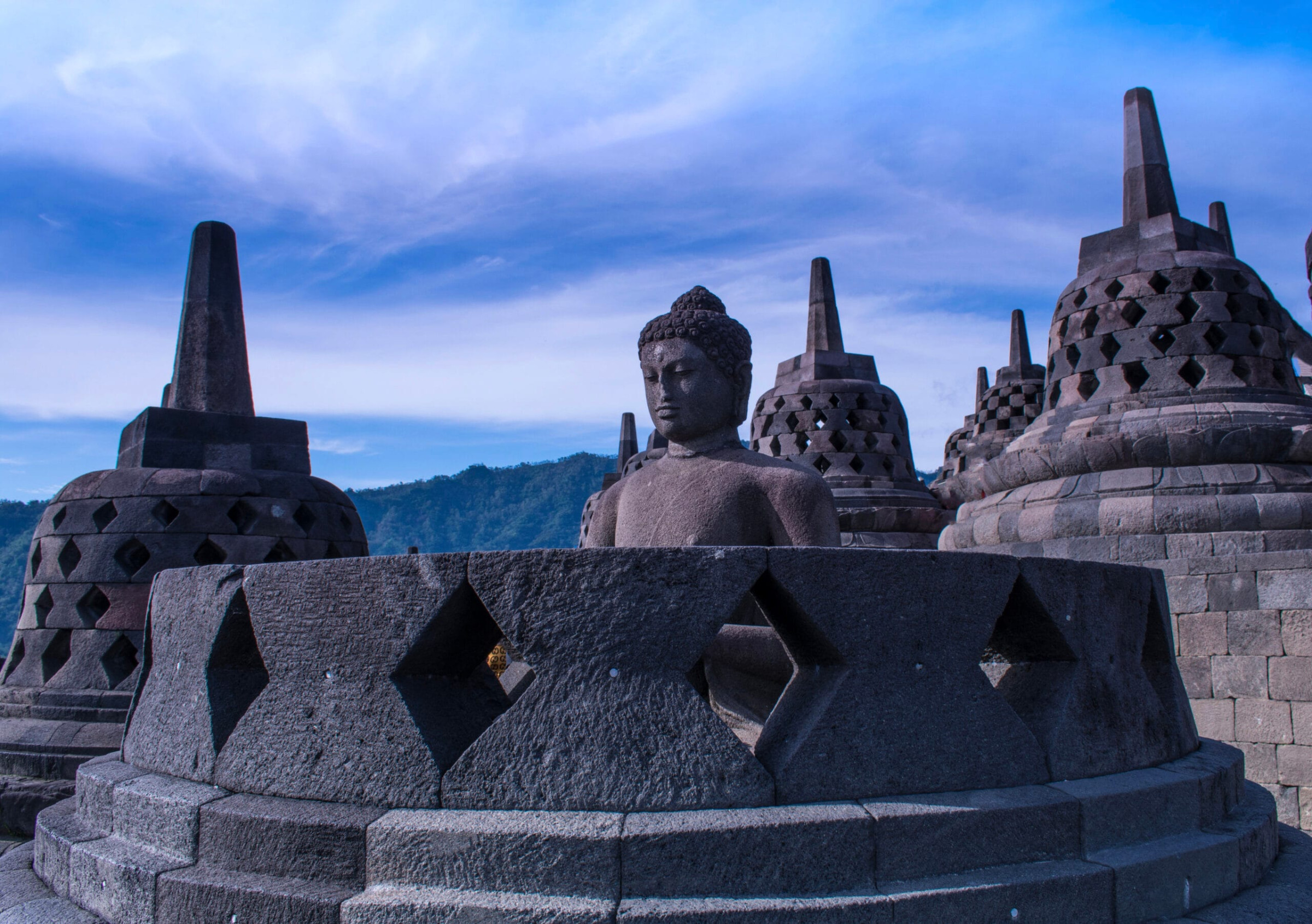
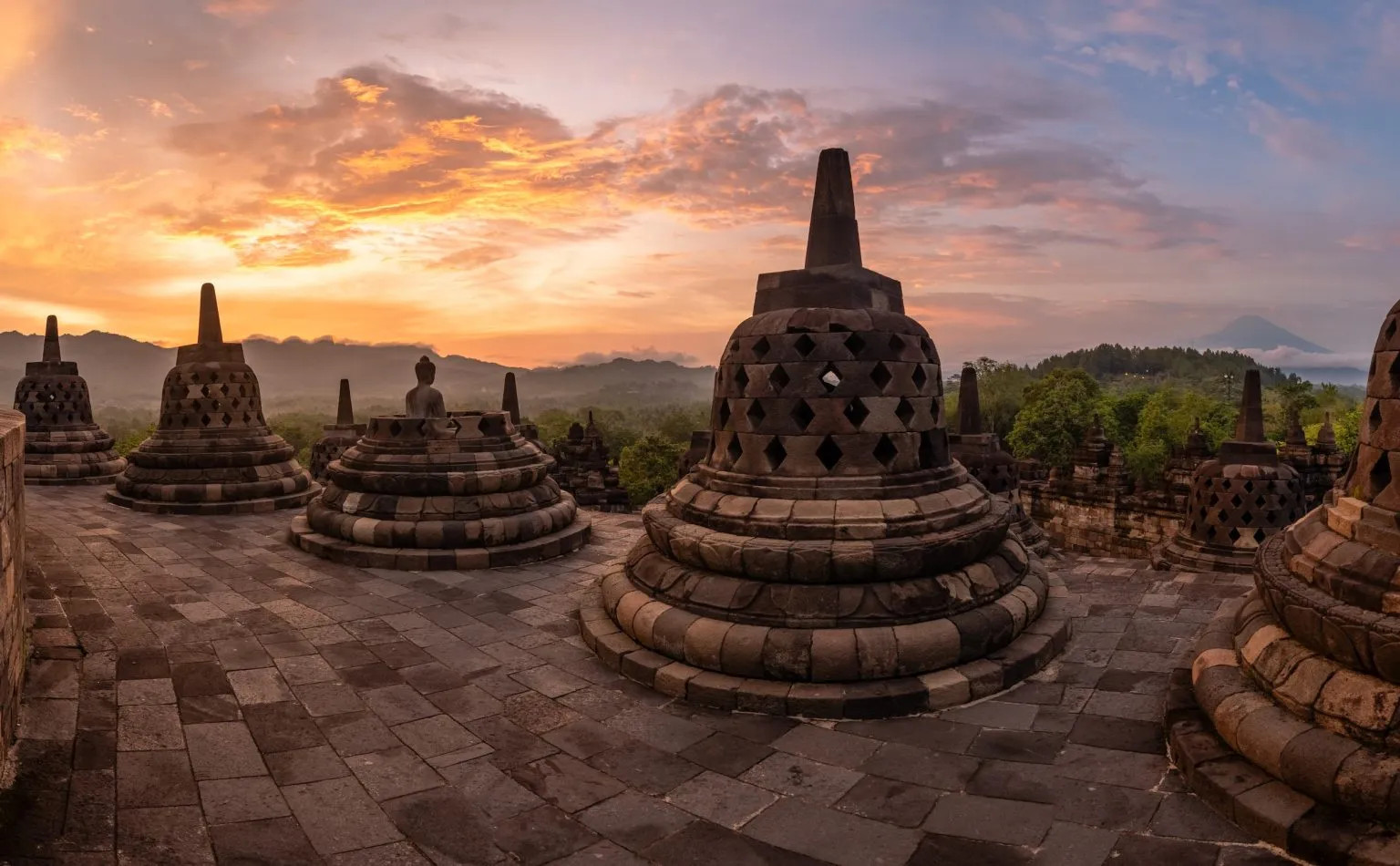
The scale of decoration matches the scale of the structure. Borobudur carries roughly 2,672 relief panels across some 2,500 square meters of carved surface — 1,460 of them narrative, tracing Buddhist cosmology, episodes from the Buddha's life, and the Jataka tales of his previous incarnations, interspersed with scenes of everyday 8th-century Javanese life that have become one of the few visual records of the period. The upper platforms carry a different kind of imagery: originally 504 Buddha statues, arranged in rows and inside 72 perforated stupas, each figure's hands set in one of five mudras corresponding to a different cardinal direction and a different aspect of Buddhist teaching. More than 300 of the original statues are now damaged or missing, victims of erosion, looting, and a millennium of exposure.
Sometime between 928 and 1006 CE, Borobudur was abandoned — most likely tied to volcanic eruptions that pushed the Mataram kingdom to relocate its center of power away from the area. For centuries afterward, the monument sat buried under layers of volcanic ash and jungle growth, known locally but essentially erased from wider memory. That changed in 1814, when Sir Thomas Stamford Raffles, the British administrator then governing Java, was told of a "hill of temples" hidden in the countryside and ordered it excavated. What emerged from the ash was one of the largest Buddhist monuments ever built, still largely intact under everything that had grown over it.
Raffles's excavation was only the beginning of a restoration effort that has continued, in phases, for more than a century. Dutch engineer Theodoor van Erp led the first major reconstruction between 1907 and 1911, dismantling and rebuilding the upper platforms to correct structural problems that had developed as the ground beneath them shifted. It wasn't enough: by the mid-20th century, drainage problems and structural instability had put the entire monument at risk, prompting a far larger UNESCO-backed restoration between 1975 and 1982. Roughly one million individual stones were dismantled, catalogued, treated, and reassembled, at a cost of around $6.9 million, with new drainage and waterproofing systems built into the foundation to prevent the water damage that had threatened to undo the temple a second time. Borobudur was named a UNESCO World Heritage Site in 1991, and after Mount Merapi's 2010 eruption coated the temple in volcanic ash once again, UNESCO contributed a further $3 million toward its rehabilitation — a reminder that the same volcanic geology that produced Borobudur's stone has never stopped shaping its fate.
Borobudur is not simply a ruin on display. It remains an active Mahayana Buddhist pilgrimage site, and each year during Vesak — the holiday marking the Buddha's birth, enlightenment, and death — thousands of pilgrims gather at the temple, many of them arriving from across Indonesia and abroad. In a country that is overwhelmingly Muslim, Borobudur's continued religious use is often cited as an example of Indonesia's layered, coexisting religious heritage, one that predates the archipelago's major faiths by centuries and is now claimed as shared national history rather than the property of any single group.
In 2012, Guinness World Records recognized it as the largest Buddhist temple on Earth, and it remains Indonesia's single most-visited monument, drawing millions of travelers each year — most of them, these days, arriving before dawn to watch the sun rise over a stone mountain that spent a thousand years buried under the ash of the same volcanoes that helped build it.
No reviews yet. Be the first to share your experience!
Share your experience and help other travelers