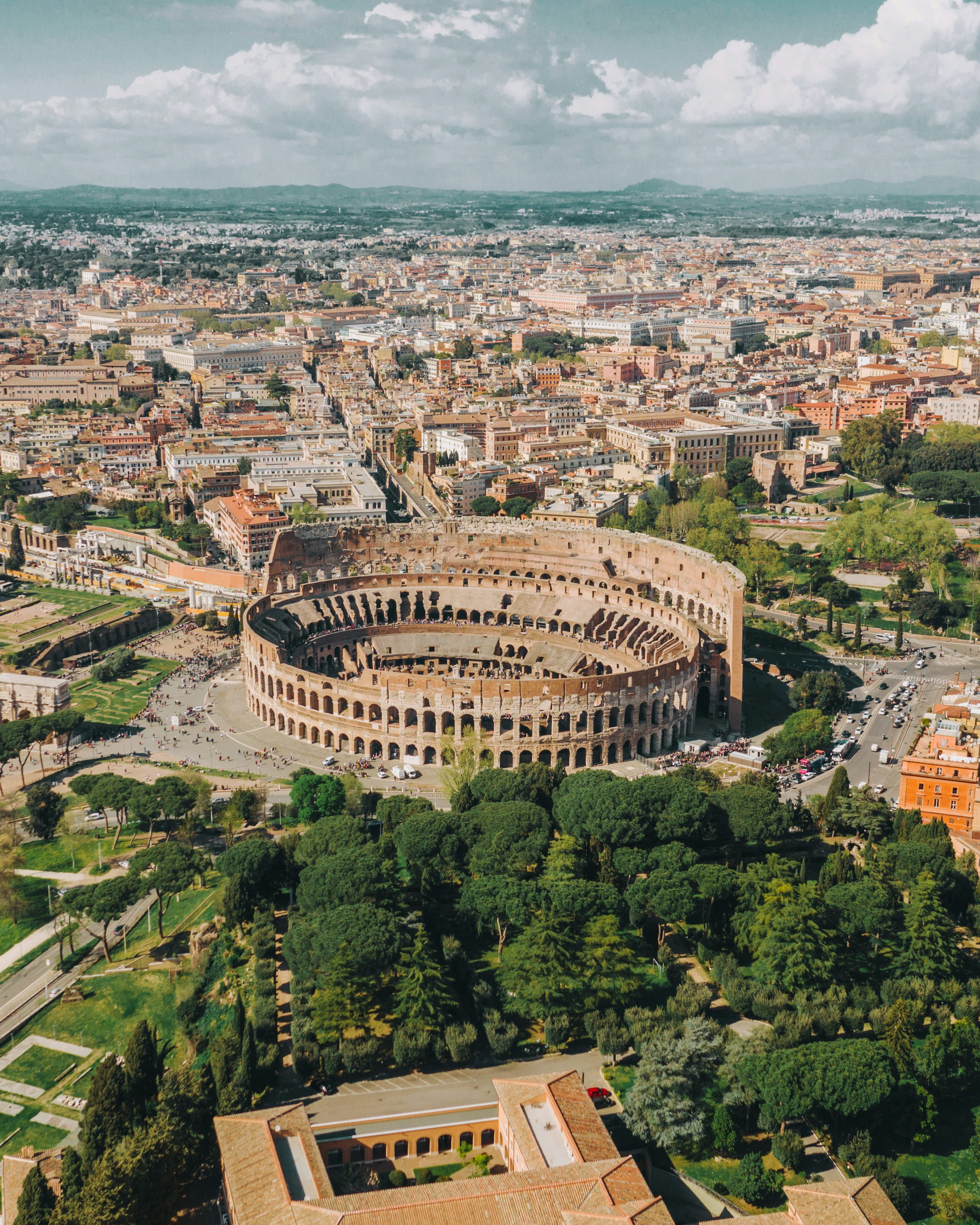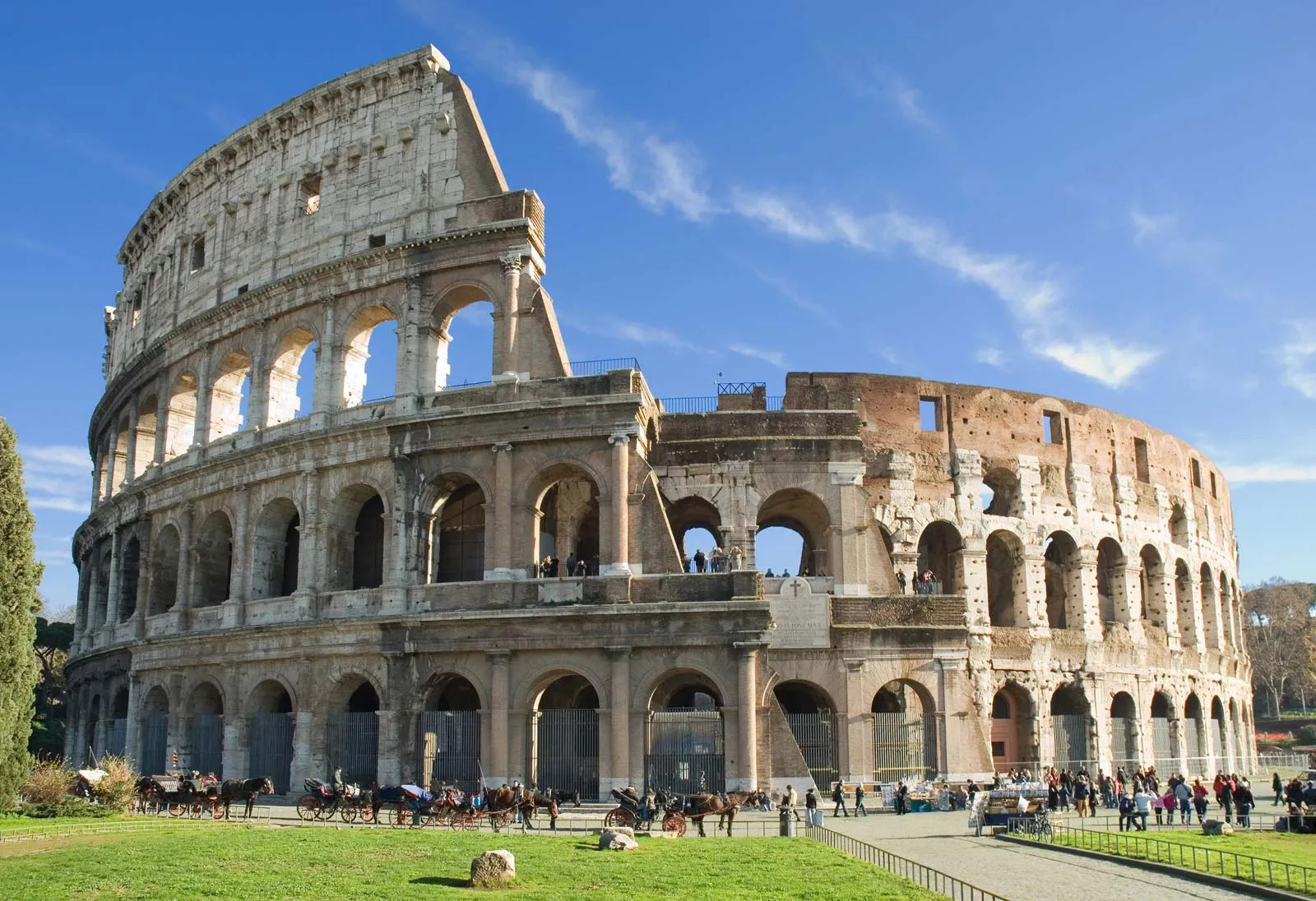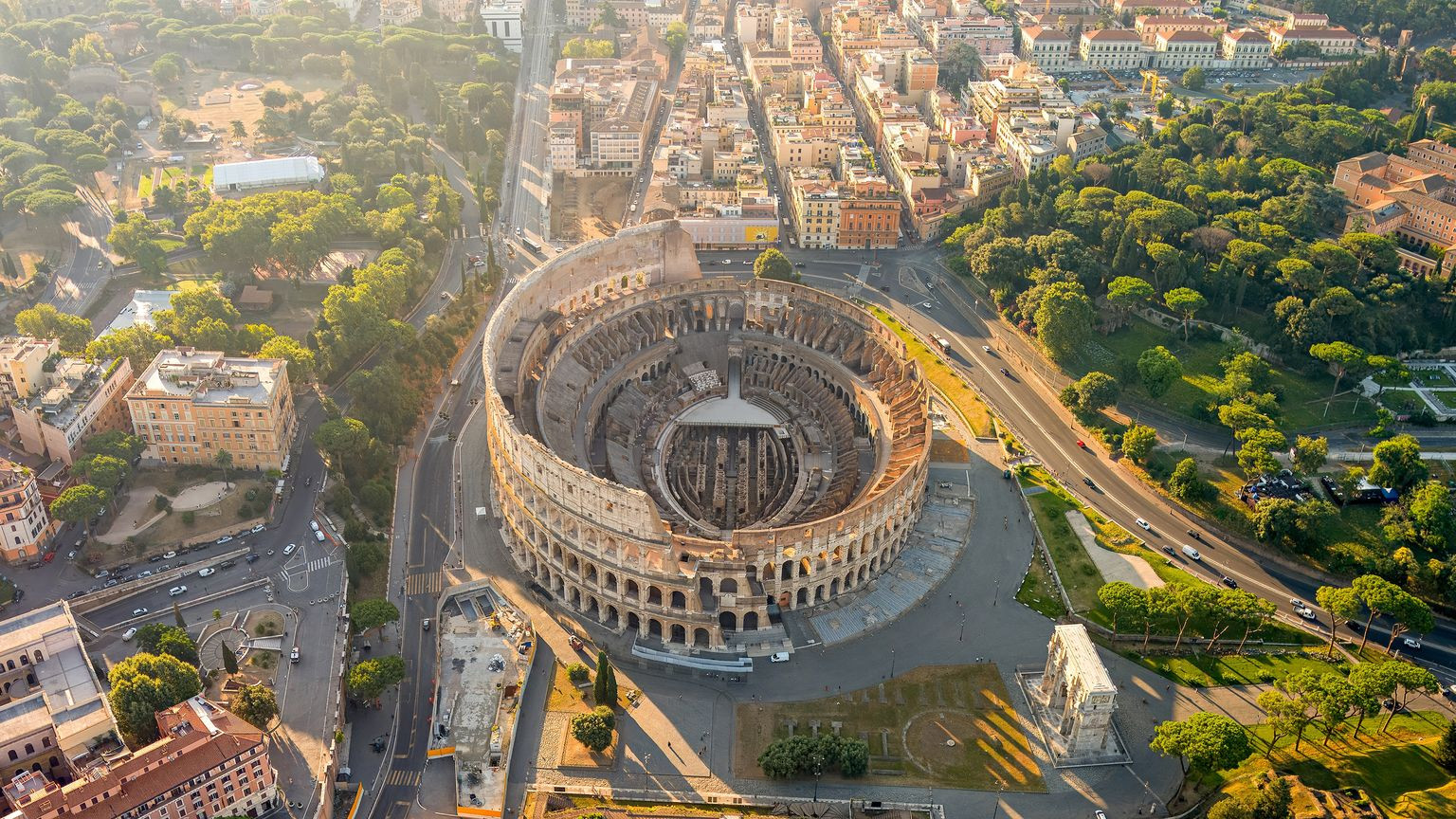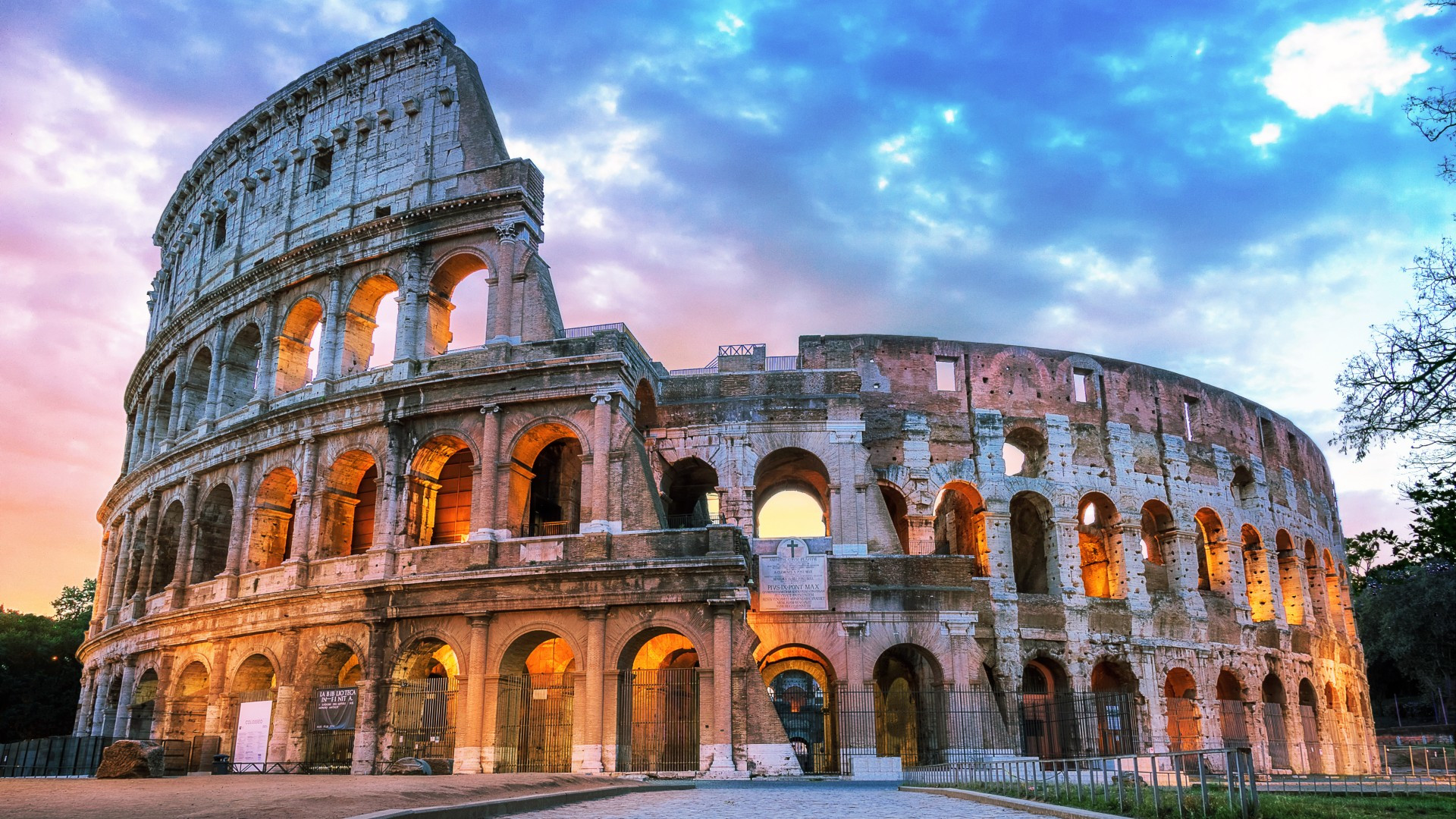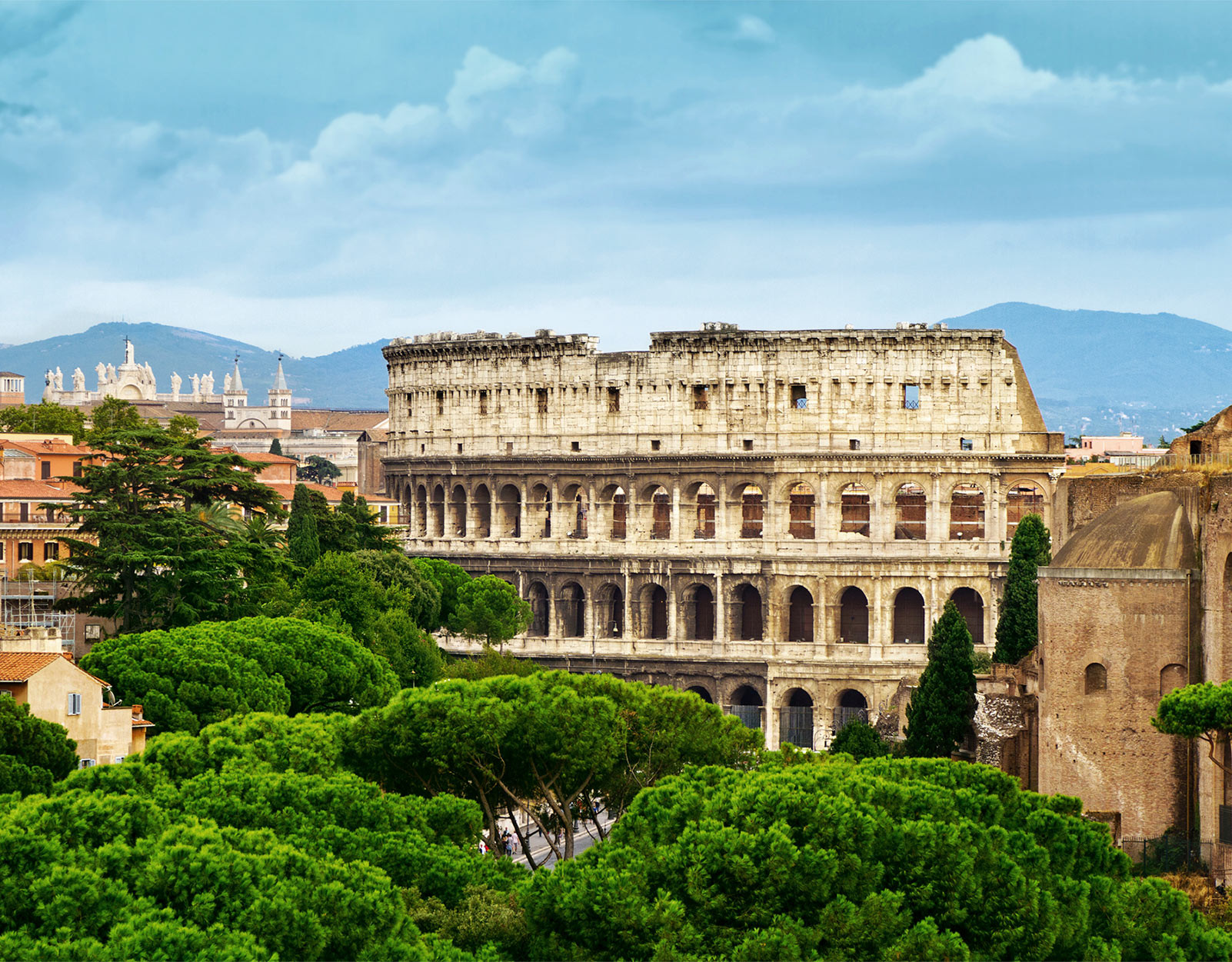
The Colosseum stands at the edge of the Roman Forum, an elliptical amphitheater whose ruined but still monumental silhouette has come to represent the power and spectacle of ancient Rome more than almost any other single building. Measuring 189 meters long and 156 meters wide, with an arena floor of 87 by 55 meters, it was built to hold somewhere between 50,000 and 80,000 spectators, with typical attendance closer to 65,000, a capacity that rivals many modern stadiums nearly two thousand years later. Its official Roman name was the Flavian Amphitheatre, after the imperial dynasty that commissioned and completed it, and the more familiar name Colosseum likely derives not from the building's own size but from a colossal bronze statue of Nero that once stood nearby, a nickname that outlived both the statue and the memory of the emperor it depicted.
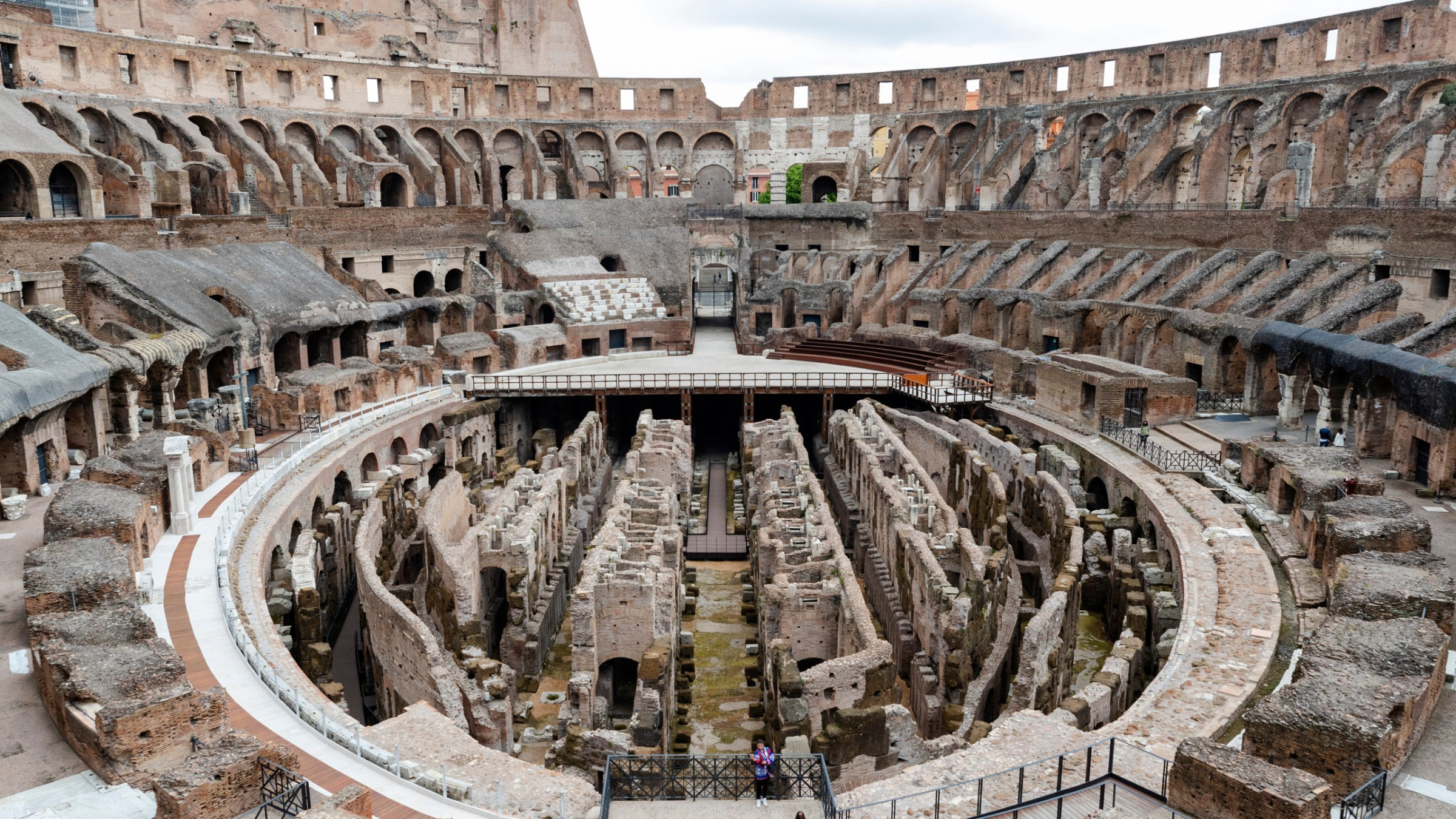
Construction began around 72 AD under Emperor Vespasian, who commissioned the amphitheater partly as a gift to the Roman people and partly as a deliberate political statement, built on the site of Nero's private lake as a symbol that the excesses of the previous, deeply unpopular emperor were being returned to public use. Vespasian did not live to see it finished; the building was completed in 80 AD under his son and successor Titus, who marked the opening with inaugural games said to have lasted a hundred days. A third Flavian emperor, Domitian, made further modifications during his reign in the 80s and 90s AD, including construction of the underground hypogeum, a warren of tunnels and chambers beneath the arena floor used to stage dramatic entrances of gladiators and animals through trapdoors. The result of these three reigns of construction was a building that combined engineering ambition with carefully staged political theater from its very first games.
The Colosseum's outer wall required more than 100,000 cubic meters of travertine limestone, quarried from nearby Tivoli and hauled to the site, held together not with mortar in the load-bearing sections but with some 300 tons of iron clamps, many of which were later pried out for their metal value. Beneath the visible travertine, the structure relied heavily on brick-faced Roman concrete and volcanic tuff, materials that allowed the building's complex vaulted passageways and tiered seating to be constructed with a level of structural sophistication that would not be widely matched again in Europe for well over a thousand years. Eighty numbered entrances at ground level allowed the enormous crowd to enter and be seated with a speed and order that modern engineers still study, while a retractable fabric awning system called the velarium, operated by sailors stationed on the upper level, could be extended over sections of the seating to shield spectators from the sun.
The events staged inside ranged from gladiatorial combat and staged hunts of wild and exotic animals to public executions, historical and mythological reenactments, and, in the amphitheater's earliest years before the hypogeum's construction, even mock naval battles achieved by flooding the arena floor. Seating was arranged with a rigid social hierarchy, from a ringside imperial box and senatorial seating at arena level up through equestrian and citizen tiers, to a distant upper gallery of wood for the poorest spectators and women, a physical layout that mirrored Roman society's structure as clearly as any written law. The games held here served a political as well as entertainment function, offering emperors a stage to display generosity, wealth, and control over both human and animal life to tens of thousands of Roman citizens at once, reinforcing imperial authority through spectacle on a scale the ancient world had rarely attempted.
A major fire in 217 AD, caused by a lightning strike according to ancient sources, destroyed much of the wooden upper structure and interior fittings, requiring extensive repairs that took years to complete. Organized games gradually declined through late antiquity as Roman society and its finances changed, with the last recorded gladiatorial contests held in the early fifth century and animal hunts continuing somewhat longer before fading out entirely. A severe earthquake in 1349 caused the collapse of the outer wall's south side, a section that was never rebuilt and whose absence is still visible today, exposing the amphitheater's inner structural rings to view from outside. Through the medieval period the building was stripped for building material on a massive scale, its travertine and marble reused in palaces, churches, and hospitals across Rome, while the structure itself was repurposed as housing, workshops, a fortress for a noble Roman family, and even a source of saltpeter for gunpowder production.
By the late sixteenth and seventeenth centuries, growing awareness of the Colosseum's historical and artistic value halted much of the ongoing stone removal, and a series of popes took steps to protect and stabilize the ruin, including consecrating the site as a place of Christian martyrdom, a designation of disputed historical accuracy that nonetheless helped preserve the building from further destruction. Major modern restoration campaigns followed in the twentieth and twenty-first centuries, most notably a large public restoration effort from 1993 to 2000 and a further multi-year project from 2013 to 2016, privately sponsored by the Italian fashion house Tod's, which cleaned centuries of grime and pollution from the travertine facade and stabilized weakened sections. These efforts have kept the monument structurally safe for the millions of visitors who now walk through it annually, even as archaeologists continue to study and reveal new details about the hypogeum and the original arena floor, portions of which have been reconstructed for public viewing in recent years.
The Colosseum today sits at the heart of Rome's most visited archaeological zone, alongside the Roman Forum and Palatine Hill, and combined tickets typically grant access to all three sites over a set validity window. Because it is one of the most visited monuments in the world, timed-entry tickets booked well in advance are strongly recommended, and options exist for standard access, arena-floor access reconstructed over the ancient hypogeum, and guided tours that include the underground chambers not open to general visitors. The site is included among the New7Wonders of the World, a modern popular designation that reflects its continuing global recognition, and it has also become a symbolic backdrop for the international movement against capital punishment, with the monument's exterior lighting changed to mark abolitions of the death penalty around the world. For most visitors, an hour or two is enough to see the main levels, though those wanting the underground hypogeum or arena floor typically need to book a specific guided time slot.
Few buildings anywhere have accumulated as many layers of meaning as the Colosseum. To Renaissance artists and Grand Tour travelers it was a romantic ruin, painted and sketched as a meditation on the fall of empires; to nineteenth-century archaeologists it became a subject of serious scientific study, as excavations gradually uncovered the hypogeum beneath the arena floor and clarified how the building's staging mechanisms had actually worked. In the twentieth century it entered popular culture more broadly still, appearing in countless films and serving as a shorthand image for ancient Rome itself, often more recognizable to a global audience than the Forum or the Pantheon despite standing only partially intact. Today its illumination is used deliberately as a form of public statement, lit in different colors to mark international causes, most consistently to mark the abolition of capital punishment in a given country, a modern use for a building whose ancient function was itself, in part, about staged death before a crowd.
No reviews yet. Be the first to share your experience!
Share your experience and help other travelers