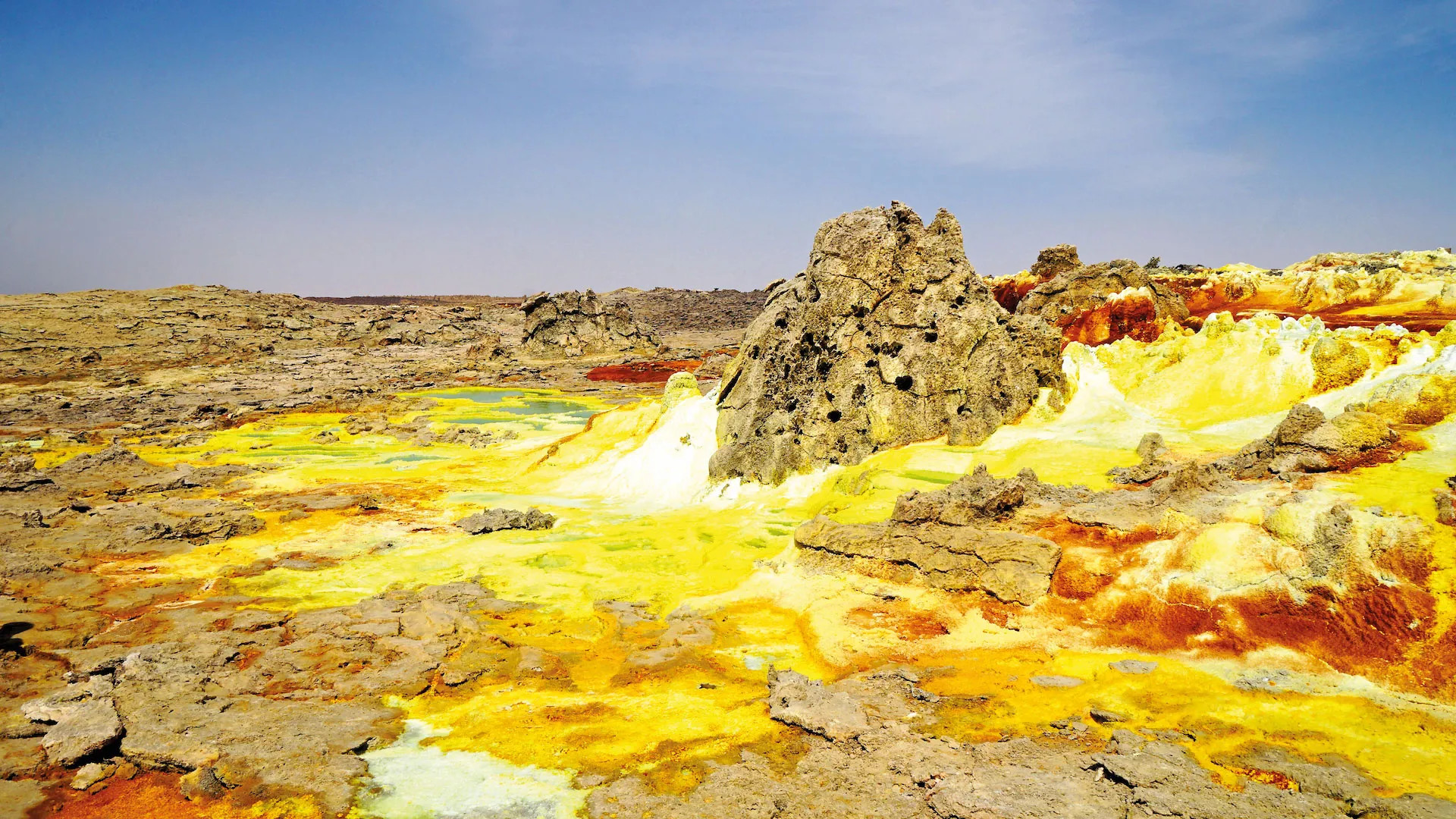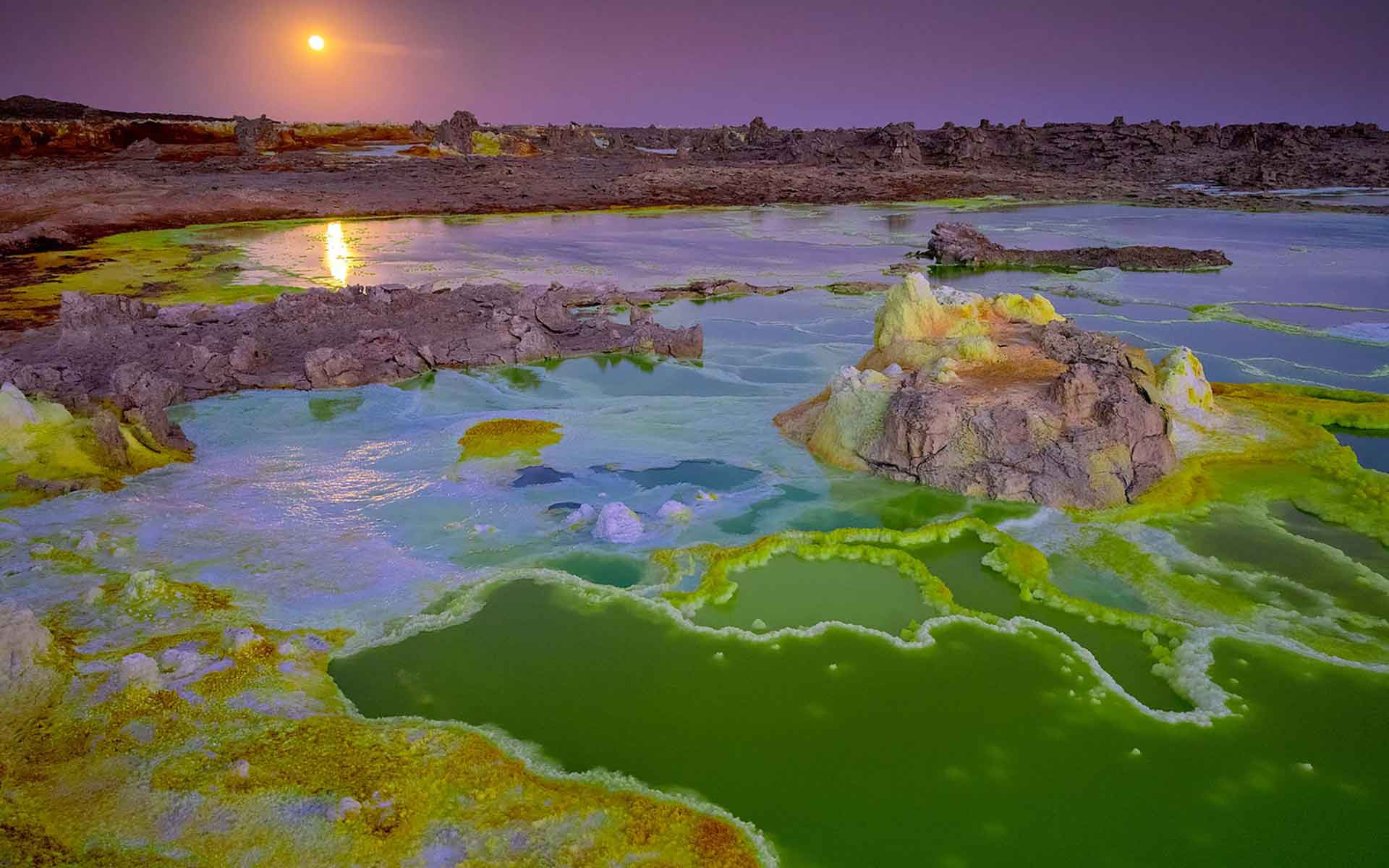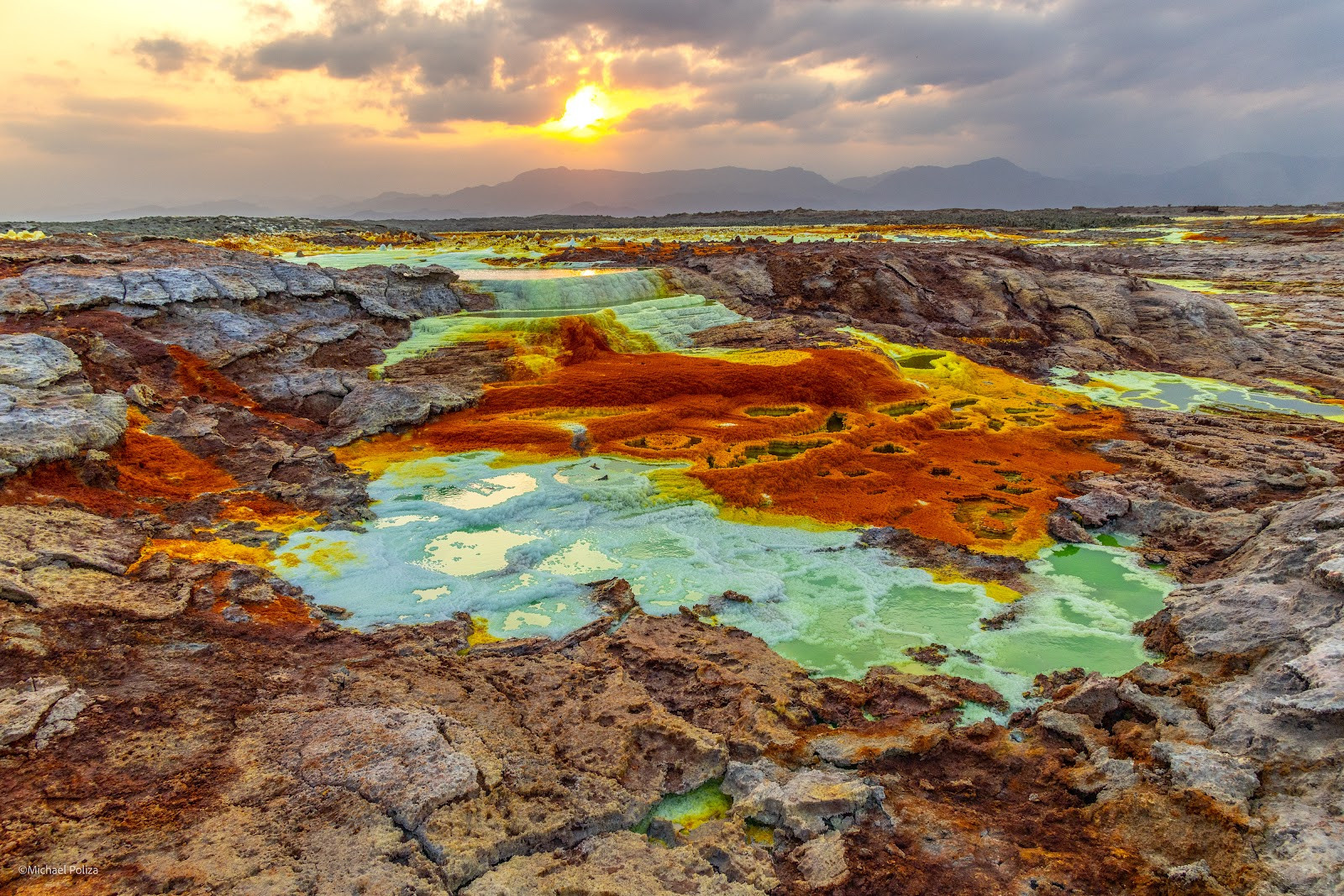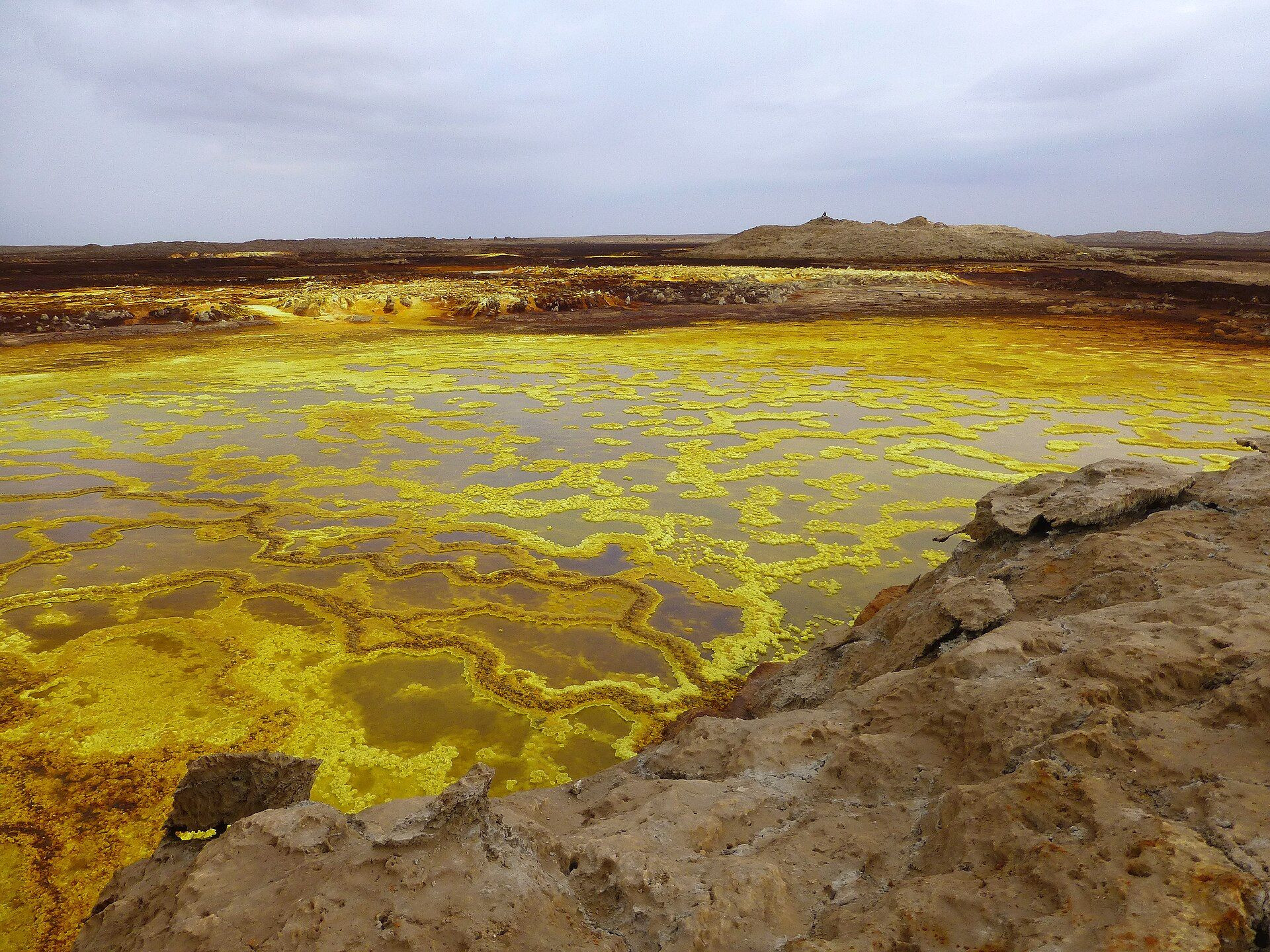
The Danakil Depression, in the Afar region of northeastern Ethiopia, is one of the hottest, lowest, and strangest places on Earth. Parts of it lie more than a hundred metres below sea level, and its shimmering salt flats, acid-green hot springs, and sulphur-stained crusts look more like images beamed back from a distant moon than a corner of Africa. Temperatures regularly climb above 40 °C, and the depression holds a record for the highest average annual temperature of any inhabited place on the planet.
Yet this is not an empty wasteland. Afar herders have lived here for centuries, salt miners still cut slabs by hand, and an active lava lake glows at the summit of Erta Ale. The Danakil is a place where geology is unfinished business, and where visitors can watch the planet being built and unbuilt in real time.
The depression sits at the Afar Triple Junction, one of the few places on land where three tectonic plates are visibly tearing away from each other. The Arabian, Nubian, and Somali plates meet here, where the Red Sea rift, the Gulf of Aden rift, and the great East African Rift system converge. As the crust stretches and thins, the land sinks, and the floor of the Danakil has dropped well below the level of the nearby ocean.
Geologists believe the region was repeatedly flooded by the Red Sea in the distant past. Each time, the seawater evaporated under the fierce sun and left behind thick beds of salt, which now reach hundreds of metres in depth and in places more than a kilometre. Rising magma beneath this thin crust feeds volcanoes, hot springs, and vents, giving the Danakil its extraordinary mix of salt, fire, and colour.
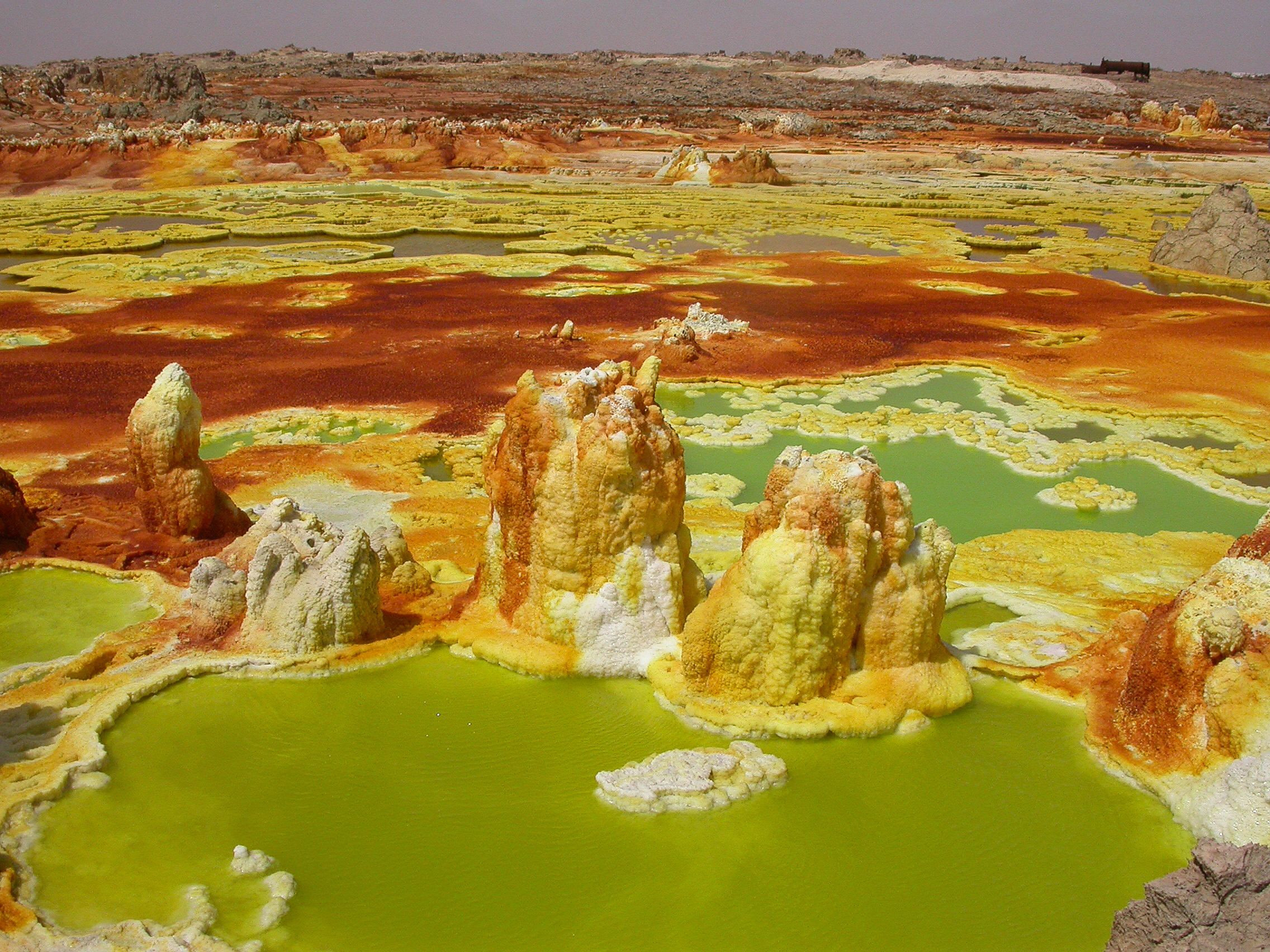
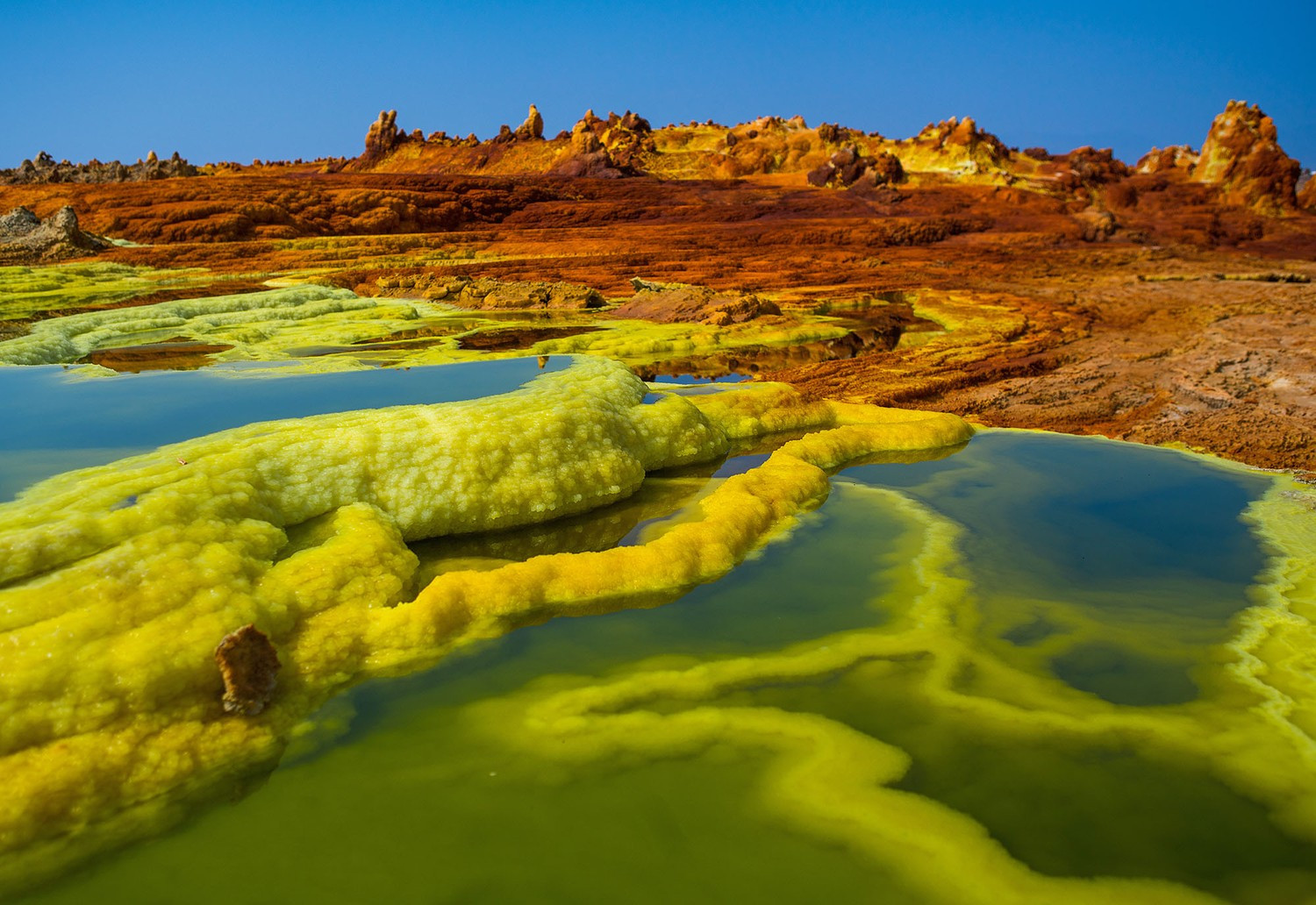
Dallol is the depression's most photographed feature, a low volcanic dome where hot brine seeps to the surface and builds a shifting mosaic of mineral terraces. Yellow sulphur, orange iron oxide, white salt, and vivid green pools of acidic water combine in a landscape that changes from month to month. The word Dallol is said to come from the Afar language and refers to dissolution, an apt name for a place where rock is constantly being dissolved and redeposited.
The ground is fragile and the fumes can be harsh, so visitors walk on marked routes with guides. The pools are intensely acidic and hot, and the air carries a sharp chemical smell. Scientists study Dallol because its extreme conditions resemble environments that may once have existed on Mars, and research there has helped define the limits of where life can survive.
To the south of Dallol rises Erta Ale, a broad shield volcano whose name means smoking mountain in the Afar language. Its summit crater has contained a lava lake for decades, one of only a handful of such persistent lava lakes on Earth. The level of molten rock rises and falls, sometimes overflowing onto the crater floor and sometimes sinking out of sight, so no two visits are quite the same.
Most travellers reach the summit by a night hike across black lava fields, setting out in the late afternoon and arriving after dark. At the rim, the glow of the lava lake, the sound of bursting gas bubbles, and the sheer heat make an unforgettable scene. Groups usually sleep on simple beds near the crater edge before descending at dawn.
For centuries the salt of the Danakil has been a trade good. Afar and Tigrayan workers cut slabs from the dry lake bed with axes and wooden levers, shape them into uniform blocks, and load them onto camels and donkeys. Long caravans then walk to highland markets, a journey that can take days across scorching terrain. The scene is one of the last living examples of a traditional salt trade that once connected much of Africa.
The Afar people, pastoralists who herd goats, camels, and cattle across the depression, are known for their resilience, their distinctive culture, and their deep knowledge of this harsh environment. Their villages are built from woven mats and sticks, and hospitality, including offering tea and shelter, remains a core value. Visitors are guests in a living landscape, and respect for local customs matters.
Surviving in the Danakil requires adaptation. Daytime temperatures in summer can exceed 45 °C, rain is scarce, and water must be carried or found at rare springs. Local people move livestock according to seasonal grazing and work early or late in the day to avoid the worst heat. Travellers should treat the environment with the same caution, drinking plenty of water, covering up against the sun, and avoiding midday exertion.
The wider Afar region is also one of the most important places in the world for human origins. In 1974, researchers working at Hadar, further south in the Afar lowlands, discovered the skeleton of Lucy, a 3.2 million-year-old Australopithecus afarensis. The same rifting that created the Danakil has exposed layers of ancient sediment, and the region continues to yield fossils that help explain how early humans lived and moved.
Reaching the Danakil is an expedition rather than an ordinary trip. Most visitors travel with an organised tour from Mekelle, the main city of northern Ethiopia, driving for several hours across the highlands and descending into the depression. Permits are required, tours usually include local guides and armed escorts, and accommodation is basic, often consisting of simple beds under the stars or in rough shelters.
Security conditions in the Afar region and along the nearby border can change quickly, so it is essential to check current government travel advisories and to use a reputable operator that monitors local conditions. Tours may be cancelled or rerouted when the situation is not safe, and flexibility is part of the experience.
The best months are generally November to March, when daytime temperatures are somewhat lower and nights are more comfortable. From April to September the heat becomes extreme, and many operators reduce or pause tours. Bring a wide-brimmed hat, light long-sleeved clothing, sturdy closed shoes for sharp crusts, a headlamp for the night hike, and a scarf or mask for dust and fumes.
Allow three to four days for a typical tour, including travel time, and expect long, demanding days. Pack plenty of water, high-energy snacks, and any personal medication, since services are limited. The reward is a landscape that feels unlike any other, where heat, salt, and volcanic fire shape one of the planet's most extreme environments.
The extreme chemistry of Dallol has attracted astrobiologists, who see in its boiling, salty, acidic pools a window onto what life, or its absence, might look like on other worlds. Studies of its brines have shown conditions so harsh that even the toughest microbes struggle to survive, helping define the outer limits of habitability. Elsewhere in the depression, colourful mineral deposits, salt towers, and bubbling springs are reminders of how quickly chemistry and geology can reshape a landscape. For visitors, this adds a layer of wonder: the colours are not decoration, but evidence of processes that have operated on Earth for millions of years.
The Danakil's beauty depends on delicate crusts and shifting mineral formations that are easily damaged by footsteps. Staying on guided paths, avoiding contact with pools and vents, and taking all rubbish away protects both the landscape and visitors. Respecting Afar customs, supporting local guides and drivers, and travelling with modest expectations about comfort help ensure that tourism benefits the communities who call this extreme region home.
No reviews yet. Be the first to share your experience!
Share your experience and help other travelers