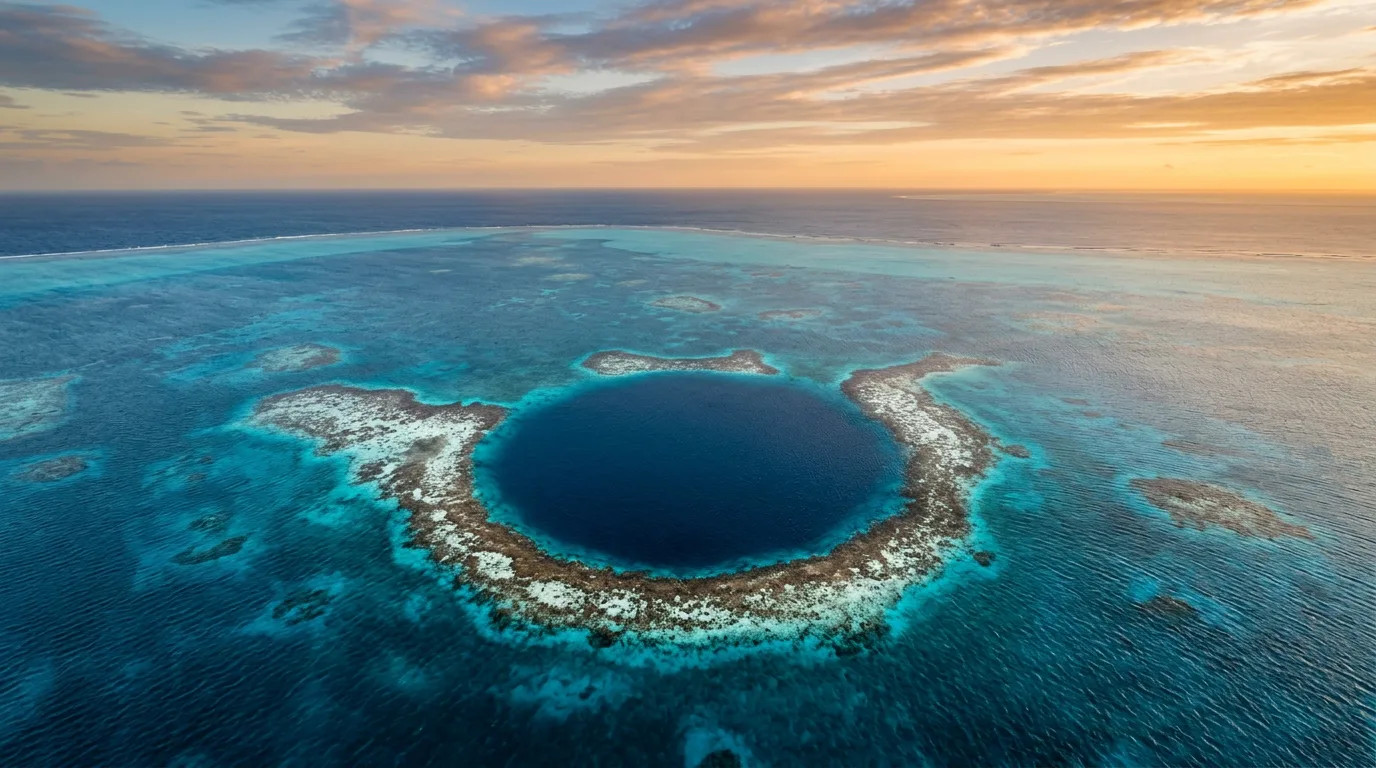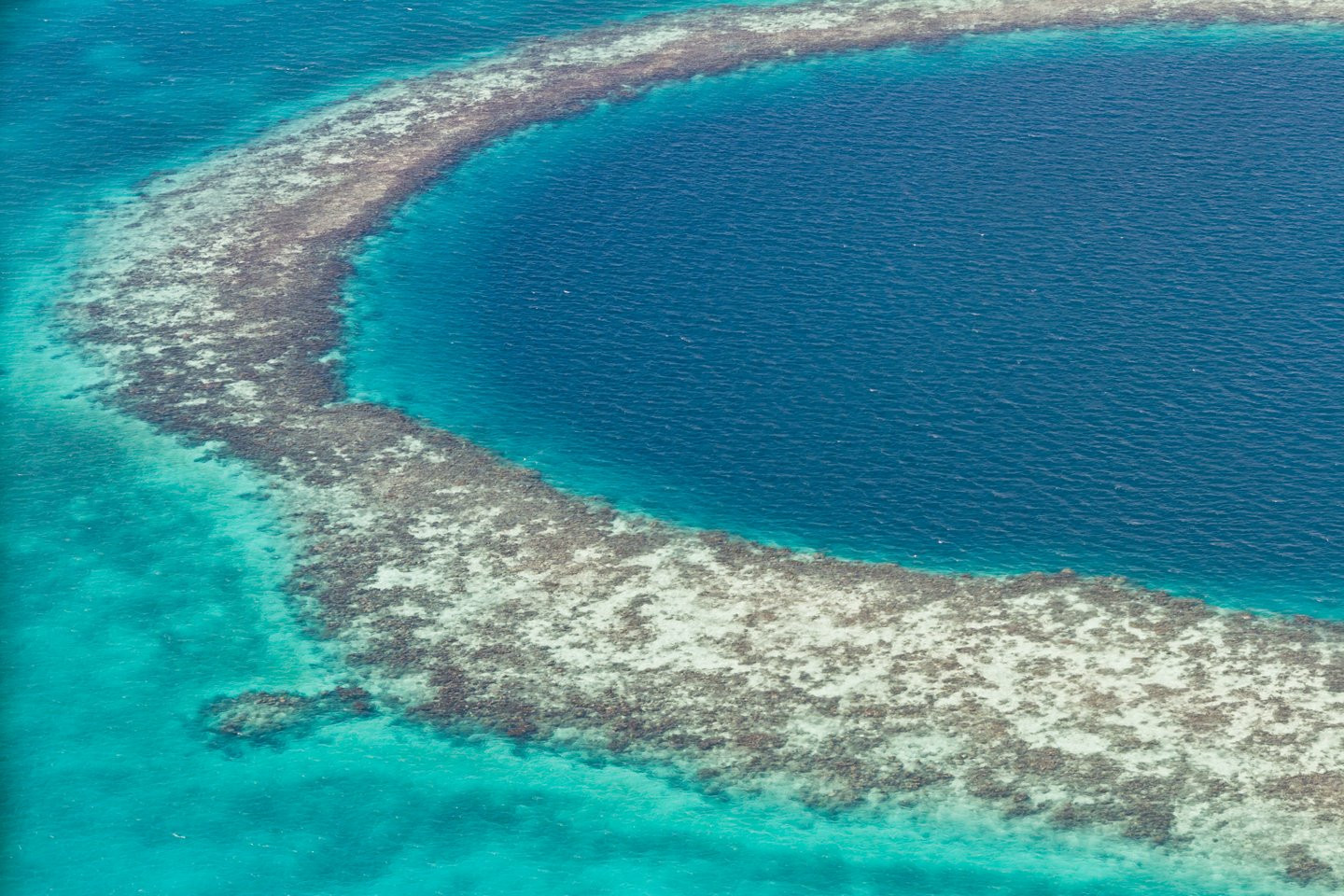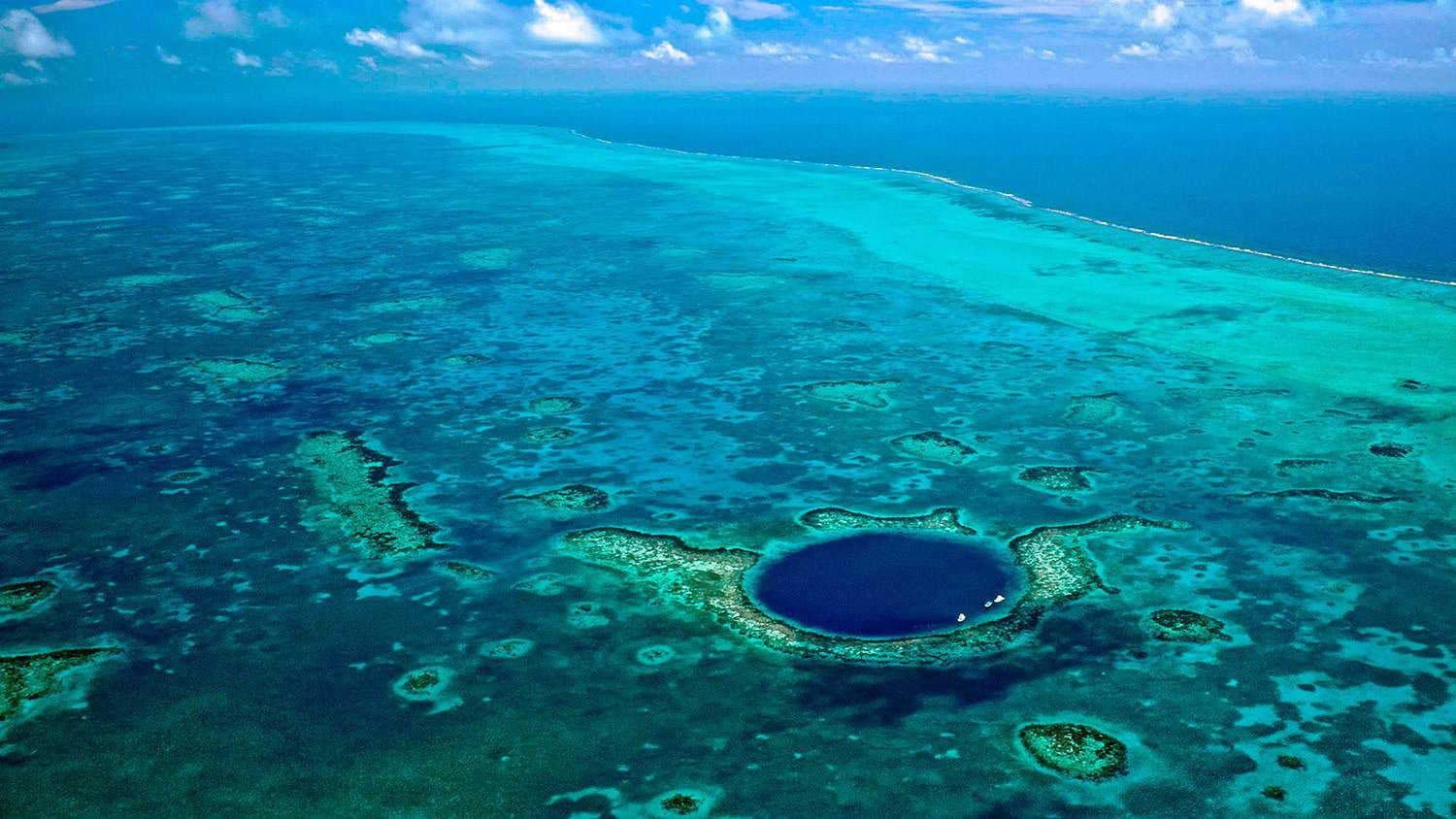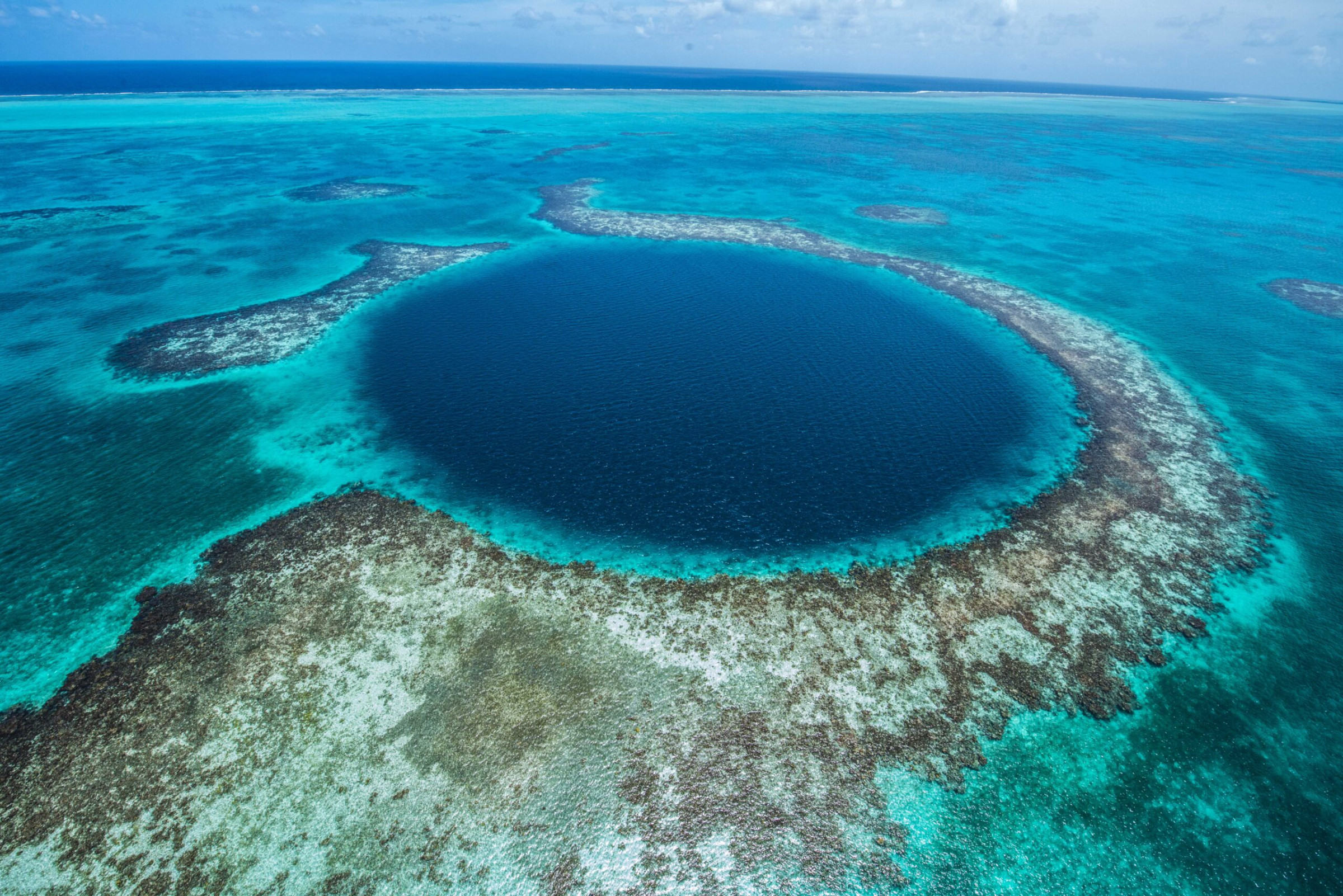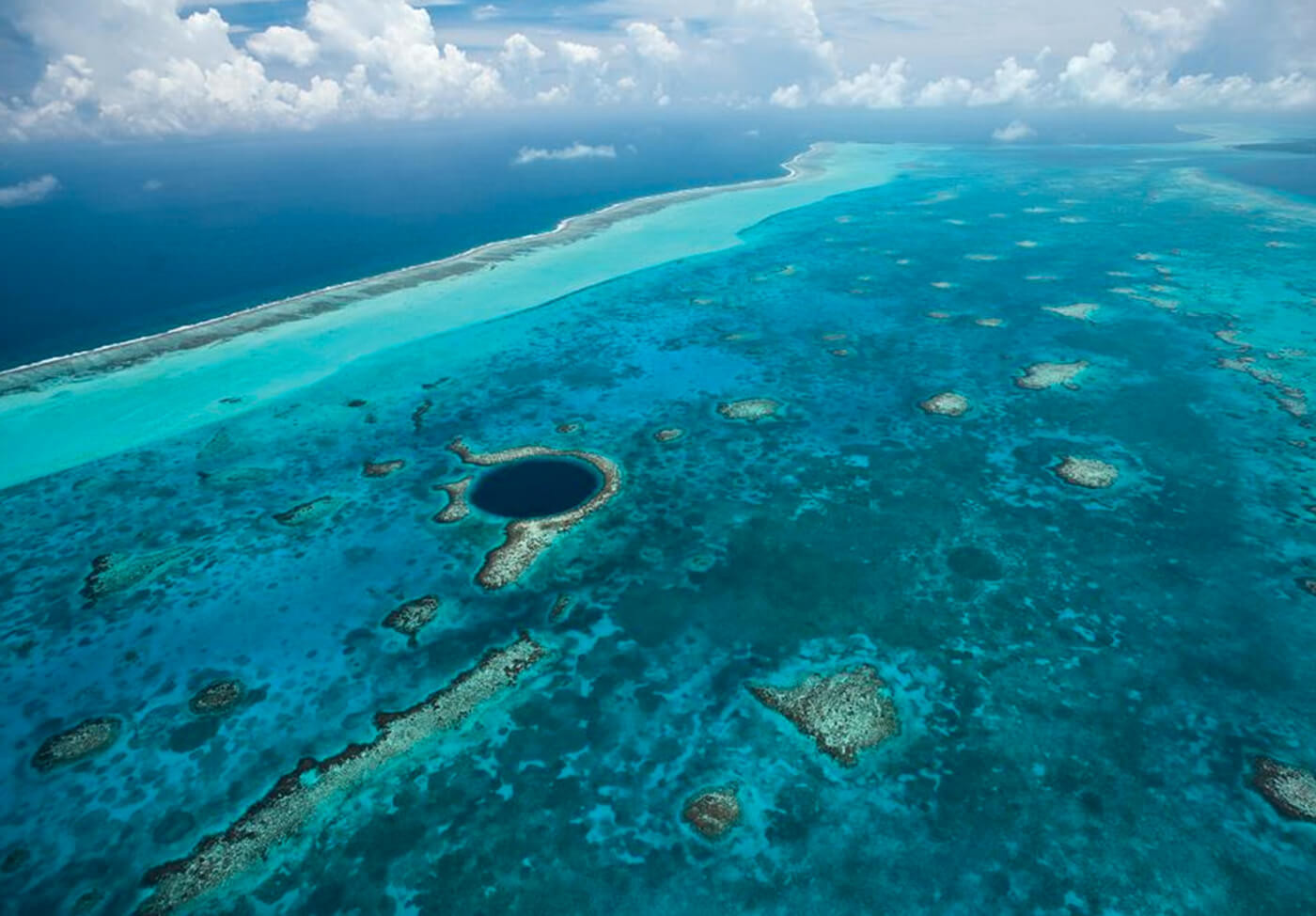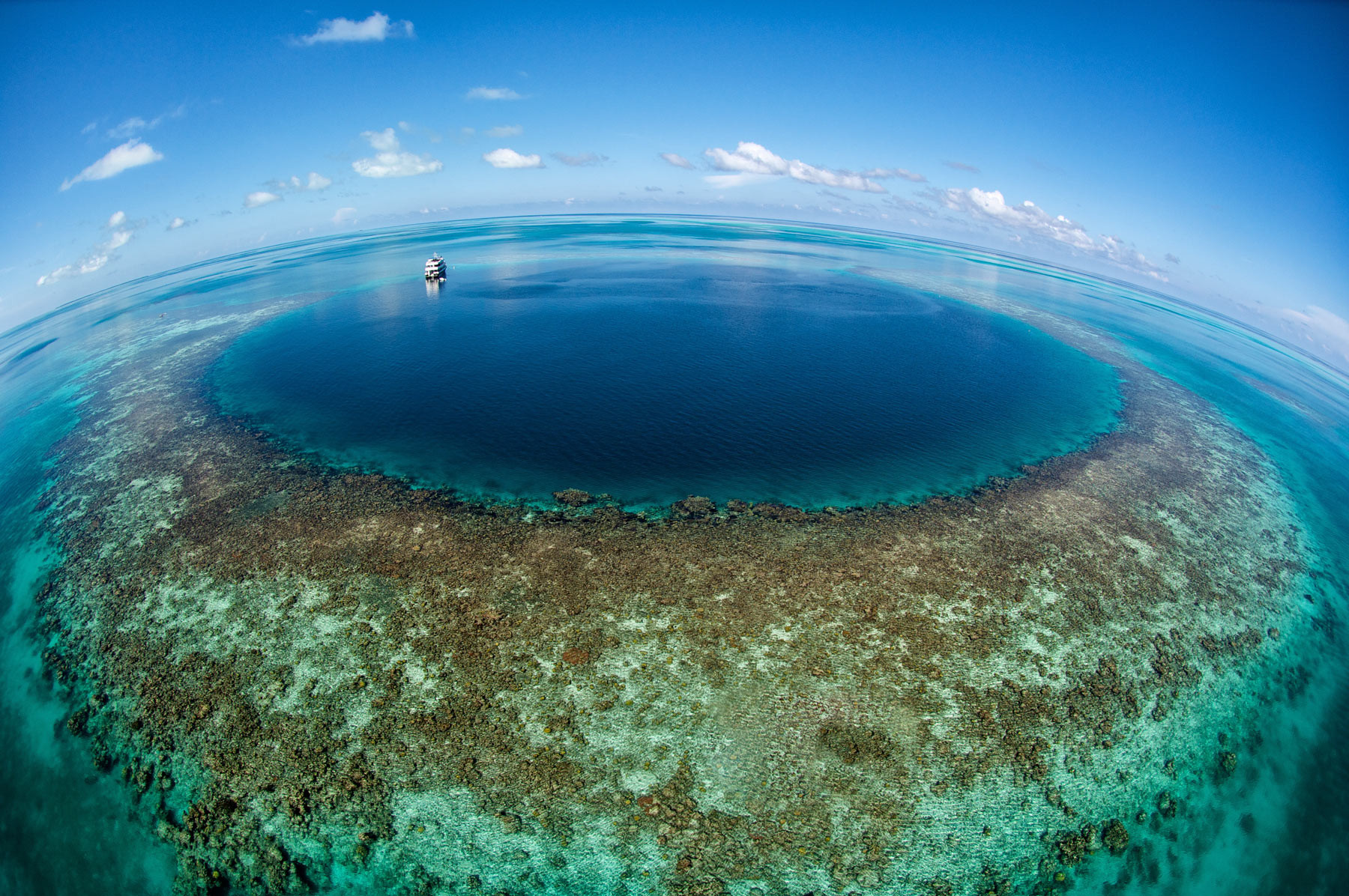
The Great Blue Hole is a massive submarine sinkhole roughly 300 meters across and 124 meters deep, sitting near the center of Lighthouse Reef Atoll about 70 kilometers off the coast of Belize, its near-perfect circular shape visible clearly from the air as a striking dark blue disc surrounded by the lighter turquoise of the surrounding shallow reef. The dramatic color contrast comes purely from depth: shallow reef water reflects light in pale turquoise tones, while the sinkhole's much deeper water absorbs light and appears deep navy blue by comparison.
Formed during past ice ages when sea levels were dramatically lower, the hole began as a limestone cave system on dry land, its ceiling eventually collapsing as rising seas flooded and submerged the cave entirely, leaving behind the vertical-walled sinkhole visible today. Stalactites found deep within its walls, mineral formations that can only form in dry air, provide physical proof that the hole was once an air-filled cave chamber long before the surrounding ocean rose to swallow it.
Though known to Belizean fishermen for generations, the Great Blue Hole gained major international attention in 1971 when French oceanographer Jacques Cousteau led an expedition to survey and dive the site aboard his research vessel Calypso, later naming it among the top diving locations in the world in his own assessment. Cousteau's expedition also confirmed the presence of ancient stalactite formations deep within the hole's walls, providing scientific evidence for the sinkhole's cave-collapse origin theory.
That endorsement transformed the Great Blue Hole from a local curiosity into one of the most sought-after dive destinations on Earth, drawing experienced divers specifically for the chance to descend past the thermocline into cooler, darker water and examine those same ancient limestone formations firsthand.
Diving the Great Blue Hole is considered an advanced activity, not because of unusual currents or marine hazards at the surface, but because reaching the site's most distinctive features, massive stalactite columns lining the walls at depths around 40 meters, requires deep diving certification and experience given the depth and reduced visibility below the thermocline. Below roughly 90 meters, the water becomes anoxic, oxygen-depleted, a condition that has actually helped preserve organic material and even some marine remains in unusually intact condition at the hole's deepest sections.
Above the thermocline, however, the surrounding shallow reef offers considerably easier snorkeling and diving with abundant marine life, nurse sharks, reef sharks, groupers, and a wide range of tropical fish species, making a Great Blue Hole excursion typically a full-day trip combining the deep dive itself with broader reef exploration around Lighthouse Reef Atoll.
The Great Blue Hole sits within the Belize Barrier Reef Reserve System, part of the Mesoamerican Barrier Reef, the second-largest coral reef system on Earth after Australia's Great Barrier Reef, stretching along nearly the entire length of Belize's coastline. This wider reef system, inscribed as a UNESCO World Heritage Site in 1996, supports extraordinary biodiversity including manatees, sea turtles, and hundreds of fish species across its combined atolls, mangroves, and coral cays.
Lighthouse Reef itself, the atoll containing the Great Blue Hole, remains one of the more remote sections of this reef system, reachable only by boat or seaplane, which has helped limit development and keep surrounding reef sections in relatively pristine condition compared to more accessible coastal areas.
Like coral reef systems worldwide, the broader Belize Barrier Reef faces mounting pressure from rising ocean temperatures, coral bleaching events, and increased storm intensity linked to climate change, prompting UNESCO to place the site on its list of World Heritage in Danger for several years in the mid-2010s before Belize's conservation efforts, including a moratorium on offshore oil exploration, led to its removal from that list in 2018. The Great Blue Hole itself, being primarily a geological rather than living coral feature, is less directly threatened by bleaching, but the surrounding reef ecosystem that makes access to it worthwhile remains vulnerable.
Belize's tourism industry has increasingly tied its economic messaging to reef conservation specifically because diving and snorkeling tourism, anchored heavily around sites like the Great Blue Hole, depends directly on maintaining healthy surrounding reef conditions rather than the sinkhole alone.
Reaching the Great Blue Hole requires either a roughly 2.5 to 3-hour boat journey from Belize City or Ambergris Caye, or a shorter scenic seaplane flight that also offers the clearest aerial view of the hole's famous circular shape from above. Most dive operators combine the trip with stops at nearby Half Moon Caye, a protected bird sanctuary within the same atoll, and additional reef sites, turning the excursion into a full-day experience rather than a single dive stop.
Because of the distance and logistics involved, advance booking through a certified dive operator is standard practice, and only divers holding advanced open water certification, or willing to complete it locally beforehand, can join the deep dive portion of the trip.
Non-divers are not entirely excluded from experiencing the Great Blue Hole: scenic flights over Lighthouse Reef Atoll let visitors see the striking circular formation from the air without needing any diving qualification at all, and this aerial perspective is, for many travelers, the single most recognizable image associated with Belize as a country. Some tour combinations pair a scenic flight with snorkeling elsewhere on the reef system for visitors who want a Belize marine experience without technical diving.
Either approach, from above by air or below by advanced dive, delivers a version of the same core appeal: a nearly perfect geological circle set against turquoise Caribbean water, unlike almost anything else visible from either the air or underwater anywhere else on Earth.
For a country as small as Belize, the Great Blue Hole carries outsized global recognition, functioning as the country's single most iconic natural image and a major driver of its dive tourism economy. Its combination of striking visual geometry, genuine geological rarity, and Jacques Cousteau's historic endorsement has kept it firmly on serious divers' bucket lists for more than five decades since that first famous 1971 expedition.
Beyond Cousteau's original expedition, later scientific missions have used remotely operated vehicles and specialized deep-diving equipment to explore sections of the Great Blue Hole below what human divers can safely reach, mapping its full depth and documenting the anoxic layer's unusual preservation effects in more detail. Some of these expeditions have even recovered debris believed to date back decades, protected from decomposition by the oxygen-starved conditions at the hole's base, offering an unusual window into how quickly, or slowly, organic material breaks down in such an isolated marine environment.
This ongoing scientific interest, alongside its continued popularity as a bucket-list dive site, has helped keep the Great Blue Hole firmly positioned as both a research subject and a tourism icon simultaneously, a combination that has sustained its global reputation for more than fifty years without significant decline.
No reviews yet. Be the first to share your experience!
Share your experience and help other travelers