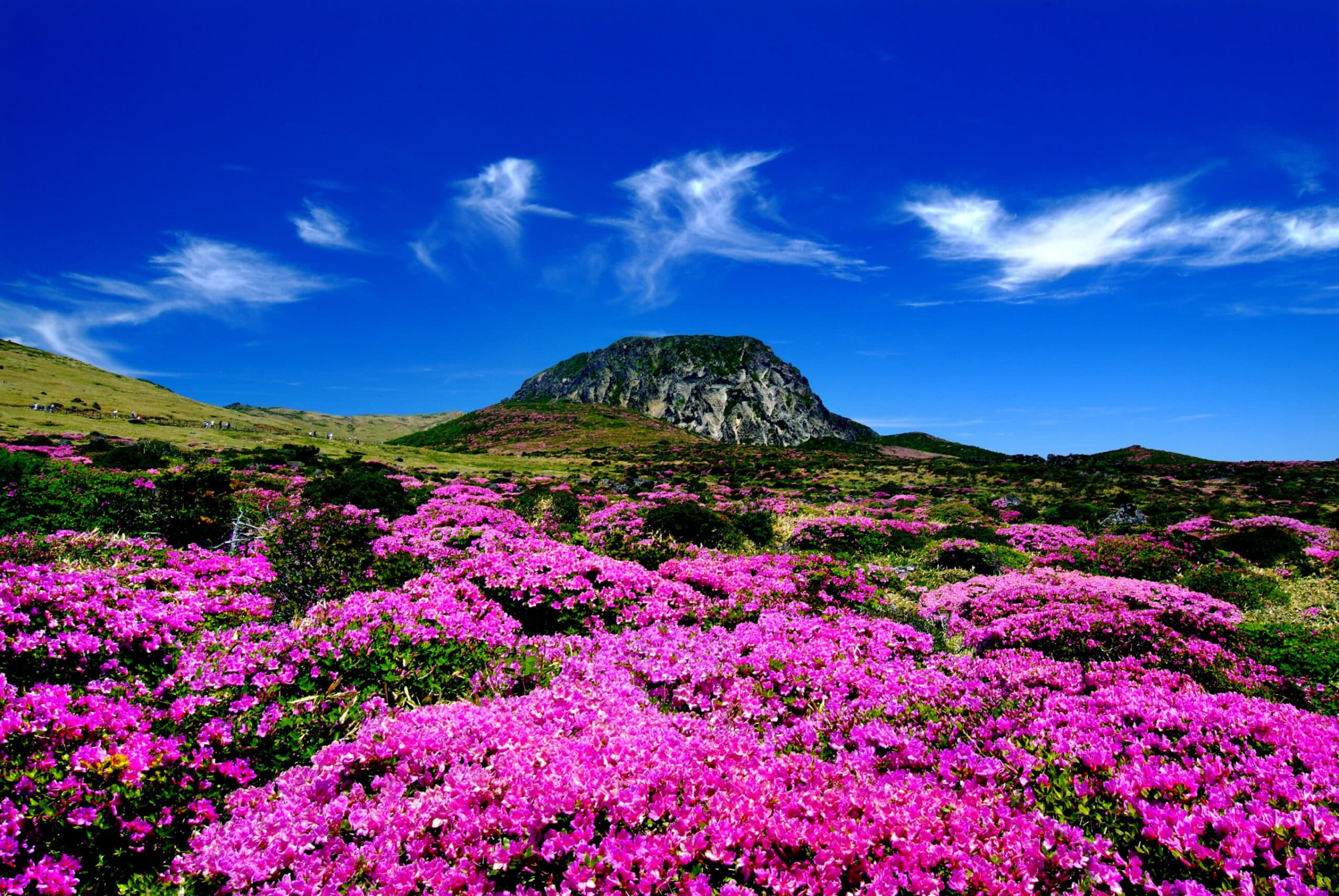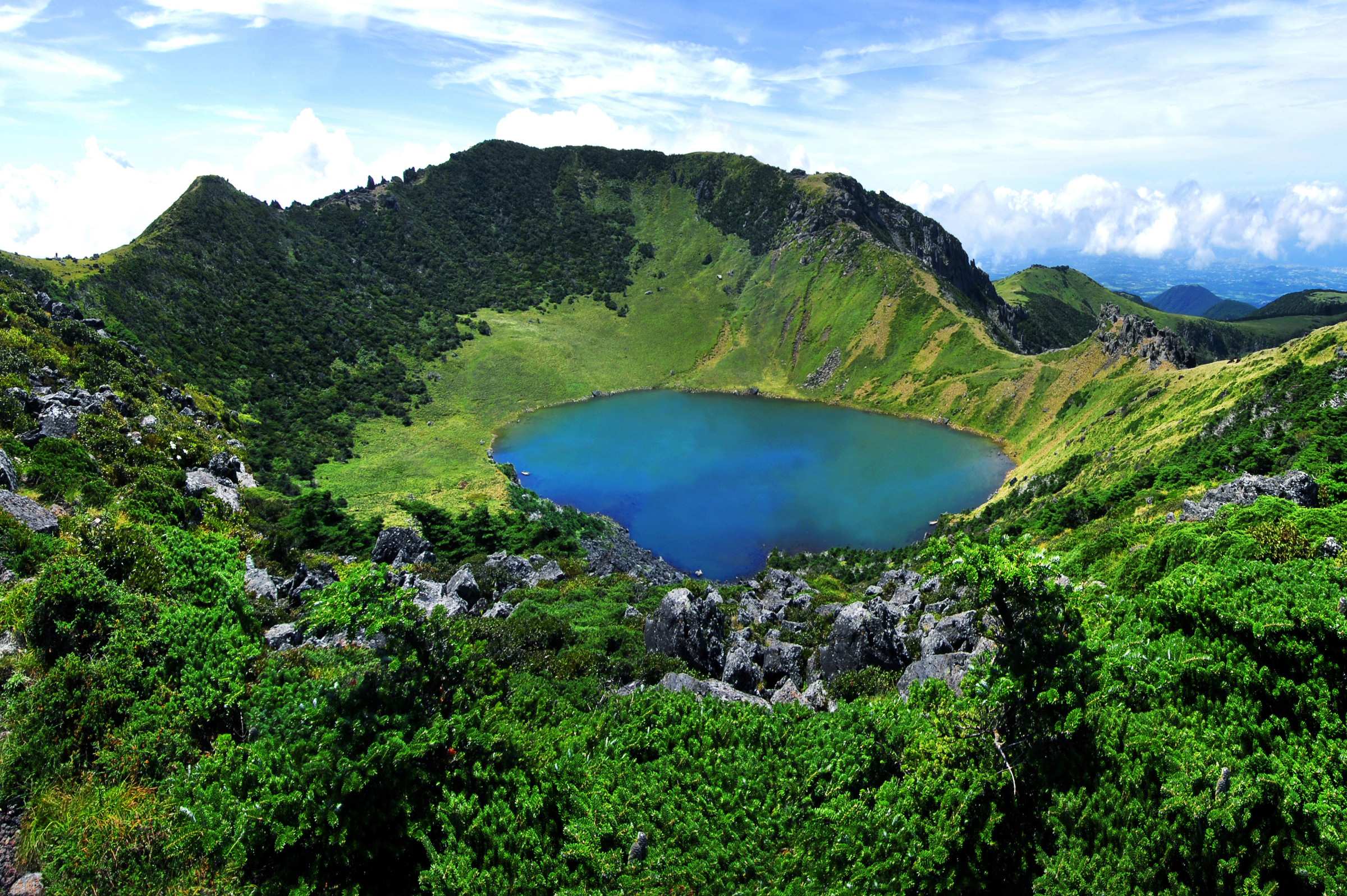
Hallasan rises 1,947 meters above Jeju Island, off South Korea's southern coast, making it the highest point in the country and the dominant feature of an island whose entire landmass is, in effect, the volcano itself. Rather than a single sharp peak, Hallasan is a broad shield volcano, its gently sloping profile built up gradually over roughly two million years through repeated eruptions of relatively fluid basalt and trachyte lava, a construction process that has produced a mountain wide enough to constitute the bulk of Jeju's land area rather than a single isolated summit rising from otherwise flat terrain. This shape, along with the island's warm subtropical coastline transitioning through temperate forest and finally to an alpine zone near the summit, gives Hallasan an unusually compressed range of ecological zones for a single mountain, all packed into a climb of a few thousand vertical meters.
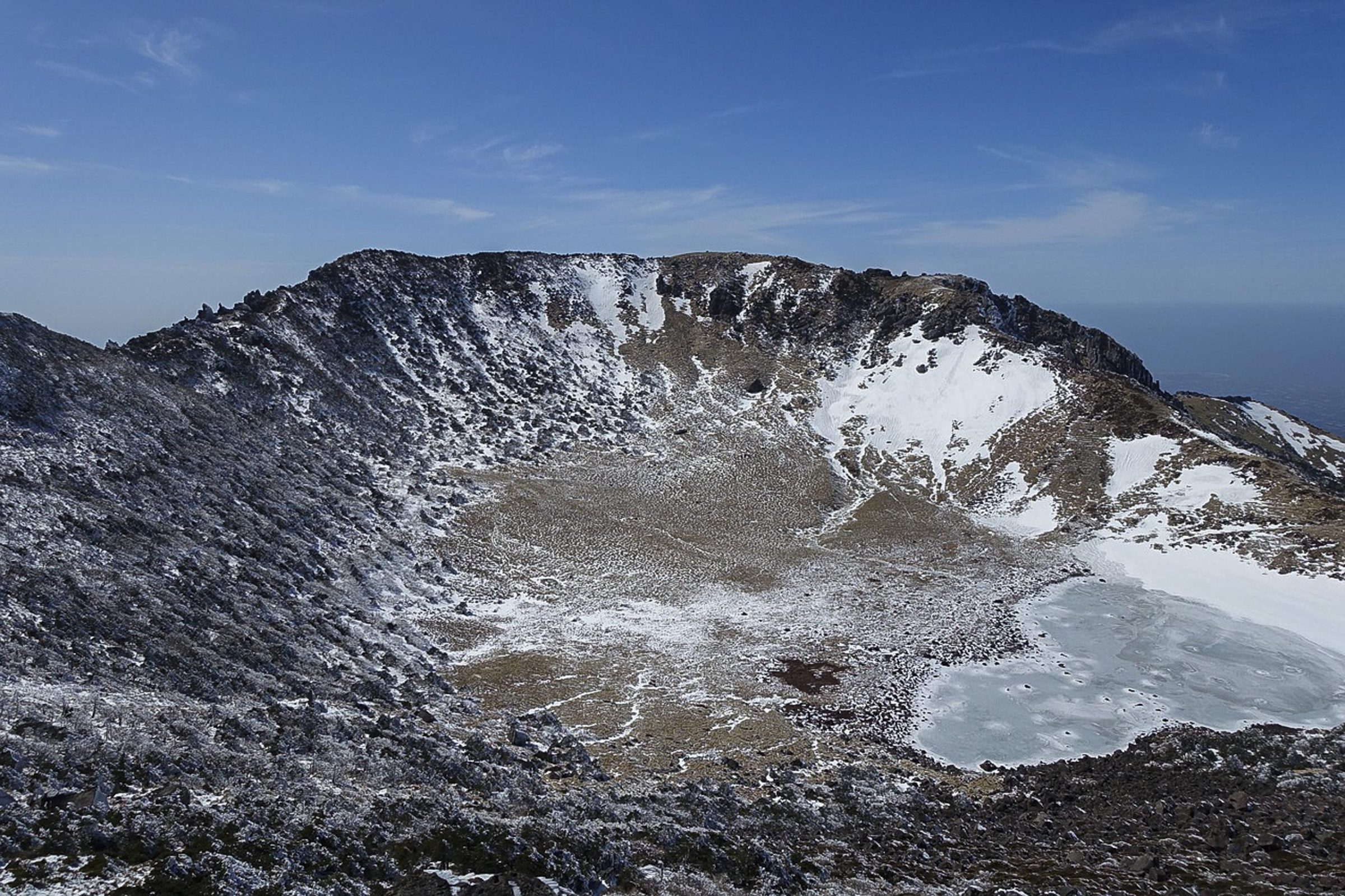
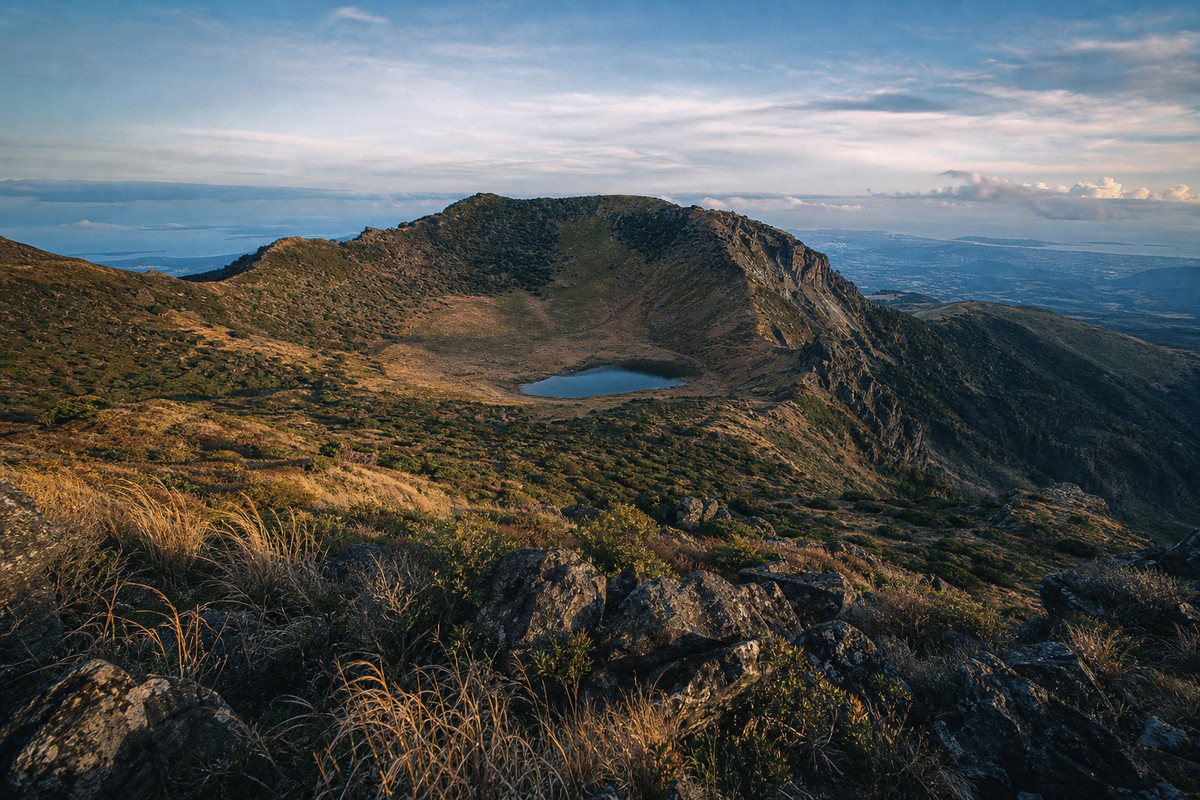
At Hallasan's summit sits Baengnokdam, a crater lake whose name translates to White Deer Lake, drawing on local legend describing mountain hermits riding white deer to drink from its waters. The lake's size fluctuates considerably with rainfall and season, its circumference reaching up to two kilometers and its depth around 100 meters at fuller periods, while during drier stretches it can shrink dramatically or nearly disappear entirely, a variability that means visitors reaching the summit on different days can encounter anything from a substantial alpine lake to little more than a damp crater floor. The crater itself formed through the volcano's eruptive history, and though geological evidence suggests Hallasan's last eruption occurred roughly 2,000 years ago, the mountain is generally classified as dormant rather than extinct, part of a broader volcanic system that also produced the roughly 360 smaller parasitic cones, known locally as oreum, scattered across Jeju's flanks below the main summit.
Beyond the crater lake and parasitic cones, Hallasan's volcanic activity left Jeju Island honeycombed with lava tubes, extensive underground tunnels formed as the outer surface of flowing lava cooled and solidified while molten rock continued draining through the interior, leaving behind hollow passages that in places extend for kilometers underground. The most significant of these, the Geomunoreum Lava Tube System, ranks among the finest examples of its kind anywhere in the world, its passages notable not only for their scale but for unusual secondary mineral formations, including sections coated in calcium carbonate deposits that developed after the tubes formed, a rare combination that adds mineralogical interest to what is already considered one of the world's best-preserved lava tube systems. Along the coast, roughly twenty tuff rings and tuff cones formed through explosive interactions between rising magma and seawater during underwater eruptions, adding a third distinct volcanic landform type to an island already shaped by shield-building lava flows and collapsed lava tube caves.
This combination of volcanic features led UNESCO to inscribe Jeju Volcanic Island and Lava Tubes as a World Heritage Site, a serial listing covering three separate components: the Hallasan Natural Reserve around the summit, the Geomunoreum Lava Tube System, and Seongsan Ilchulbong, a dramatic tuff cone on the island's eastern coast formed by a single explosive eruption from the seafloor. The designation recognizes not just the individual sites but their combined value in illustrating a wide range of volcanic processes within a single, relatively compact island, from gentle shield-building eruptions to explosive hydrovolcanic events to the slow underground drainage that created the lava tubes, a geological diversity unusual for an island of Jeju's modest size. South Korean authorities had already recognized Hallasan's significance decades before the UNESCO listing, designating the mountain and its surrounding area as Natural Monument number 182 in 1966, one of the country's earliest formal conservation designations for a natural landscape.
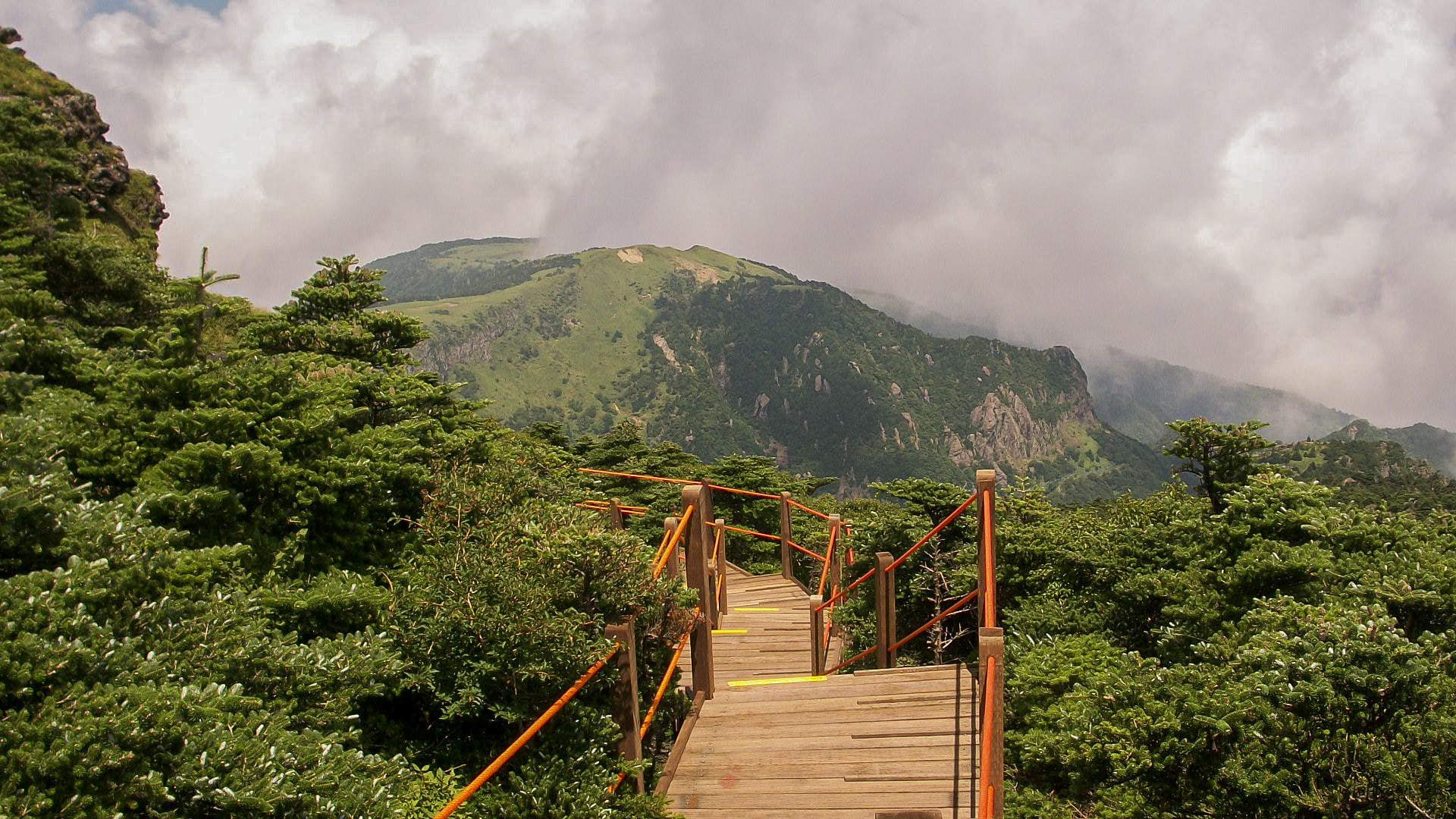
Five established hiking routes ascend Hallasan's slopes, though access has narrowed over time as conservation concerns have led authorities to restrict some paths: today only the Gwaneumsa Trail, running 8.7 kilometers, and the Seongpanak Trail, at 9.6 kilometers, actually reach the true summit and crater lake, while the shorter Yeongsil, Eorimok, and Donnaeko trails have been closed to summit access since 1994 as part of an ongoing vegetation restoration effort, though sections remain open for shorter hikes to lower viewpoints. Both summit-accessible trails typically take the better part of a full day to hike round trip, passing through Hallasan's layered ecosystem from subtropical forest near the trailheads through cooler temperate and finally alpine zones near the crater rim, with rangers enforcing cutoff times for starting the ascent to ensure hikers can safely descend before dark, a rule strictly applied given how quickly Hallasan's weather and visibility can deteriorate at altitude.
Jeju International Airport, on the island's northern coast near Jeju City, connects to major South Korean cities including Seoul with some of the busiest domestic flight routes in the world, alongside a growing number of direct international connections from elsewhere in East Asia. From Jeju City, bus routes run to the various Hallasan trailheads, with travel times ranging from roughly 25 to 60 minutes depending on which trail a hiker plans to take, making the mountain readily accessible as a day trip from almost anywhere on the compact island. Jeju's well-developed tourism infrastructure, built up over decades as the island became South Korea's most popular domestic vacation destination, means visitors combining a Hallasan hike with time on Jeju's coastline, waterfalls, and other volcanic sites will find transport, accommodation, and guided tour options considerably more developed than at many comparably remote volcanic destinations elsewhere in the world.
Hallasan's layered ecosystem means conditions can vary considerably between the trailhead and the summit even on the same day, and the mountain experiences a genuine four-season climate despite Jeju's generally mild, subtropical coastal reputation, with snow common on the upper slopes in winter and occasional trail closures during severe weather. Spring, from April through May, and autumn, from September through November, are generally considered the most comfortable seasons for hiking, offering milder temperatures and, in autumn particularly, striking foliage color along the forested lower trail sections, while summer brings heat and humidity at lower elevations along with a higher chance of typhoon-related disruption to the wider island, and winter transforms the crater rim into a snow-covered alpine landscape that draws its own dedicated group of visitors despite the more demanding conditions.
Long before Hallasan became a hiking destination, Jeju's indigenous shamanic and folk traditions treated the mountain as a spiritual center, home in local mythology to a creation goddess named Seolmundae Halmang, said to have formed the island itself by scooping earth into the sea, with Hallasan's summit crater explained as the result of her stepping too hard and breaking through the peak she had built. Shrines and ritual sites connected to Jeju's distinct folk religion, which developed somewhat separately from mainland Korean traditions given the island's historical isolation, are still scattered across the lower slopes, and elements of this older belief system persist alongside more conventional Buddhist and Confucian influences found elsewhere on the island. This layered spiritual history gives Hallasan a cultural weight beyond its geological and ecological significance, positioning the mountain as something closer to a foundational symbol of Jeju identity than simply a scenic hiking destination, a distinction that shapes how many Jeju residents themselves talk about the mountain even as it has become one of South Korea's most visited natural attractions.
No reviews yet. Be the first to share your experience!
Share your experience and help other travelers