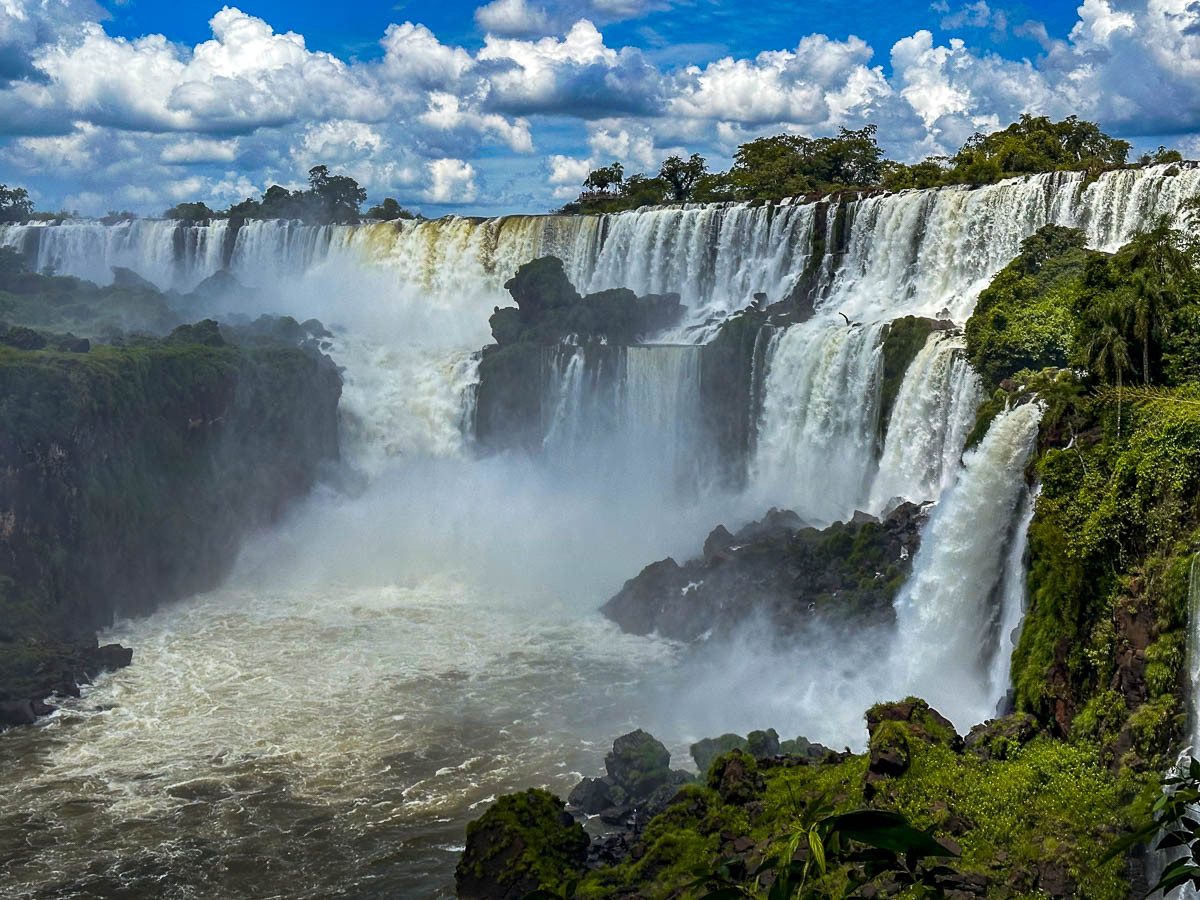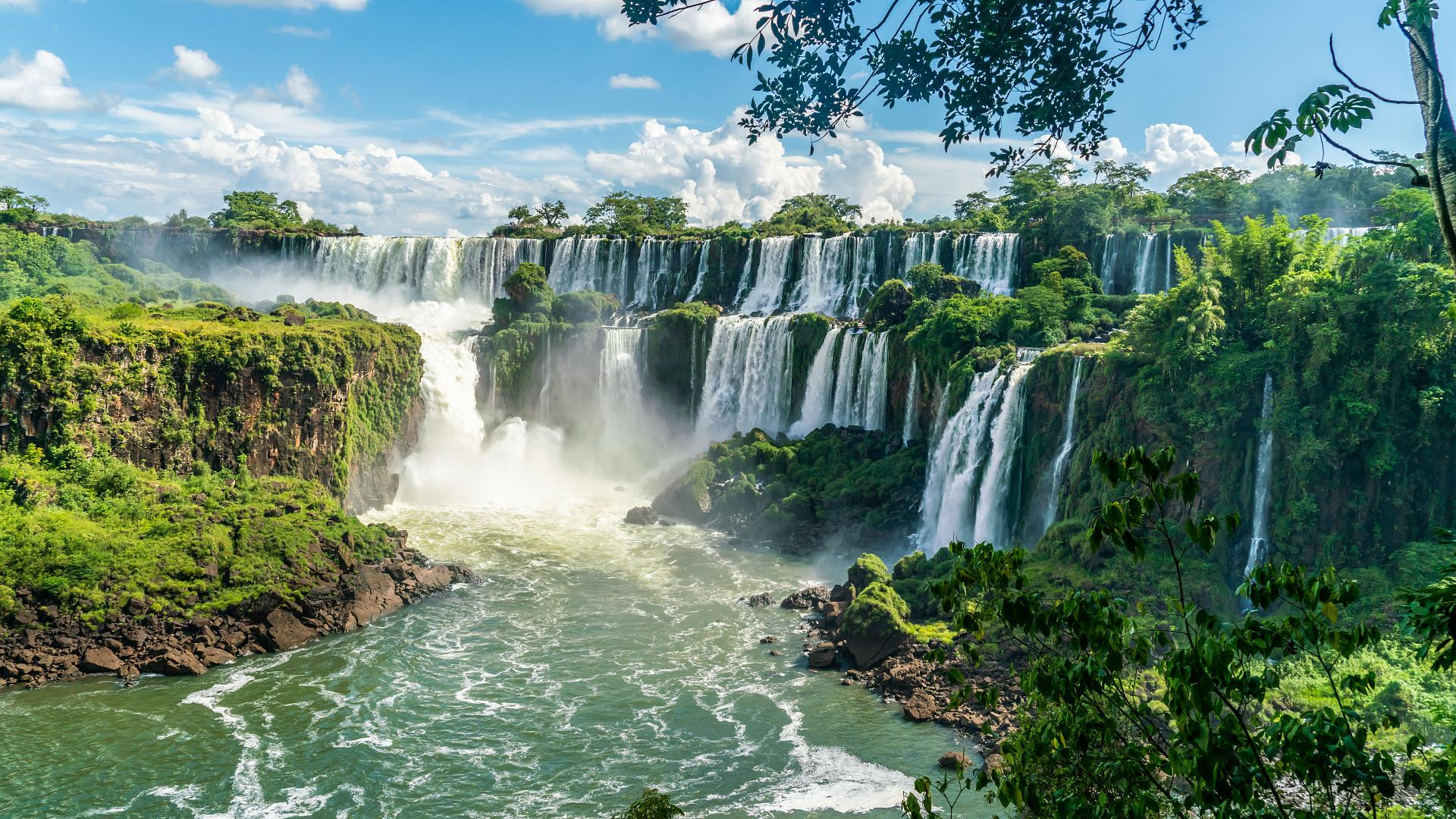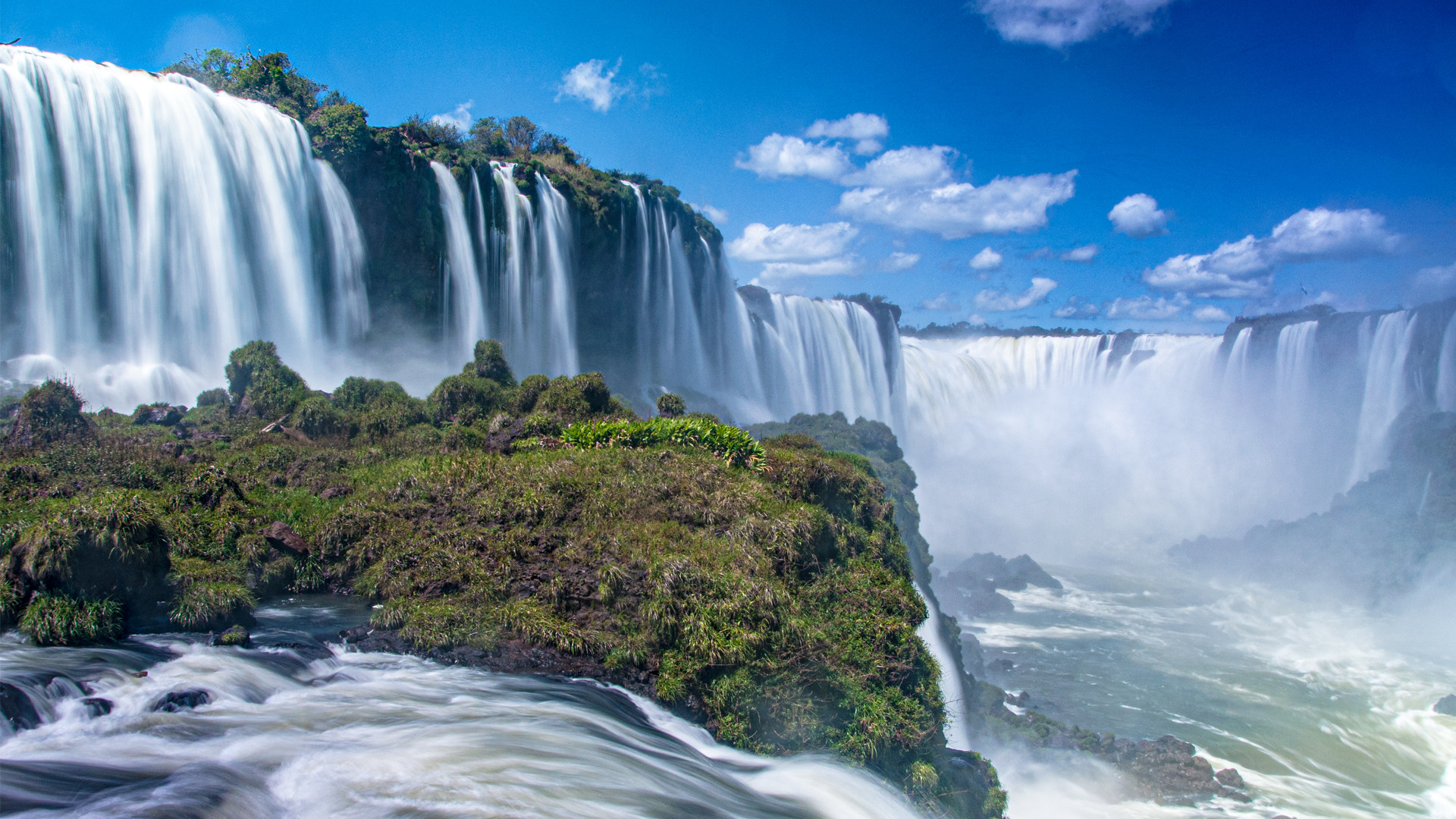
Where the Iguazu River meets a fault line in the basalt plateau along the Argentina-Brazil border, it does not fall as a single sheet of water but shatters into an estimated 275 individual cascades, spread across a curved escarpment 2.7 kilometers wide. Individual drops along this arc range from about 60 to 82 meters, and the sheer number and density of separate falls, rather than any single record height, is what gives Iguazu its distinctive character among the world's great waterfalls: a horseshoe-shaped wall of water and spray so extensive that no single viewpoint, on either the Argentine or Brazilian side, can take in the whole system at once. The name Iguazu comes from the Guarani words for big water, a description that ancient inhabitants of the region settled on long before any European traveler wrote of it, and one that still feels understated once you stand within earshot of the roar.
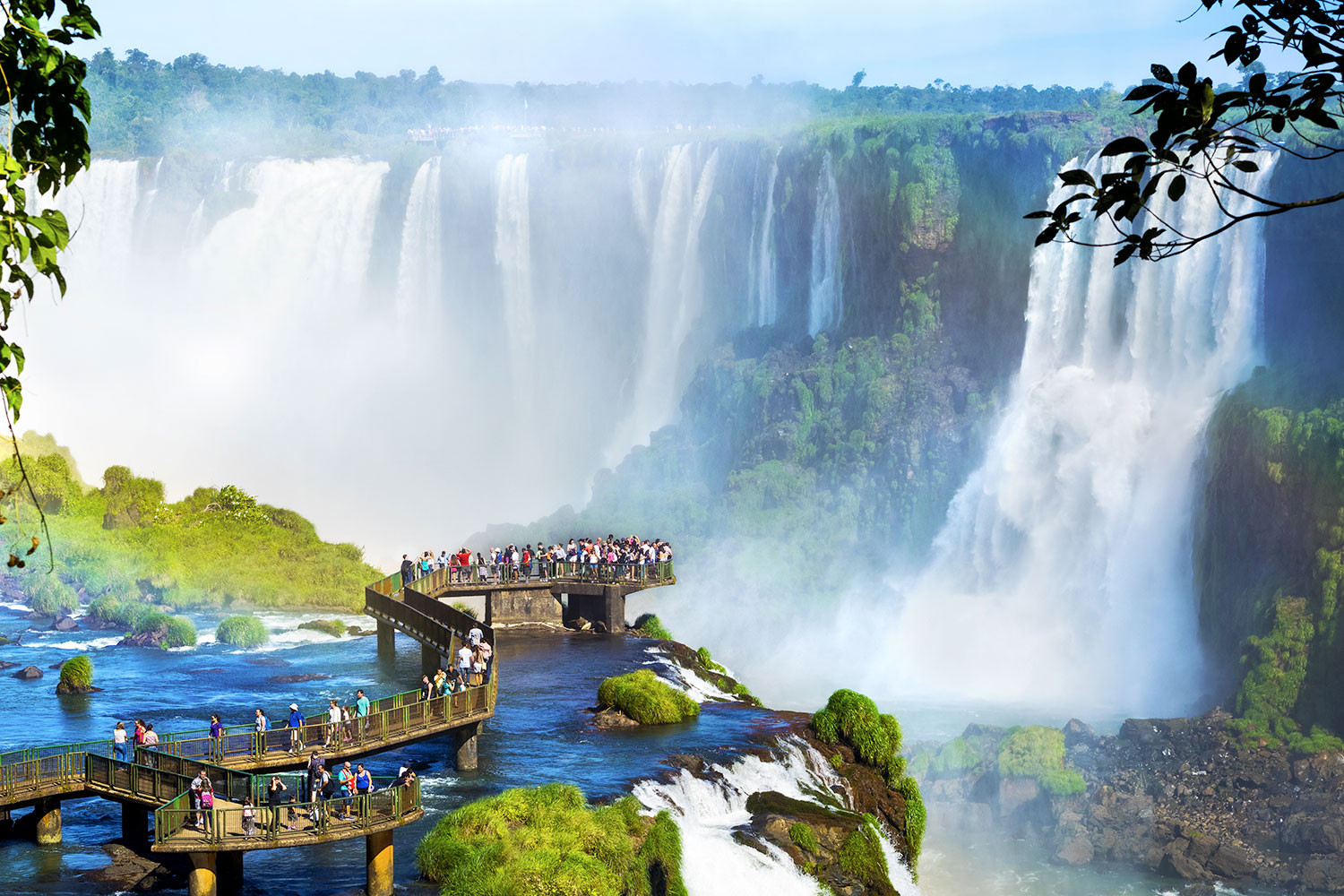
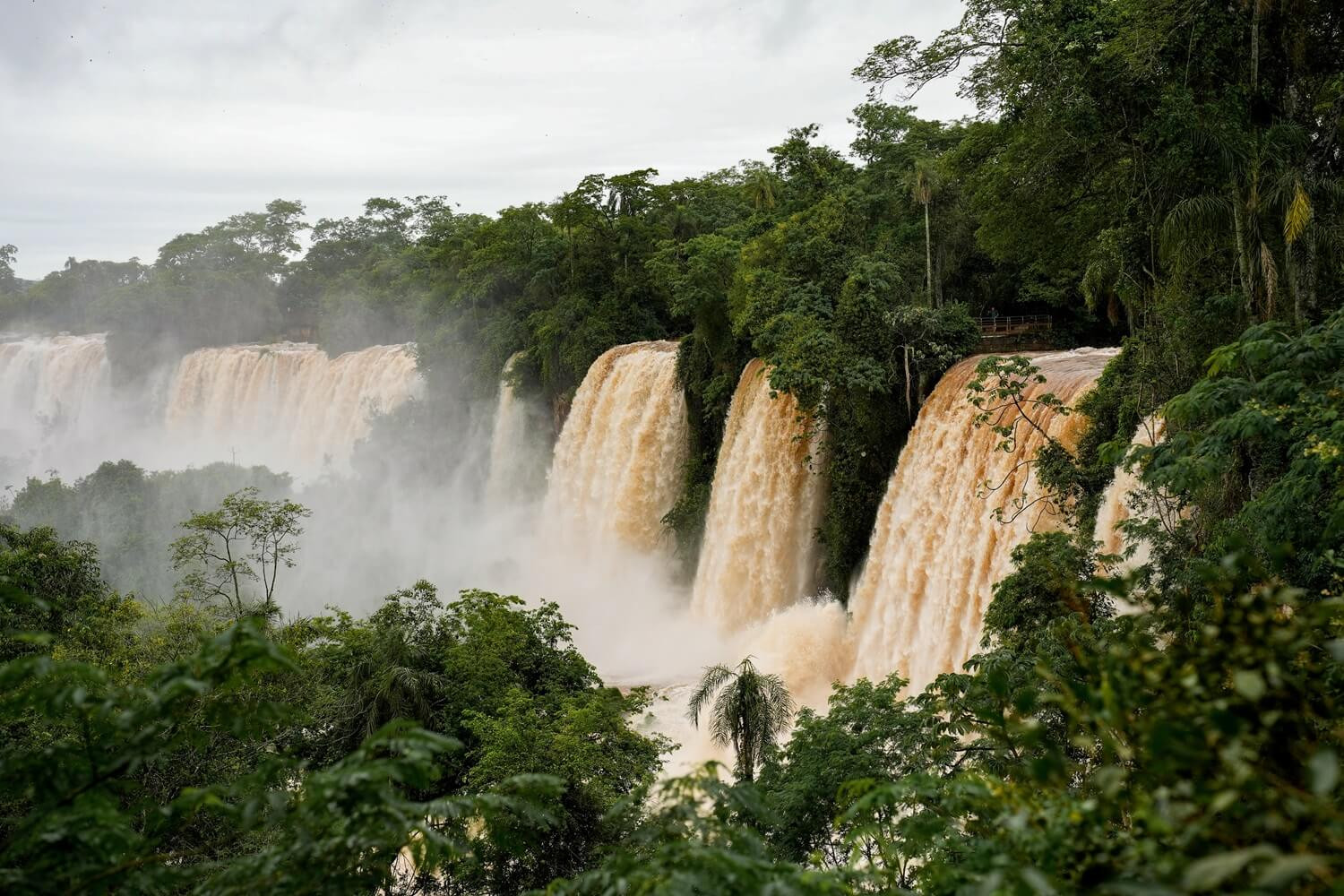
At the heart of the falls system lies Garganta del Diablo, the Devil's Throat, a U-shaped chasm roughly 80 to 90 meters wide and 70 to 80 meters deep into which close to half of the entire river's flow converges and drops in a single overwhelming column of water and mist. Rising spray from the Devil's Throat is visible from a considerable distance and frequently produces rainbows arcing across the gorge on sunny days, a detail that has made the platform overlooking this section, reached via a long catwalk on the Argentine side, one of the most photographed vantage points in South America. The volume of water passing through this single chasm is difficult to grasp in the abstract: the falls system as a whole averages 1,756 cubic meters of flow per second, ranking sixth in the world for average annual discharge among waterfalls, and during exceptional flood conditions recorded flow has spiked to more than 45,000 cubic meters per second, a volume capable of reshaping the riverbed and temporarily submerging walkways on both sides of the border.
Iguazu's staircase-like structure is the product of successive layers of basalt laid down by ancient volcanic activity across the region, with a particularly hard, vesicular basalt layer near the top acting as a resistant cap that controls where and how the water drops. Beneath this resistant cap, softer rock erodes more quickly, undercutting the harder layer above it and causing the falls to retreat gradually upstream over geological time, a process estimated to be advancing the falls' position at somewhere between 1.4 and 2.1 centimeters per year. This same basaltic geology extends across a much wider area of southern Brazil, Paraguay, and northern Argentina, part of one of the largest volcanic provinces on Earth, and it is this shared geological inheritance that also explains the presence of other, smaller basalt-controlled waterfall systems scattered through the same border region, none approaching Iguazu's scale but all shaped by the same underlying rock.
The falls are shared almost evenly between Iguazú National Park on the Argentine side and Iguaçu National Park on the Brazilian side, each independently inscribed as a UNESCO World Heritage Site, in 1984 for the Argentine park and 1986 for the Brazilian one, with the wider falls system itself later added to the World Heritage List in 2013 to recognize the transboundary whole. The two sides offer meaningfully different experiences: Argentina's park, considerably larger and offering closer, more immersive access, includes an ecological train and a network of walkways that bring visitors directly over and alongside individual falls, including the celebrated catwalk out to the Devil's Throat platform. Brazil's smaller park instead emphasizes panoramic views, its walkways and lookout points arranged to take in the sweeping curve of the falls from a distance in a way the more intimate Argentine trails do not replicate, and most visitors who have time for both sides describe them as complementary rather than redundant.
Both national parks protect substantial areas of Atlantic Forest surrounding the falls, a biome that has been reduced to a small fraction of its original extent elsewhere in Brazil and Argentina but survives here in a comparatively large, connected block thanks to the protection the falls themselves have afforded the wider landscape. The parks are home to over 2,000 plant species and hundreds of bird species, along with mammals including coatis, a raccoon relative that has grown notably accustomed to tourists and is frequently seen scavenging near walkways, as well as more elusive residents such as jaguars, tapirs, and giant anteaters that visitors are far less likely to encounter directly. Toucans and swifts that nest in crevices behind and beside the falling water are among the more distinctive sights for birdwatchers, with flocks of great dusky swifts sometimes visible flying directly through the curtain of spray to reach nesting sites hidden behind the cascades.
Three towns serve as gateways to the falls: Puerto Iguazú in Argentina and Foz do Iguaçu in Brazil both have their own airports with domestic and some regional international connections, while Ciudad del Este in Paraguay offers a third, less commonly used approach across the nearby triple border. Many visitors base themselves in Foz do Iguaçu or Puerto Iguazú and cross the border for a day to see both national parks, a straightforward trip given the short distance between the two towns, though travelers should carry appropriate identification and check visa requirements for crossing between Argentina and Brazil in advance. Water flow, and with it the visual drama of the falls, peaks during the regional rainy season from December through February, though this period brings more crowds and hotter, more humid conditions, while the cooler, drier months from April through September offer a more comfortable visiting climate at the cost of somewhat reduced flow, except during unusually wet years when the falls can remain dramatic in any season.
Iguazu is almost inevitably compared to the world's other most famous waterfalls, a comparison the falls tend to win on breadth if not always on singular statistics. Eleanor Roosevelt is widely quoted as having exclaimed "Poor Niagara!" upon first seeing Iguazu, a reaction to a falls system roughly three times wider than Niagara's combined horseshoe and American falls, even though Niagara's individual drop heights are broadly comparable. Against Victoria Falls in Zambia and Zimbabwe, often cited as having the single largest unbroken sheet of falling water in the world, Iguazu instead offers the far greater number of individual cascades and, during peak flow events, a maximum recorded discharge that exceeds both Niagara and Victoria Falls by a wide margin. For most visitors who have seen more than one of the world's major waterfalls, the comparison ultimately comes down to a matter of character rather than a simple ranking: Victoria Falls for raw singular power, Niagara for accessibility and proximity to a major city, and Iguazu for sheer, sprawling scale spread across dozens of individual falls at once.
Guarani mythology offers its own account of how Iguazu came to be, telling of a river god who desired a young woman named Naipi and planned to marry her, only for Naipi to flee downriver by canoe with her mortal lover Tarobá. Enraged, the god sliced the riverbed apart in front of the fleeing couple, creating the falls and condemning Naipi to fall eternally into the base of the chasm while Tarobá was turned into a tree overlooking her endless descent, a story local guides still recount at the Devil's Throat platform where the two figures are said to remain, one below the water and one above it. Whatever its historical origins, the legend captures something of the falls' effect on visitors even today: a landscape violent and overwhelming enough in scale that it has always seemed to demand an explanation beyond ordinary geology, long before basalt layers and headward erosion rates were available to describe what people were actually looking at.
No reviews yet. Be the first to share your experience!
Share your experience and help other travelers