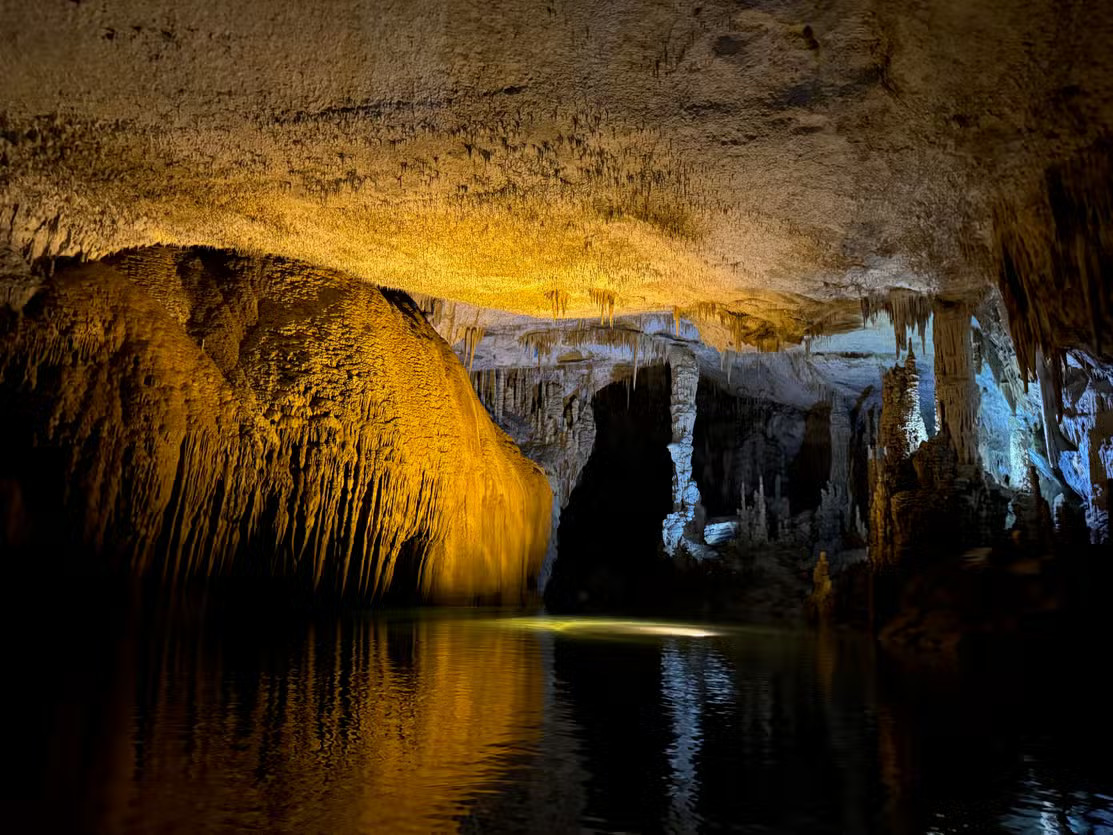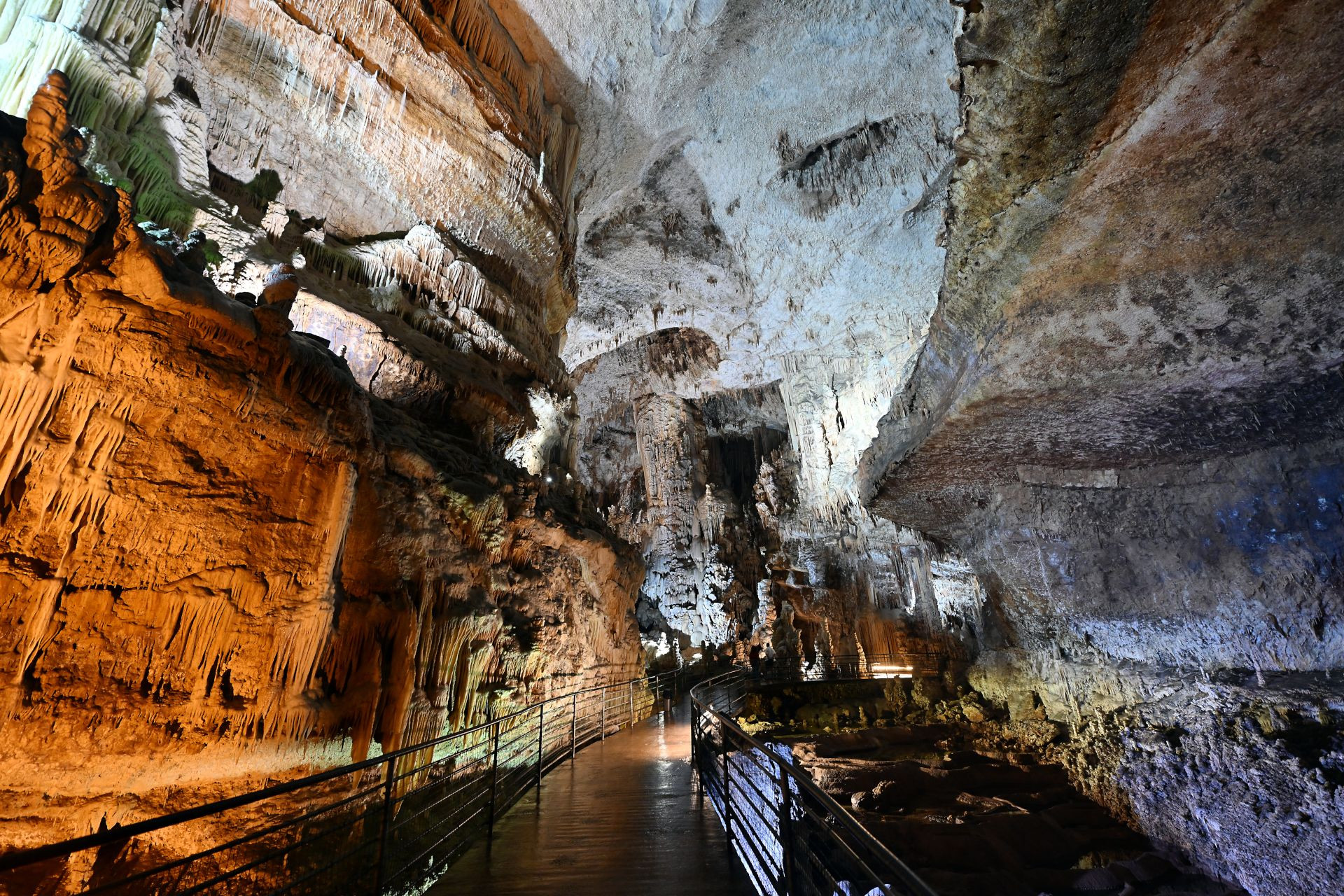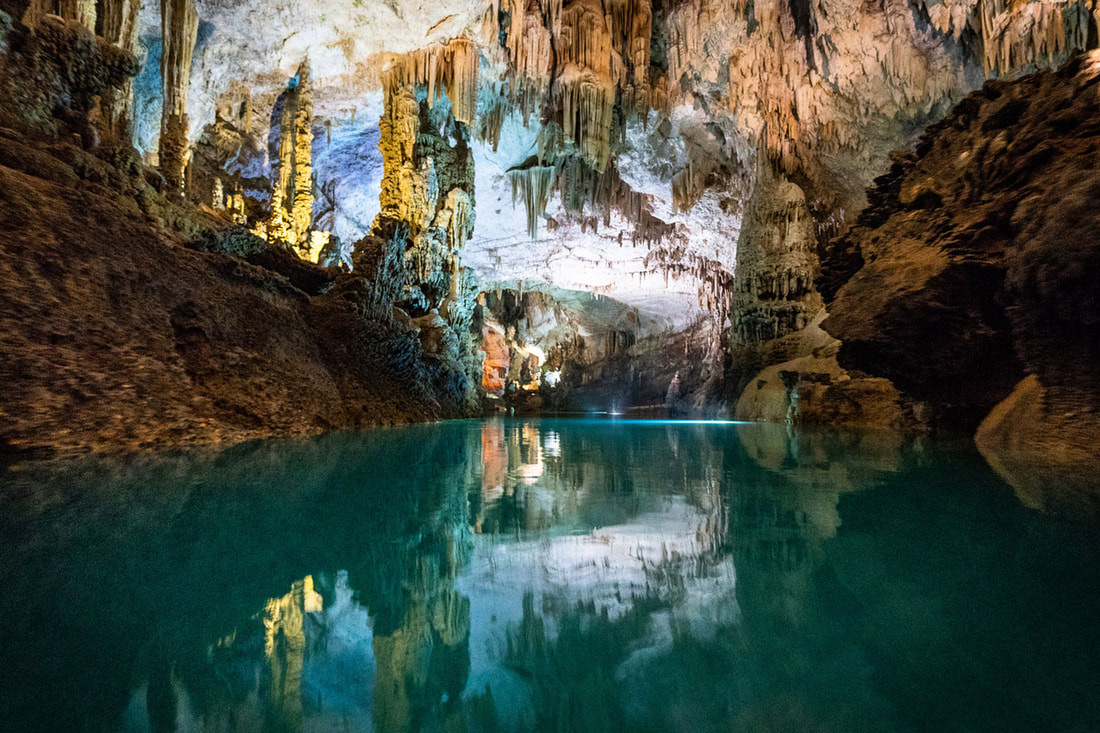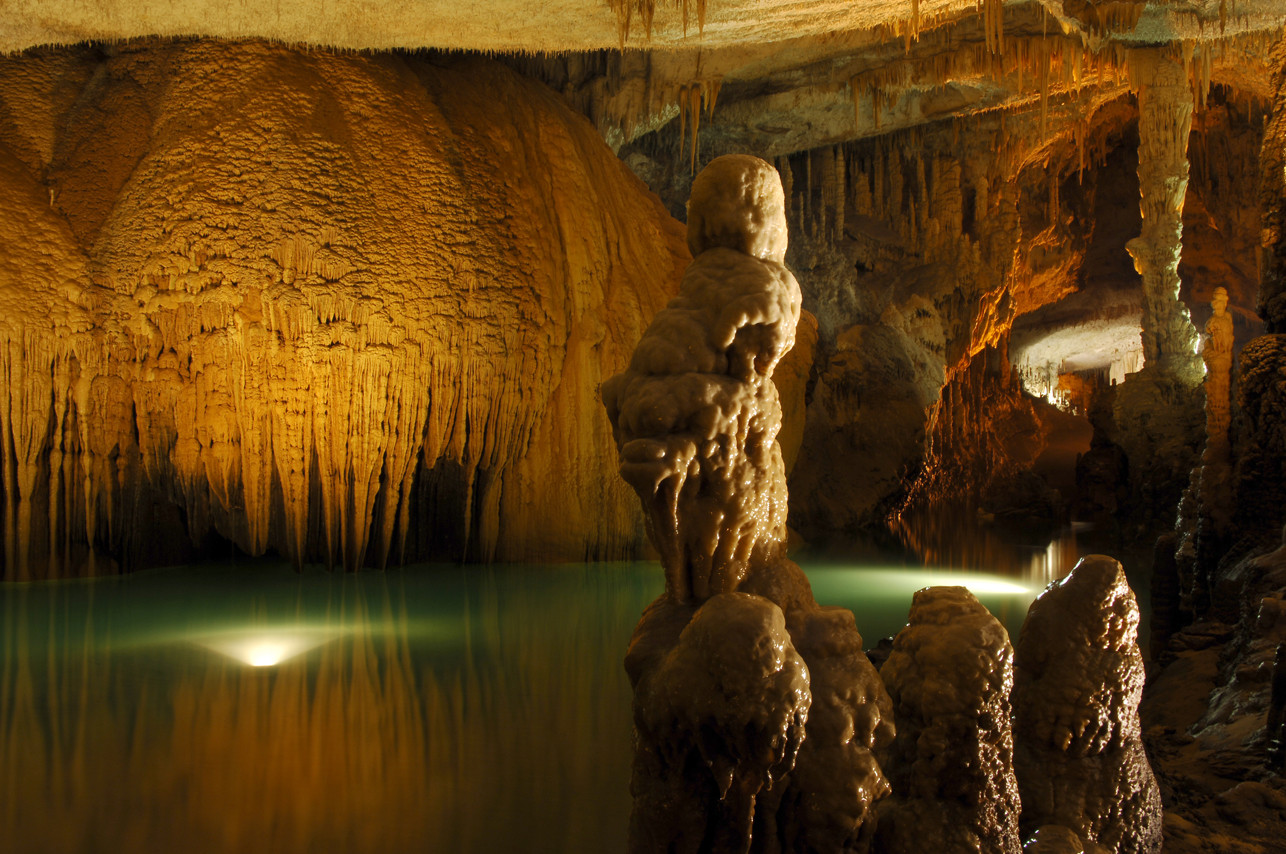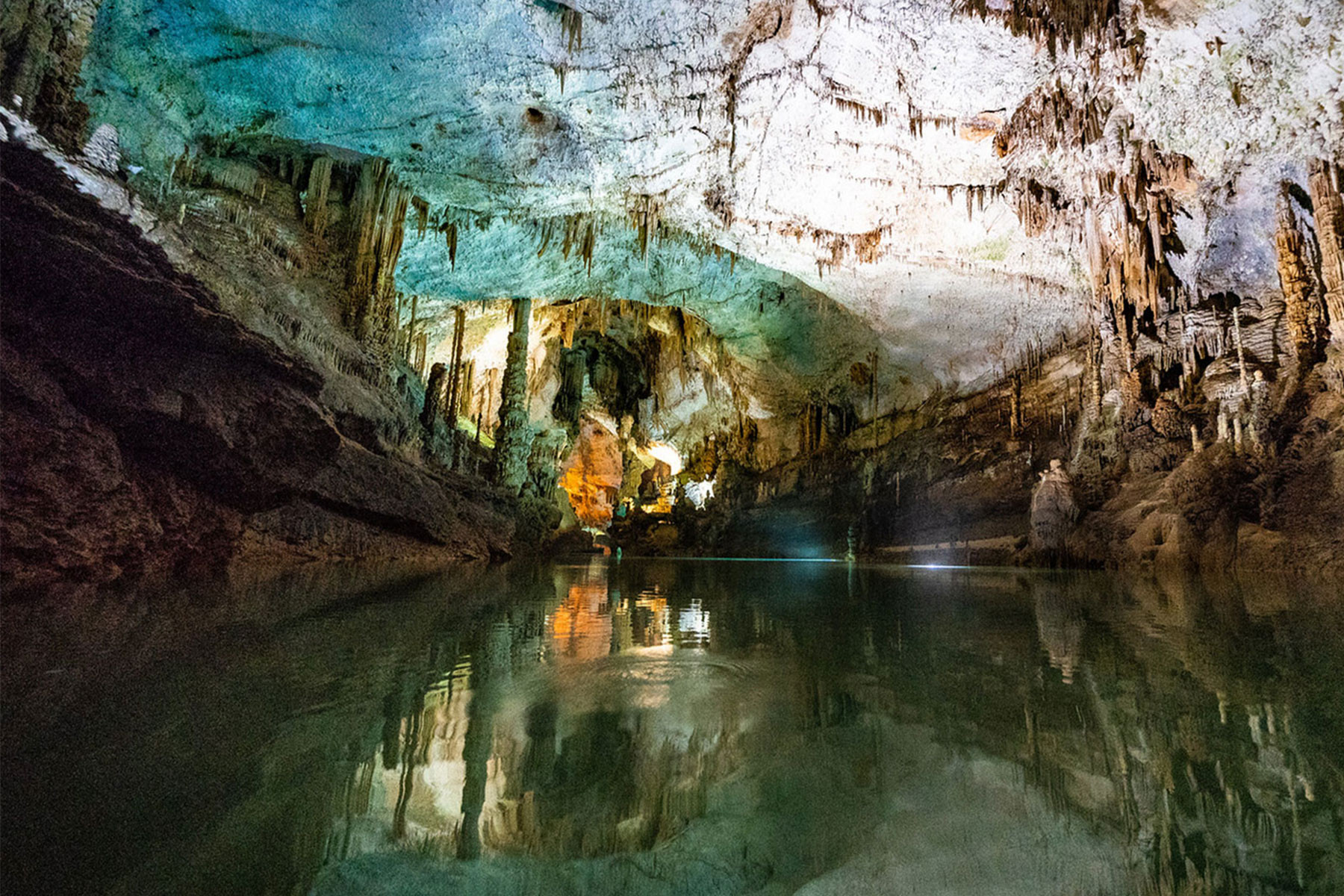
Jeita Grotto is a two-part limestone cave system carved over millions of years by an underground branch of the Nahr al-Kalb River as it cuts through Mount Lebanon roughly 18 kilometers north of Beirut. The system consists of two interconnected caves, an upper gallery accessible on foot and a lower gallery navigated by boat along a still, cold underground river, together forming one of the most extensive and visually dramatic cave networks in the Middle East. Combined, the explored passages stretch over 9 kilometers, though only a fraction is open to the public for conservation reasons.
The upper cave, discovered relatively recently in 1958 by a group of Lebanese speleologists, sits about 60 meters above the lower gallery and contains some of the largest known stalactite and stalagmite formations in the world, including a single stalactite measured at nearly nine meters, believed to be among the longest ever recorded anywhere on Earth. Colored lighting installed along the walkways accentuates the mineral formations without altering the cave's natural humidity or temperature, both carefully regulated to protect the fragile calcite structures.
Like all limestone caves, Jeita formed through a slow chemical process: slightly acidic rainwater seeped through cracks in the limestone bedrock over an immense span of geological time, gradually dissolving passages and chambers, while mineral-rich water dripping through the cave ceiling deposited calcium carbonate drop by drop to build the stalactites, stalagmites, columns, and curtain-like flowstone formations that now define the space. Some of the largest formations are estimated to have taken well over a million years to reach their current size.
The lower gallery's underground river remains an active hydrological system today, not just a historical feature, supplying a significant portion of Beirut's drinking water and making Jeita as ecologically important as it is scenically spectacular. This dual role, tourist attraction and functioning water source, shapes nearly every conservation decision made about how the site is managed and how many visitors it can safely accommodate.
While the lower cave's entrance had been known to local residents for centuries, systematic exploration only began in 1836 when American missionary William Thomson ventured partway into the cave, followed by more extensive expeditions later in the 19th century that mapped further sections of the underground river. Archaeological evidence, including ceramic remains found near the entrance, suggests the cave's mouth was used by earlier inhabitants of the region long before any formal exploration took place.
Jeita remained relatively obscure internationally until the mid-20th century, when improved lighting, walkways, and boat access transformed it from a local curiosity into one of Lebanon's most visited natural sites, eventually leading to its nomination as a finalist in the New7Wonders of Nature campaign in the early 2010s.
Jeita Grotto has held particular symbolic weight in Lebanon precisely because it has remained physically untouched by decades of regional conflict that damaged much of the country's built heritage elsewhere. During Lebanon's civil war and subsequent periods of instability, the cave was periodically closed for security reasons but suffered no direct damage, allowing it to reopen each time as one of the few major attractions in the country requiring no reconstruction.
That resilience has made Jeita a point of quiet national pride, frequently referenced in Lebanese tourism promotion as evidence that the country's extraordinary natural heritage persists regardless of political turmoil above ground, a narrative that resonates strongly with Lebanese visitors as much as international ones.
Visitors moving through the upper gallery's walkways encounter chambers with names like the White Chamber and the Hall of Freedom, some large enough to hold the Sphinx of Giza with room to spare, according to comparisons frequently made by guides. Lighting designers have deliberately avoided garish colored illumination in favor of subtler tones intended to highlight the formations' natural texture rather than overwhelm it with spectacle.
The lower cave's boat ride offers a completely different sensory experience, silent, cool, and dark except for targeted lighting on ceiling formations reflected in the still water below, creating symmetrical, almost surreal visual effects that photography is explicitly prohibited from capturing, a rule enforced to protect the cave's delicate ecosystem from camera flash and equipment.
Cave ecosystems are notoriously sensitive to human impact, temperature changes, increased carbon dioxide from breathing crowds, and artificial light can all interfere with mineral deposition rates and any cave-adapted organisms living within the system. Jeita's managers cap daily visitor numbers and prohibit photography in the lower cave specifically to minimize these disruptions, a stricter policy than many comparable show caves elsewhere in the world.
Given its dual function supplying drinking water to Beirut, protecting water quality inside the cave carries consequences well beyond tourism, adding an additional layer of environmental stewardship that shapes almost every operational decision at the site, from lighting choices to boat maintenance standards.
The site is easily reached as a half-day trip from Beirut, with organized tours and public transport options both available, and typically includes a cable car ride up to the upper cave entrance offering sweeping views over the surrounding Nahr al-Kalb valley before visitors even step underground. A combined ticket usually covers both the upper walking tour and the lower boat ride, though the lower gallery is occasionally closed during periods of high water flow.
Because temperatures inside remain cool and stable year-round regardless of surface weather, Jeita functions as a comfortable destination even during Lebanon's hot summer months, drawing steady visitor numbers across most of the calendar year rather than concentrating tourism into a narrow seasonal window.
Jeita Grotto's combination of scale, formation quality, and functioning ecological role sets it apart from many show caves that exist purely as tourist spectacles. It remains simultaneously a working water source, a scientifically significant geological formation, and a rare symbol of continuity in a country whose above-ground history has been repeatedly disrupted, a combination that gives a visit here weight well beyond its undeniable visual drama.
Long before formal exploration mapped its passages, the cave's dark, echoing entrance and the river disappearing into the mountainside likely fed local folklore about underground spirits and hidden realms, a pattern common across cave systems worldwide before science offered a geological explanation. Some regional oral traditions describe the cave as a mythical gateway, though little of this pre-modern folklore was formally recorded before 19th-century missionary accounts began documenting the site in more systematic, scientific terms.
That shift from myth to measured geological curiosity mirrors a broader pattern seen at show caves worldwide, where local legend often precedes and eventually gives way to guided tourism infrastructure once a site's scale becomes impossible to ignore.
No reviews yet. Be the first to share your experience!
Share your experience and help other travelers