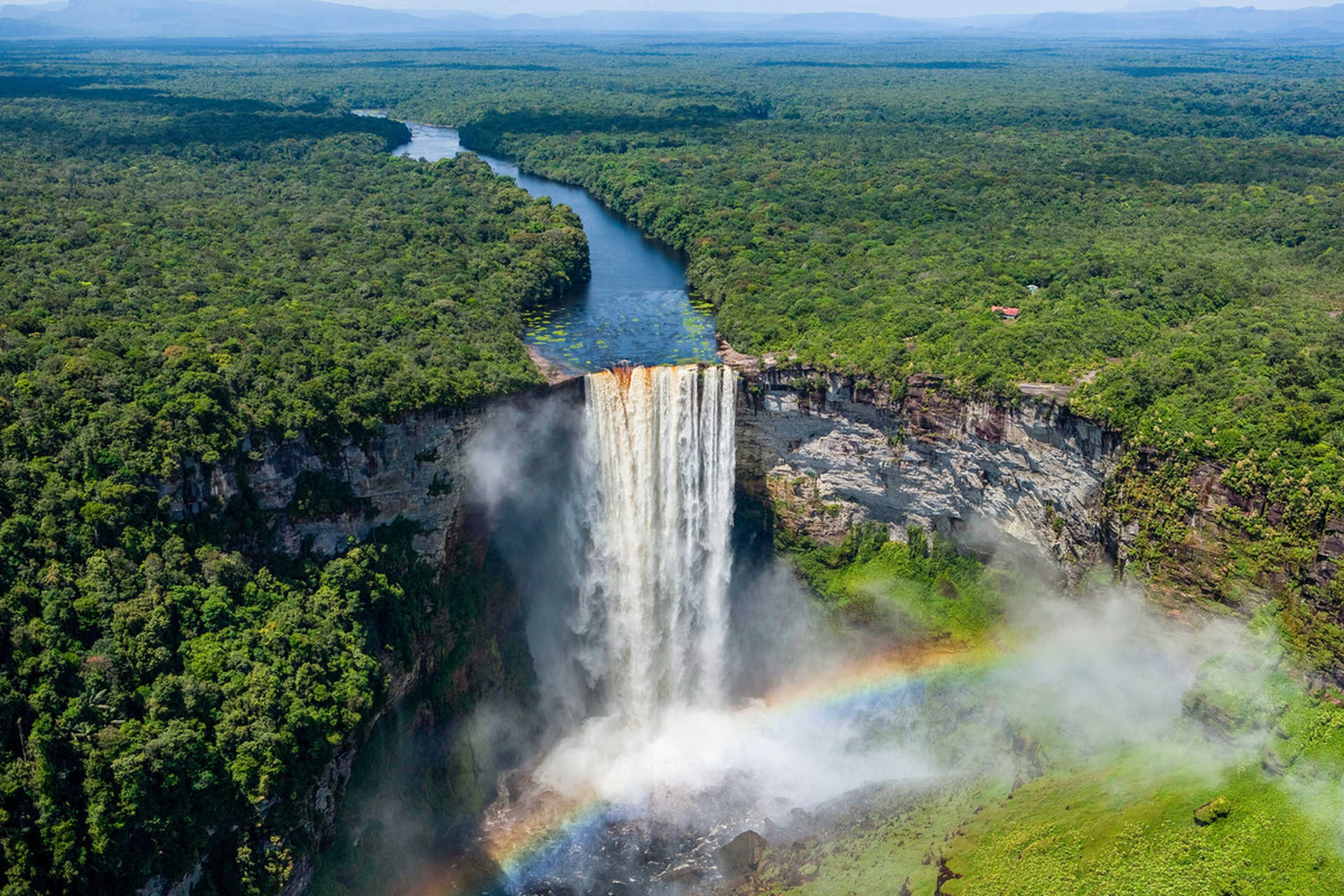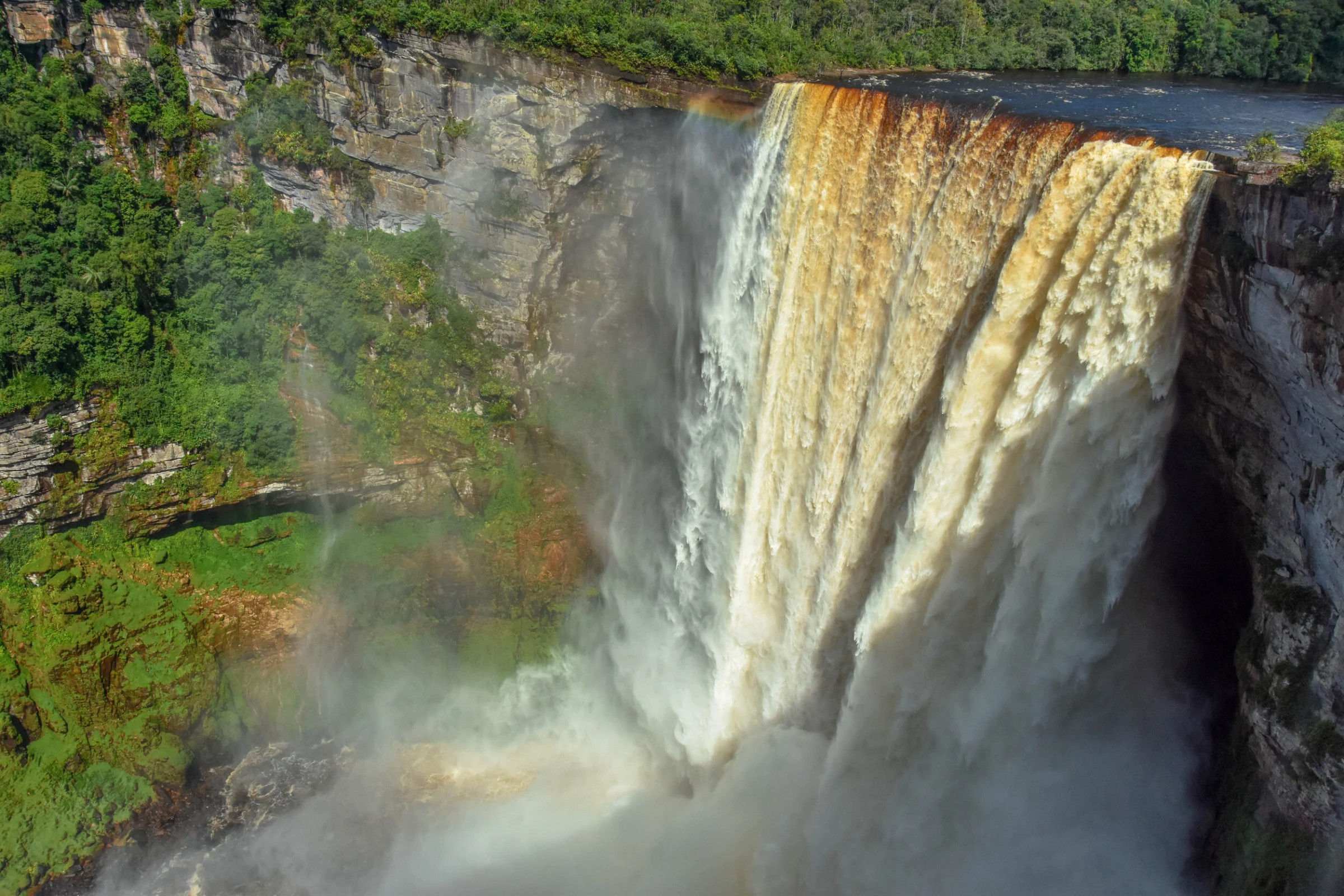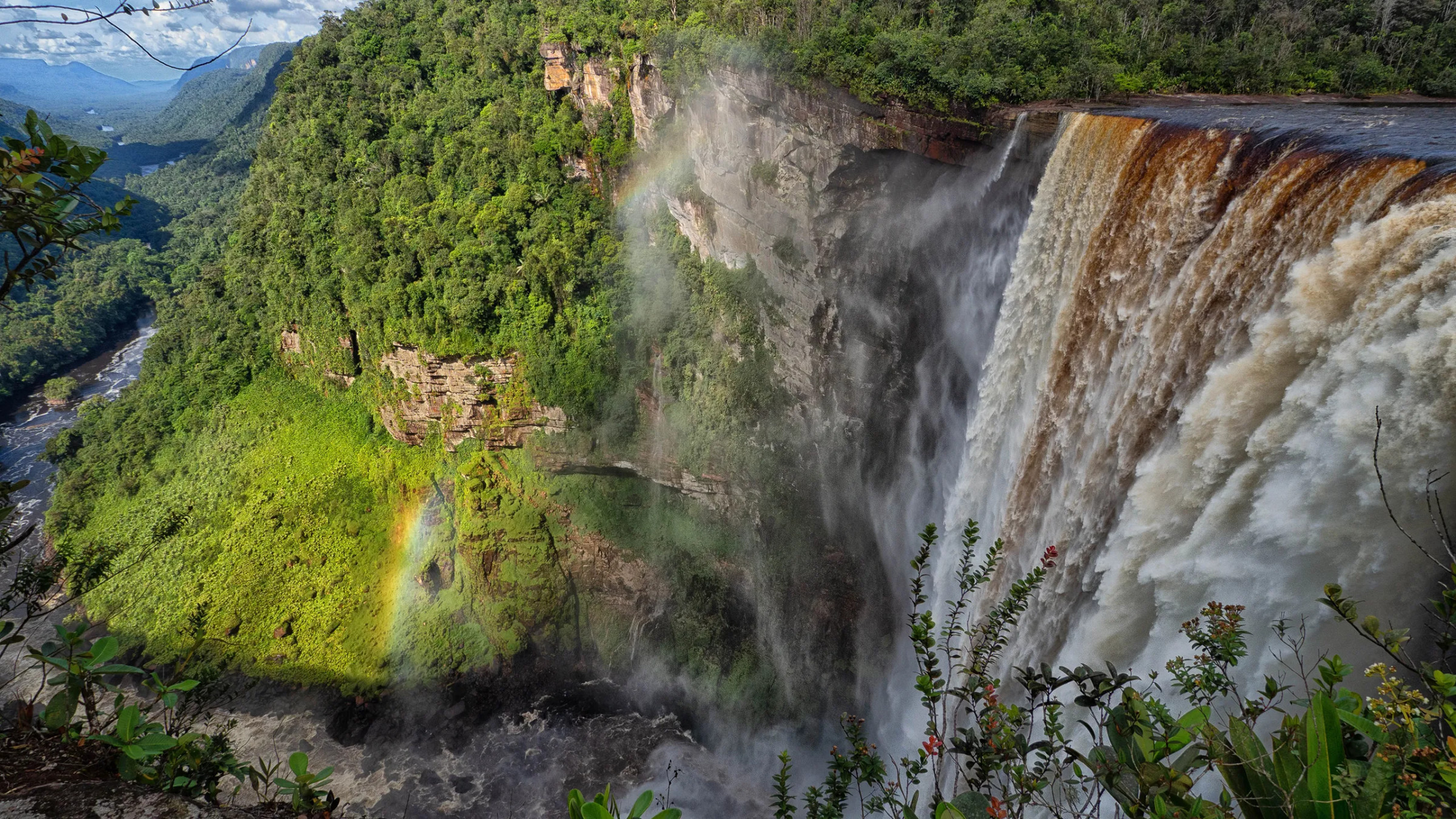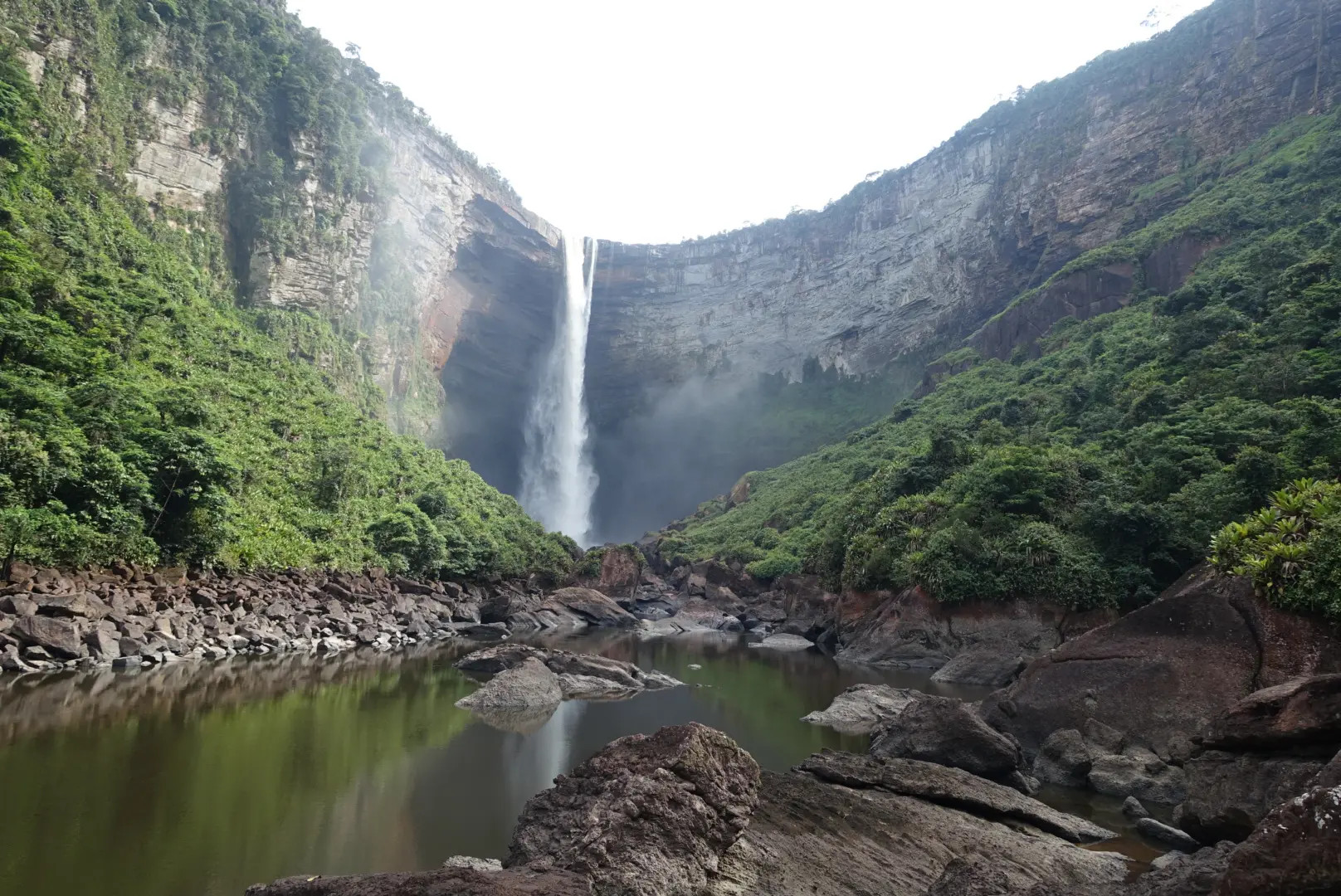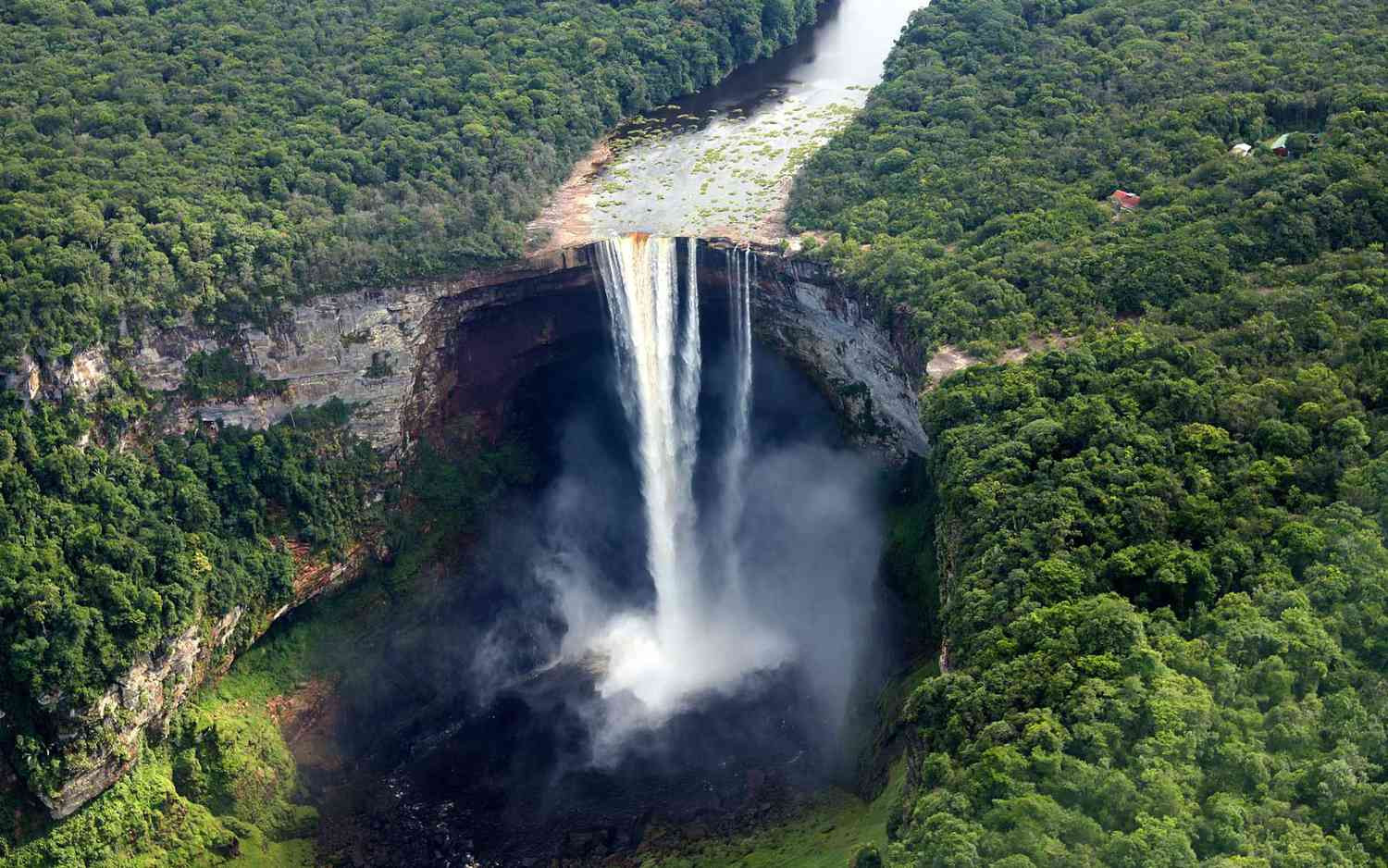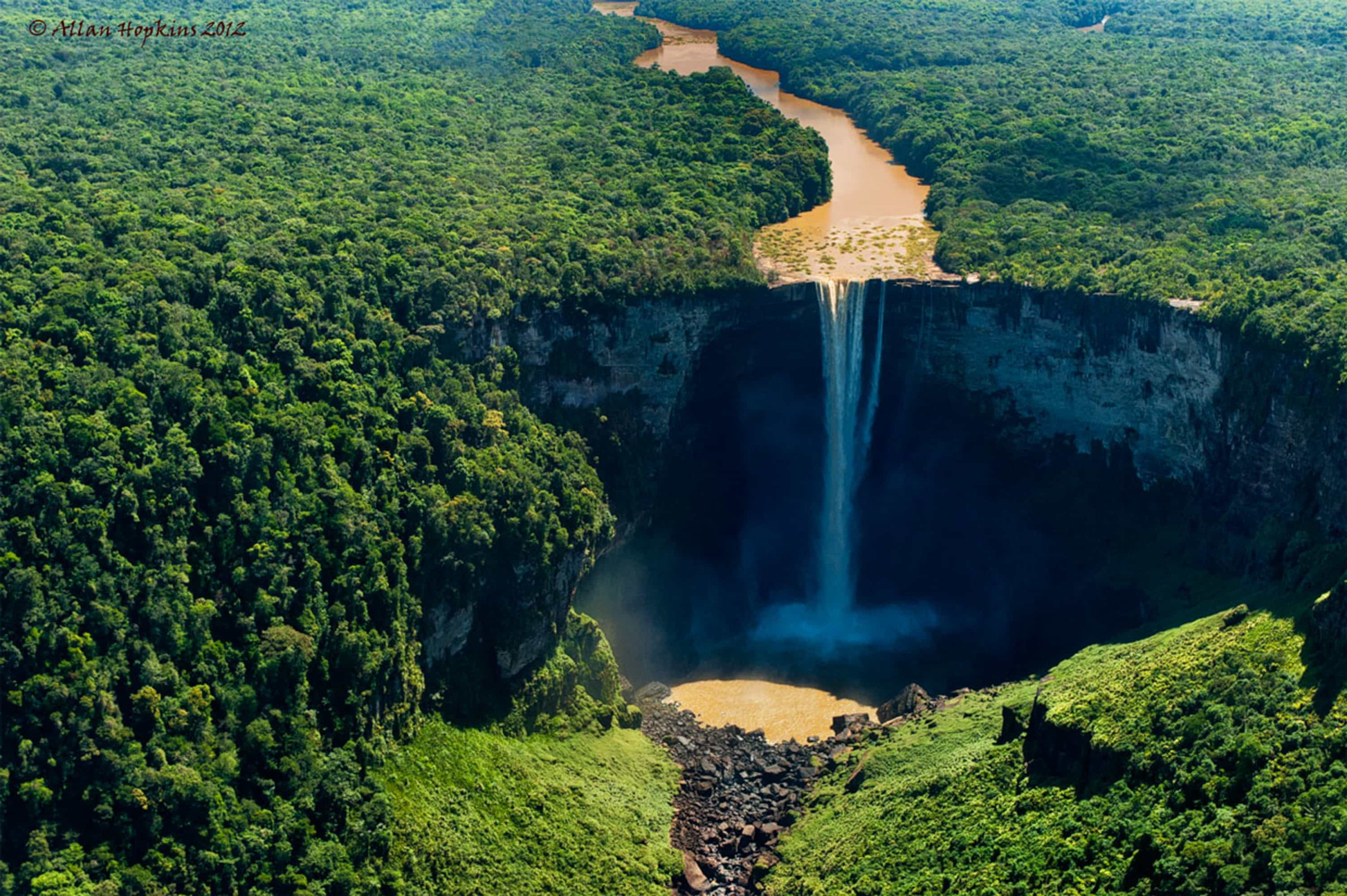
Kaieteur Falls plunges 226 metres in a single leap from the edge of the Guiana Shield into a gorge of the Potaro River, deep in the rainforest of central Guyana. With a total drop of about 250 metres including the cascades beneath, it is among the highest single-drop waterfalls in the world, roughly five times taller than Niagara and several times higher than Victoria Falls. Unlike many famous waterfalls, it is not a short walk from a road. Kaieteur is remote, wild, and still reached mainly by small plane.
The falls sit inside Kaieteur National Park, a protected area of old rainforest, sandstone plateau, and rare wildlife. The river that feeds them is the colour of strong tea, stained by tannins from the forest, and the thundering white water against dark rock makes a striking contrast.
The falls owe their power to the ancient geology of the Guiana Shield, one of the oldest rock formations on Earth. The Potaro River flows across a hard sandstone and conglomerate plateau, and then drops abruptly over the edge into the lowland below. Because the rock is resistant, the river has not cut back a long gorge, and the falls retain a dramatic, sheer-sided profile.
The volume of water is large, with an average flow high enough to make Kaieteur one of the most powerful single-drop falls by flow rate. During the rainy seasons the flow increases and the falls widen, producing an even more thunderous display, while in drier months the river narrows and the cliff face and surrounding rocks become more visible.
The name Kaieteur is often explained through a local legend about a chief named Kai, who is said to have sacrificed himself by paddling over the falls in a canoe to save his people. The word is sometimes translated as old man's fall. Indigenous communities, including the Patamona, have lived in the area for centuries and know the falls as a sacred and powerful place.
The first European to report seeing the falls was the geologist Charles Barrington Brown, who reached them in 1870 during a survey of the interior. His description of the cascade tumbling into the jungle brought the falls to international attention, although for decades afterwards they remained difficult to reach and rarely visited.
The surrounding national park is a haven for rare wildlife. The tiny golden frog, a bright orange amphibian found only in the park and nearby areas, lives its entire life in the water held by giant tank bromeliads, plants that grow on the rocks near the falls. The Guianan cock-of-the-rock, a vividly orange bird with a flamboyant crest, can sometimes be seen near the trails, particularly in the early morning.
At dusk, great dusky swifts perform one of the park's most remarkable sights, swooping in flocks through the spray and disappearing behind the curtain of water to roost on the cliff face. Jaguars, giant otters, tapirs, and many kinds of monkeys live in the wider forest, though most visitors are unlikely to see them on a short visit.
Most travellers reach Kaieteur by a day trip from Georgetown, the capital, flying in a small aircraft over unbroken rainforest. The flight takes roughly an hour or a little more, and on a clear day the view of the forest canopy, winding rivers, and tabletop mountains is part of the experience. Upon landing on a small airstrip near the falls, visitors walk a short trail to the main viewpoints.
Longer expeditions are also possible, trekking and travelling by river through the Potaro region for several days. These trips require careful planning, experienced guides, and a willingness to camp in remote areas, but they reward adventurous travellers with a sense of discovery that few waterfalls can match.
From the main viewpoints, visitors can stand just metres from the lip of the falls, watching the river slide smoothly to the edge before disappearing into the abyss. There are few barriers, so care is essential, particularly on wet rocks. Guides explain the history and ecology of the area and point out wildlife along the short trails between viewpoints.
The mist rising from the gorge nourishes mosses, ferns, and bromeliads on the cliff walls, and rainbows often appear in the spray on sunny afternoons. Photographers enjoy the changing light, though the humidity can fog lenses, so a cloth and protective bag are useful.
Kaieteur National Park is managed to protect its fragile ecosystems, and visitor numbers remain modest. Staying on marked paths, not feeding or approaching wildlife, and carrying out all rubbish helps to keep the area pristine. Indigenous communities near the park are partners in tourism and conservation, and employing local guides and buying local crafts supports the people who know the land best.
Because the area is remote, emergency services are limited, so travellers should follow guides' instructions, carry sufficient water, and take precautions against insects and sun. Flights can be delayed or cancelled by weather, so it is wise to build some flexibility into your schedule.
Guyana has two wet seasons and two dry seasons, and the falls can be visited all year. The drier periods, roughly February to April and August to October, offer more reliable flights and clearer views, while the wet seasons bring higher water and a more powerful, thunderous display, with a greater chance of cloud and delays. Book flights with an established operator in Georgetown, and confirm weight limits for luggage on small aircraft.
Wear light, quick-drying clothing, sturdy shoes with good grip, and a hat, and bring insect repellent, sunscreen, water, and a rain jacket. A day trip is possible, but combining Kaieteur with a stay at a nearby lodge or an additional site such as Orinduik Falls allows a deeper appreciation of the interior.
The area around Kaieteur lies within the traditional lands of the Patamona people, who live in villages along the Potaro and nearby rivers. Community-based tourism initiatives provide guiding, accommodation, and cultural experiences, from cassava bread-making to storytelling about the falls and the forest. Visiting these communities can add depth to a trip, offering insight into how people have lived with the river and rainforest for generations.
Many visitors combine Kaieteur with other sights in Guyana's interior. Orinduik Falls, a wide, stepped cascade on the Ireng River near the Brazilian border, offers shallow pools for swimming, while the Rupununi savannas, rainforest lodges such as Iwokrama, and the colonial architecture of Georgetown round out a broader journey. Each shows a different side of a country where forest covers most of the land and nature remains at the heart of daily life.
Guyana has set aside large areas of its forest for conservation and promotes low-impact tourism as part of a broader strategy to protect its natural heritage. Kaieteur's remoteness has helped keep the falls and their wildlife in remarkably good condition, and careful management aims to keep it that way. For travellers, the reward is the rare chance to see a world-class waterfall in a setting that still feels untouched.
No reviews yet. Be the first to share your experience!
Share your experience and help other travelers