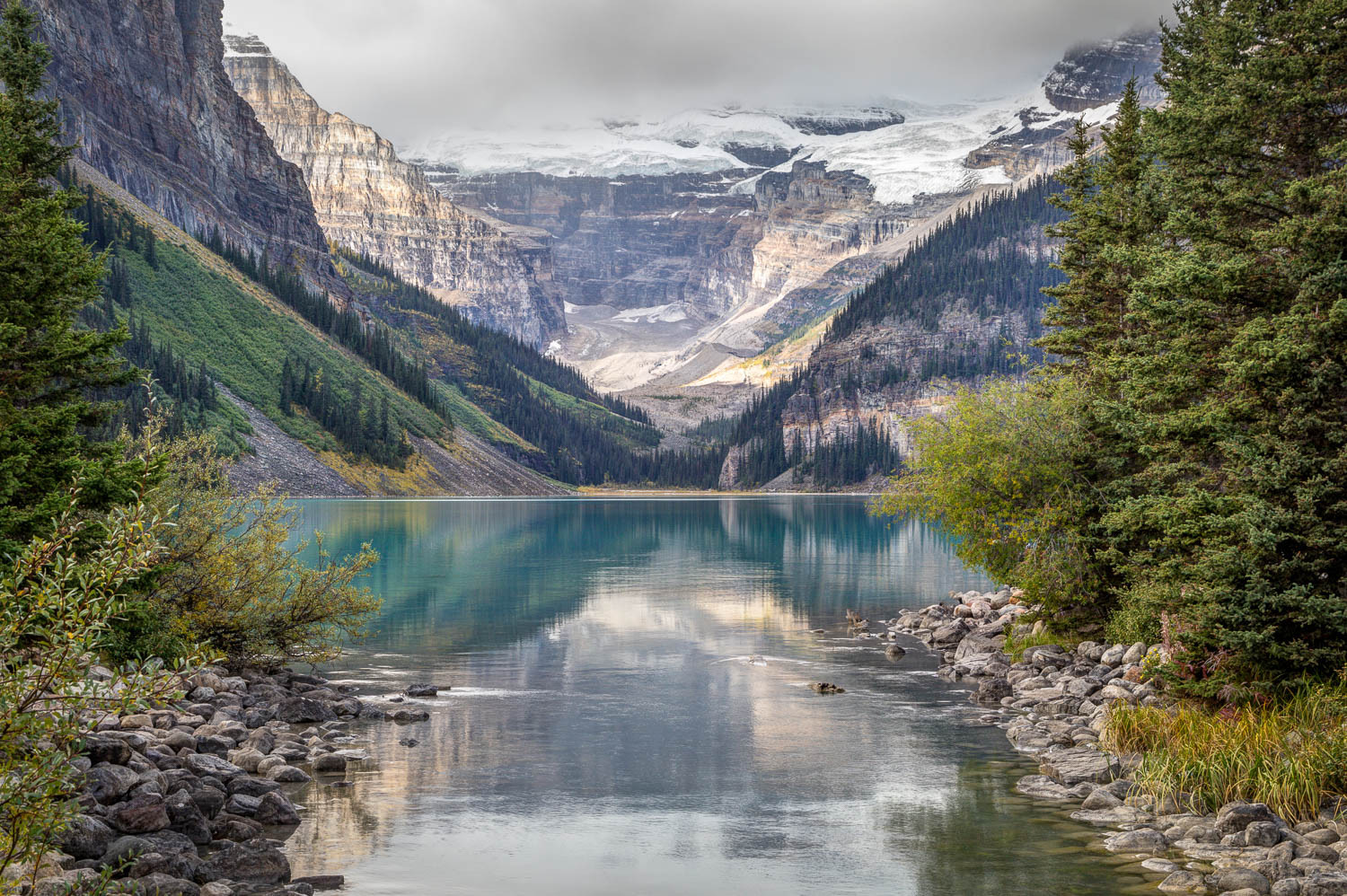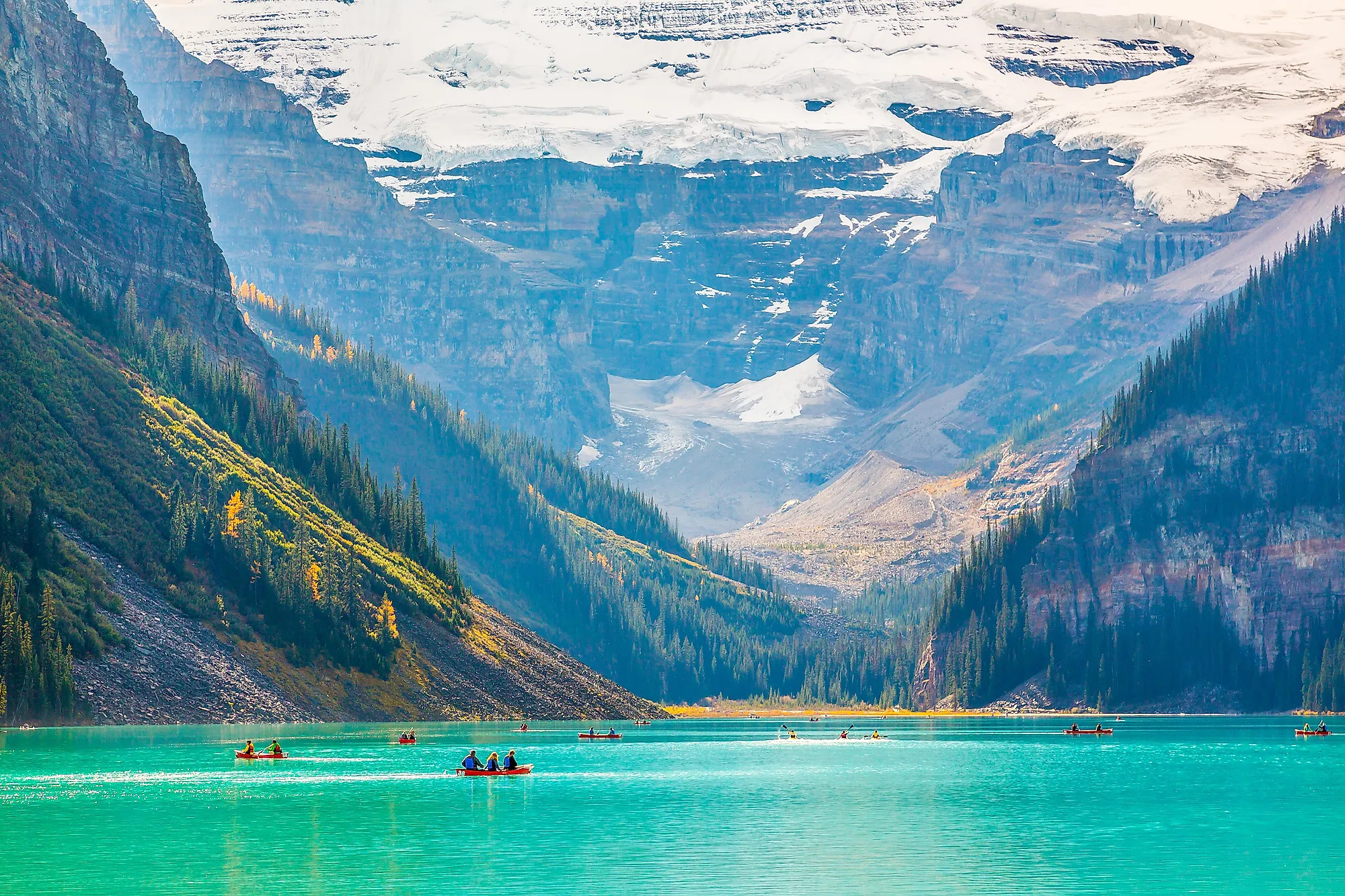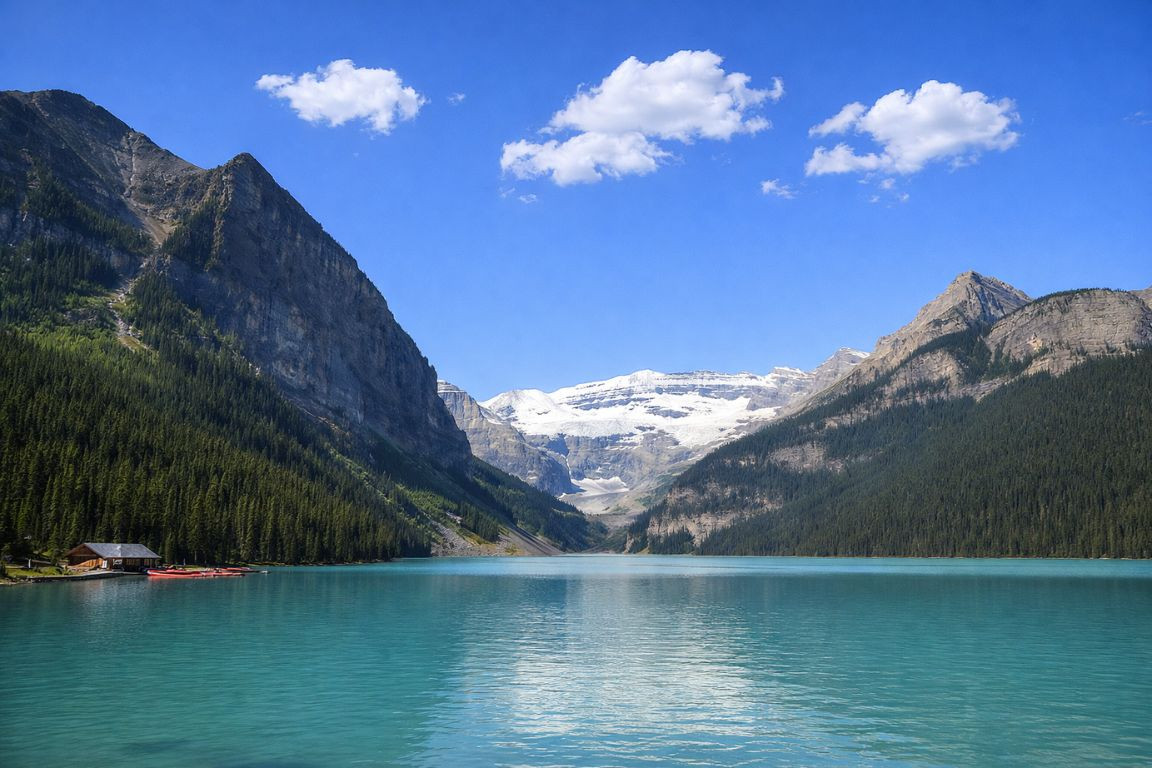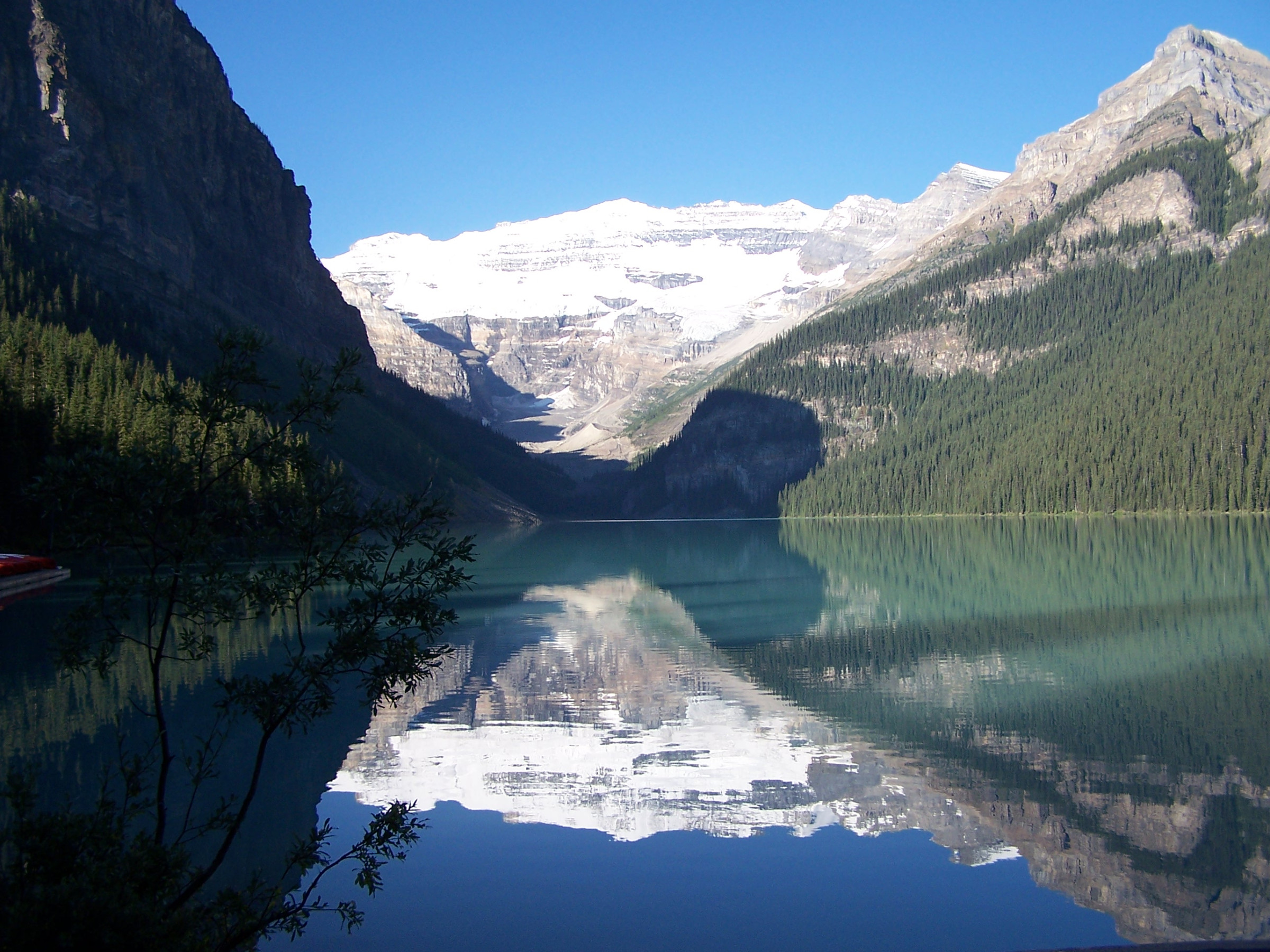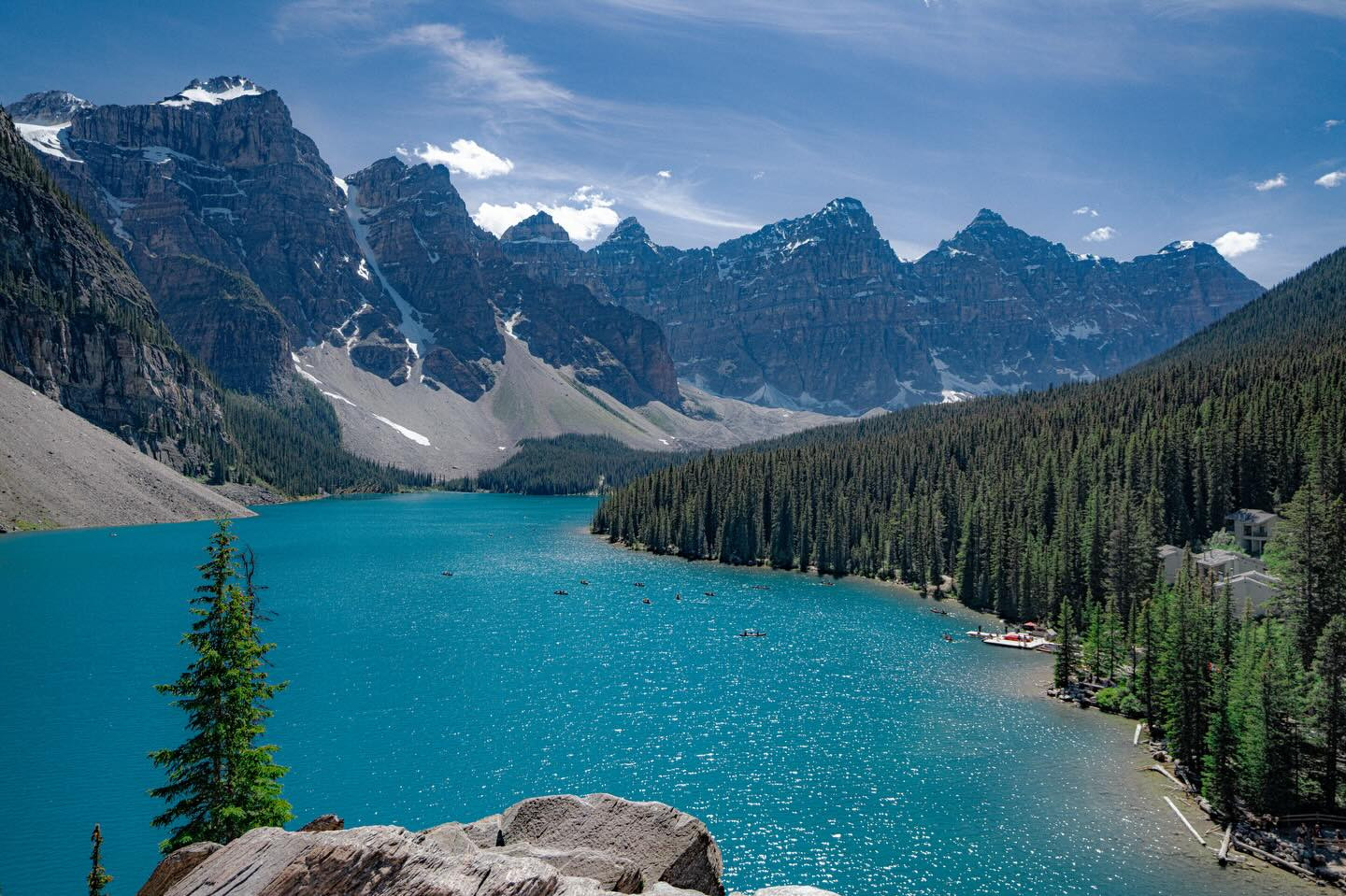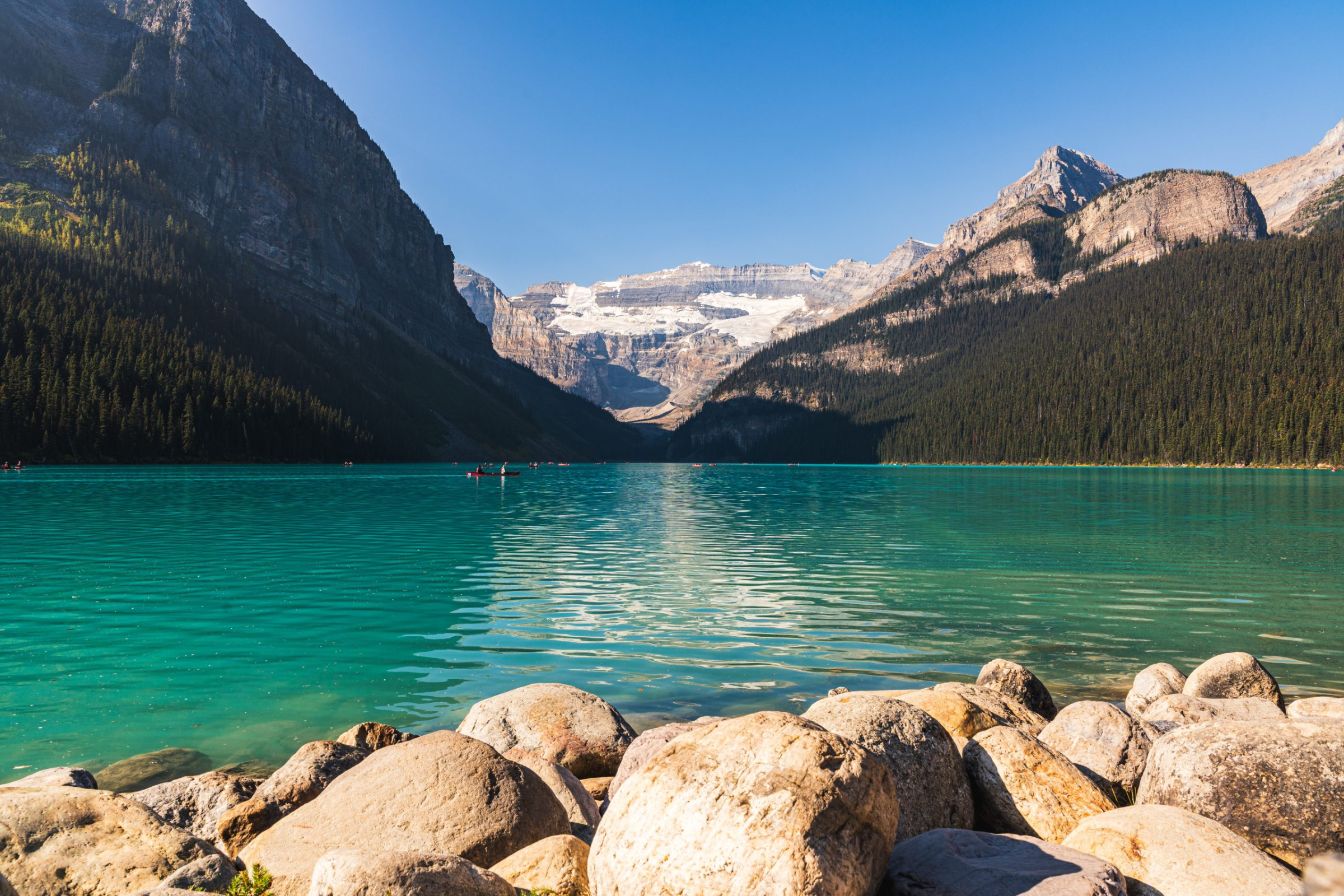
Lake Louise sits within Banff National Park in Alberta, Canada, its small, brilliantly turquoise surface framed by steep, forested mountainsides and a backdrop of glaciated peaks that has made it one of the most photographed lakes in North America. The lake occupies a classic glacial basin, carved out by ice during past glacial periods and now fed by meltwater descending from the surrounding mountains, a formation process shared with countless other alpine lakes across the Rockies but rarely producing a combination of scale, accessibility, and color quite as striking as Lake Louise offers. Sitting at an elevation of roughly 1,750 meters and framed by peaks that rise well over a thousand meters higher still, the lake occupies a setting that places it firmly within Banff's high mountain landscape rather than at the park's lower, forested valley floor, a setting that shapes both its climate and the alpine hiking terrain immediately accessible from its shores.
Lake Louise's distinctive color comes from rock flour, extremely fine particles of pulverized rock ground down by the slow, grinding movement of glaciers over the underlying bedrock and carried into the lake by meltwater streams. Once suspended in the water, these microscopic particles scatter sunlight in a way that shifts the water's apparent color toward the blue-green spectrum, an effect most pronounced during the warmer months when glacial melt is at its peak and the particle concentration in the water is highest, making the lake's most vivid turquoise color a distinctly seasonal phenomenon rather than a constant year-round feature. This same rock-flour mechanism produces similarly colored water at numerous other glacially fed lakes throughout the Canadian Rockies, but Lake Louise's combination of easy road access, dramatic mountain backdrop, and a long-established grand hotel on its shore has made it by far the most visited and internationally recognized example of the phenomenon.
The Fairmont Chateau Lake Louise, a large luxury hotel built on the lake's eastern shore in stages beginning in the early twentieth century, was constructed by the Canadian Pacific Railway as part of a broader strategy of building grand hotels at scenic stops along its transcontinental rail line, a pattern that also produced other landmark Canadian Rockies properties and helped establish the region as an internationally known tourism destination decades before automobile travel made the area broadly accessible. The Chateau's presence directly on the lakeshore has shaped how generations of visitors experience Lake Louise, offering a fixed, elegant vantage point from which the lake's changing seasonal colors and the surrounding peaks can be viewed regardless of the crowds that gather along the more informal public shoreline nearby. This railway-hotel heritage links Lake Louise to a broader chapter of Canadian development history, in which the Canadian Pacific Railway actively marketed the Rockies as a scenic tourist destination to help justify and fund the enormous cost of the transcontinental line itself.
A dense network of hiking trails fans out from Lake Louise's shores into the surrounding mountains, ranging from easy, mostly flat walks along the lake's edge to more demanding climbs toward high alpine terrain. The trail to Lake Agnes, climbing through forest to a smaller, higher alpine lake with a historic teahouse built in 1901 still serving refreshments to hikers, ranks among the most popular routes, while further climbs to the Big Beehive and Little Beehive viewpoints reward hikers with sweeping views back down over Lake Louise itself, the Chateau on its shore reduced to a small structure against the much larger scale of the lake and surrounding peaks. Other routes lead toward Saddleback Pass and up Fairview Mountain, at 2,744 meters, or along the Plain of Six Glaciers trail toward views of hanging glaciers on the flanks of Mount Victoria, giving hikers of varying fitness and ambition a genuine range of options radiating outward from the same easily accessible trailhead beside the lake.
Lake Louise supports a genuinely different set of activities across each season, a versatility unusual among the world's most famous alpine lakes. Summer brings hiking, canoeing, and kayaking on the lake's surface, with rental canoes a popular, if somewhat expensive, way to get out onto the turquoise water directly beneath the surrounding peaks, while winter transforms the frozen lake surface into an outdoor ice skating rink, complete with a seasonally maintained skating trail and, in some years, elaborate ice sculptures displayed near the Chateau. The surrounding area also operates as a significant ski destination in winter, with Lake Louise Ski Resort, on the mountainside opposite the lake, ranking among the largest ski areas in Canada and drawing a considerable share of visitors who come primarily for skiing and snowboarding rather than the summer lake scenery most international visitors associate with the Lake Louise name.
Lake Louise sits a short distance west of the small community of the same name, itself located directly beside the Trans-Canada Highway roughly 180 kilometers west of Calgary, making the lake reachable as a day trip or overnight stop for travelers driving through Banff National Park along one of Canada's main east-west highway corridors. Calgary International Airport serves as the primary air gateway for international and domestic visitors, with rental cars, shuttle buses, and organized tours all commonly used to cover the roughly two-hour drive from the airport into the park and on to the lake itself. Parking at the lake fills quickly during peak summer season, and Parks Canada has increasingly promoted shuttle bus service from designated parking areas outside the immediate lake vicinity as a way to manage the substantial visitor volume the site now receives, particularly during the peak weeks of summer when the turquoise color and warm weather combine to draw the largest crowds of the year.
The lake's most famous turquoise color is most vivid from roughly June through September, when glacial melt is highest and the surrounding trails are free of snow, making this the peak season for both hiking and the classic postcard views of the lake that dominate its international reputation. Late spring and early autumn offer a quieter alternative with a somewhat less intense but still attractive water color, along with noticeably thinner crowds than the height of summer, while winter presents an entirely different character, the lake frozen solid and often snow-covered, drawing skaters, cross-country skiers, and downhill skiers to an experience built around ice and snow rather than the turquoise water most visitors picture when they imagine Lake Louise.
Lake Louise's popularity has made it a focal point for Parks Canada's broader efforts to balance mass tourism against the ecological integrity of a national park that is also home to grizzly bears, wolverines, and other wide-ranging wildlife sensitive to human disturbance. Wildlife corridors around the lake and surrounding valley are actively managed to allow animal movement despite the heavy visitor traffic concentrated at the lakeshore itself, and seasonal trail closures are sometimes implemented when bear activity is reported nearby, a reminder that despite its manicured lakeshore and grand hotel, Lake Louise remains embedded within a genuinely wild mountain ecosystem rather than existing as an isolated scenic attraction. This tension between accessibility and wilderness protection runs through much of Banff National Park's management more broadly, and Lake Louise, as the park's single most visited natural feature, sits at the center of that ongoing balancing act.
No reviews yet. Be the first to share your experience!
Share your experience and help other travelers