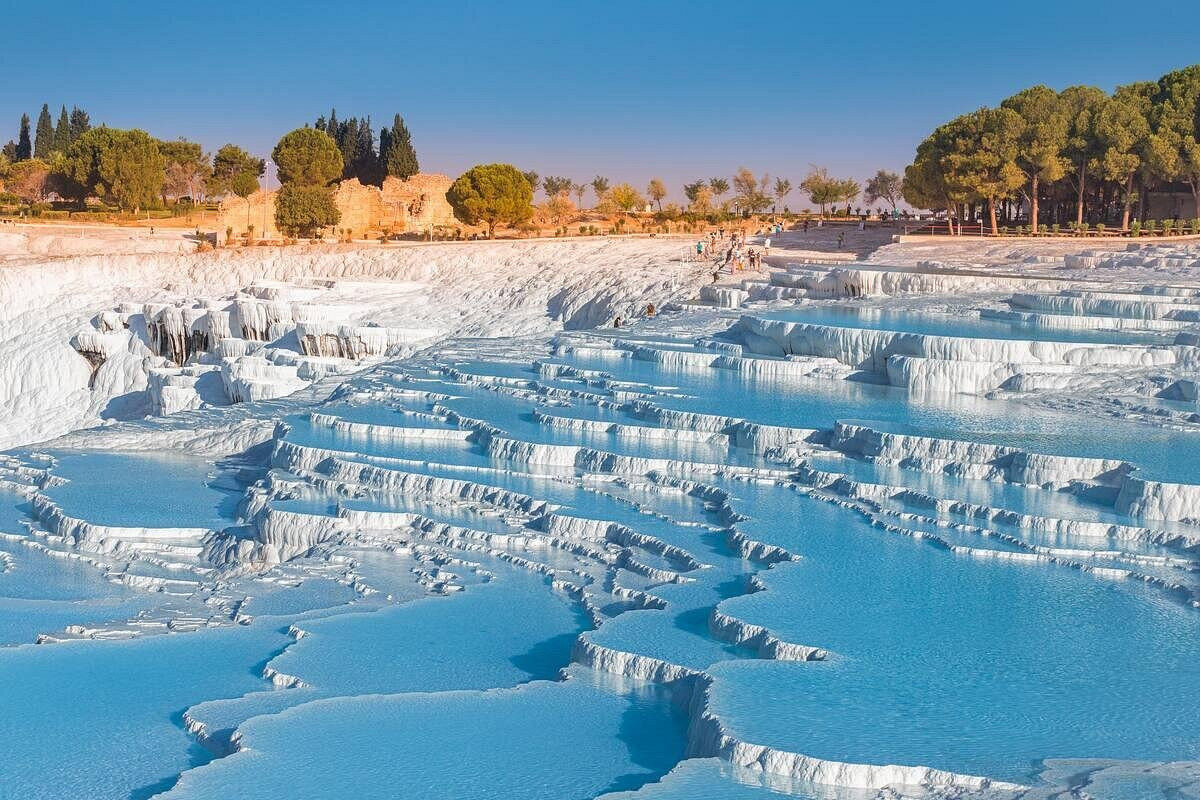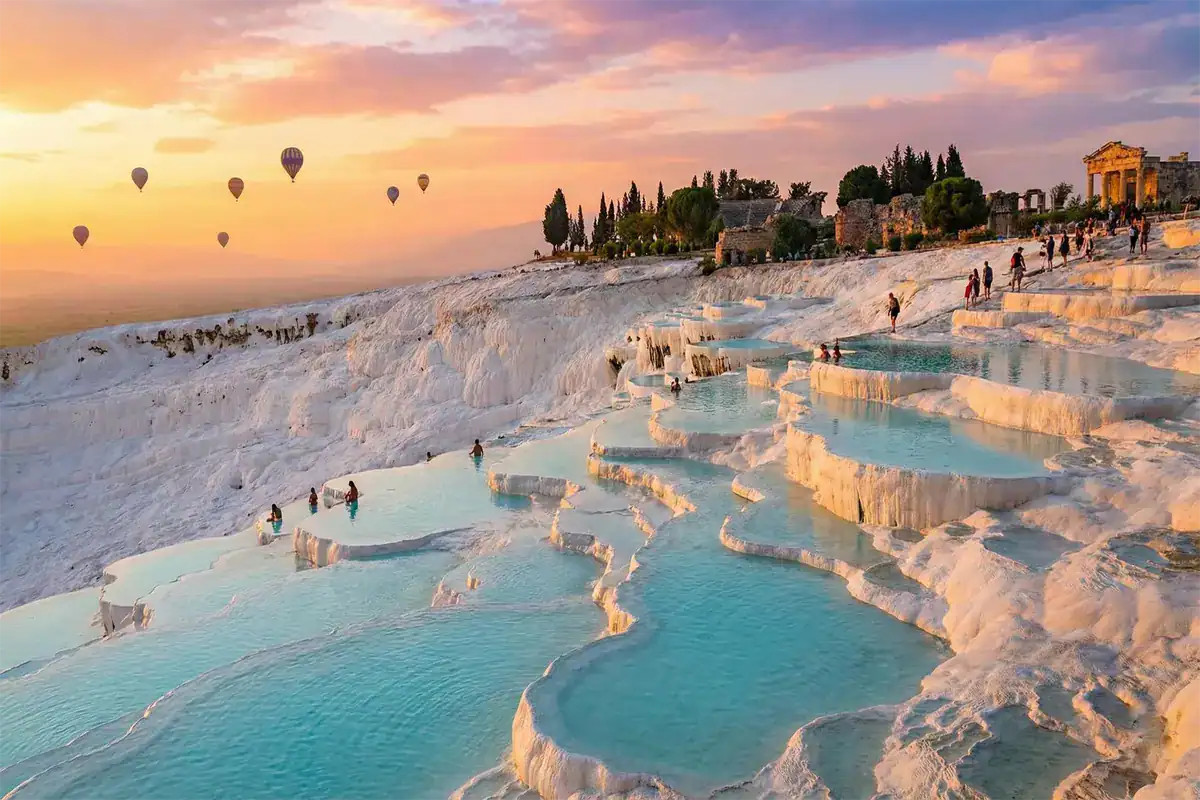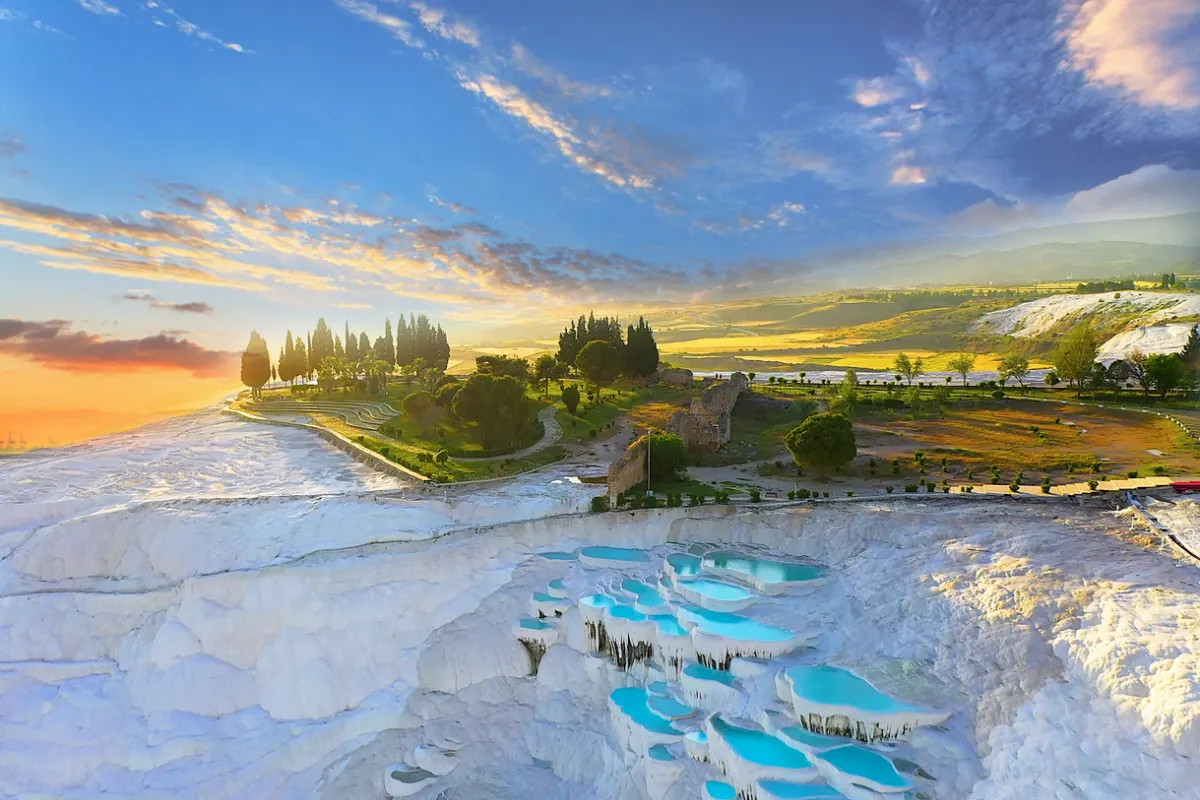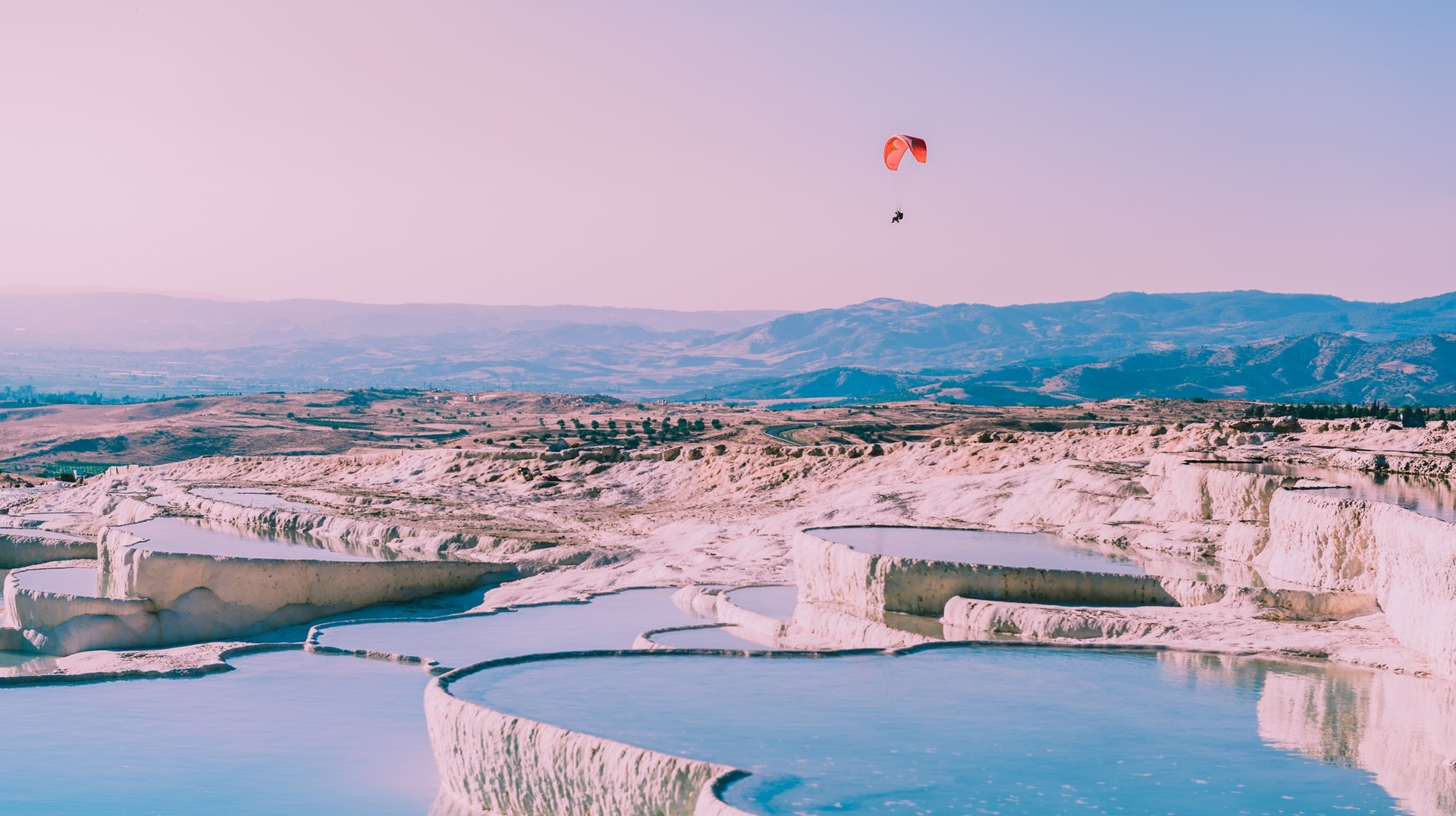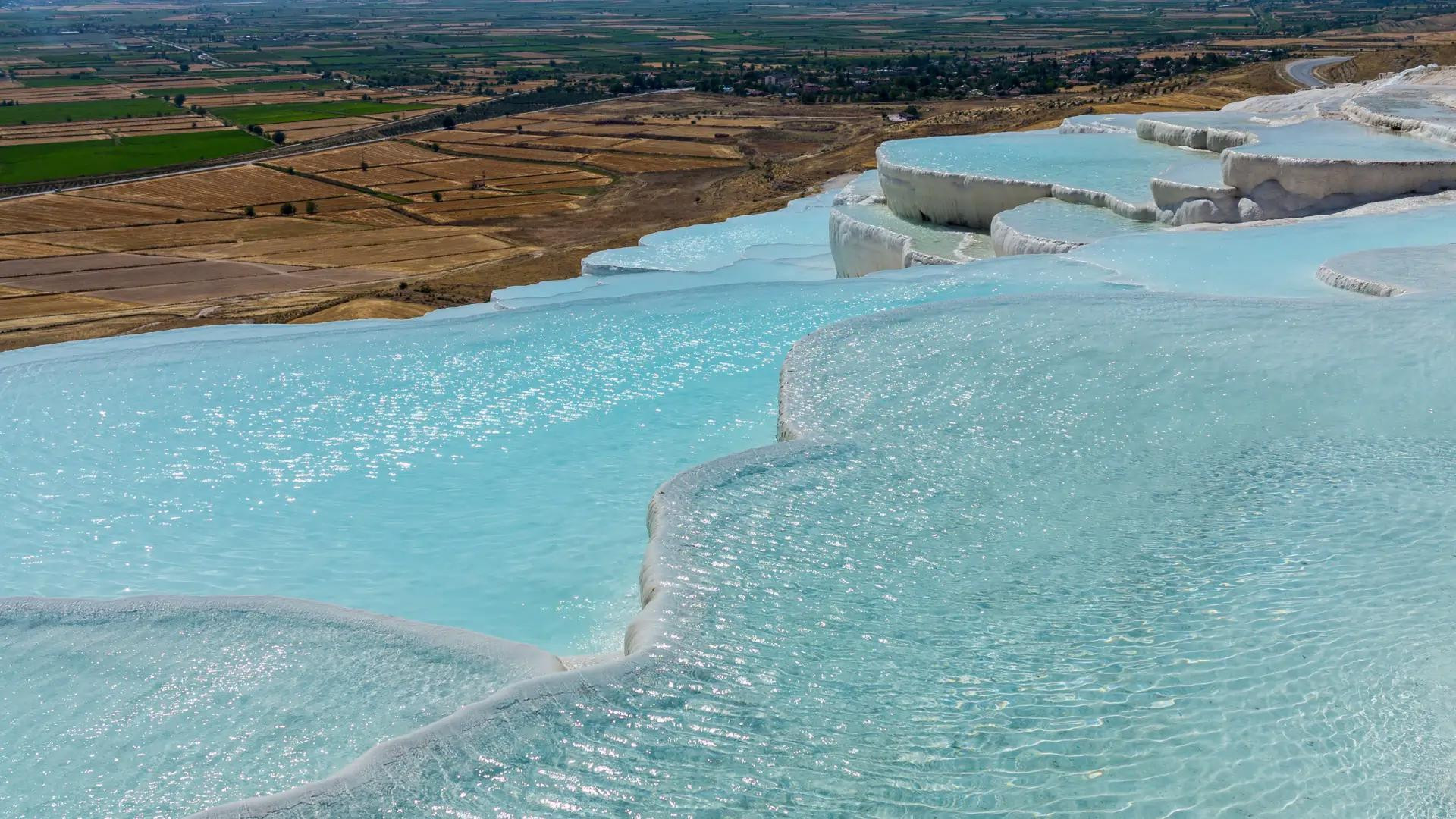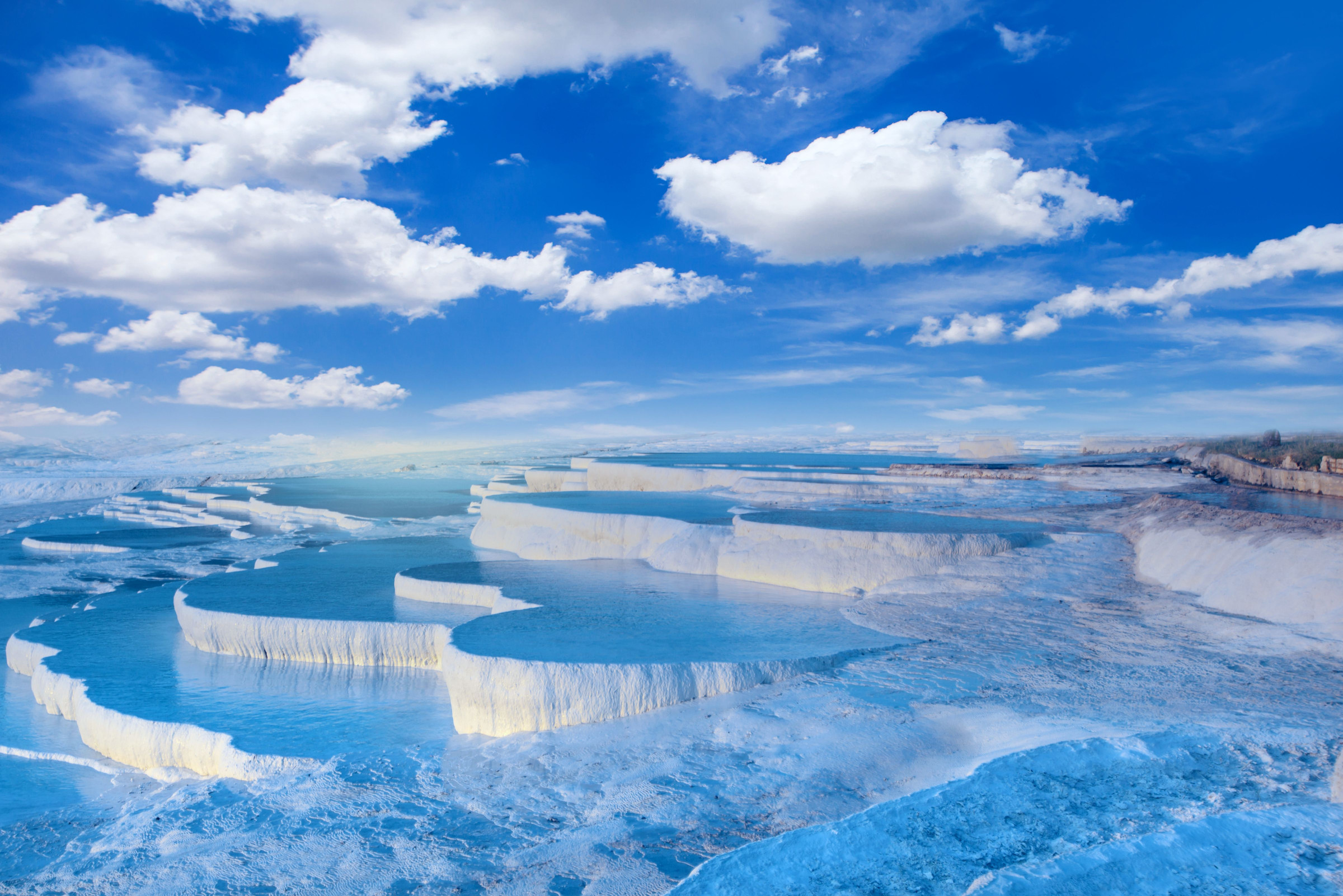
Pamukkale, meaning "cotton castle" in Turkish, is a hillside in southwestern Turkey covered in brilliant white travertine terraces, cascading pools formed by calcium-rich mineral water flowing down the slope for thousands of years. From a distance, the terraces genuinely resemble a frozen waterfall or snowfield rather than mineral deposit, an illusion that has drawn visitors to this stretch of the Menderes River valley since antiquity, long before "tourism" existed as a modern concept.
The formations sit above the ancient Greco-Roman city of Hierapolis, whose ruins spread directly across the plateau overlooking the terraces, meaning a visit here combines a genuinely rare natural phenomenon with substantial classical archaeology within the same short walk, a pairing few sites elsewhere in the world can offer this seamlessly.
Pamukkale's terraces form as geothermal spring water, rich in dissolved calcium carbonate, emerges from underground and flows down the hillside, cooling and losing carbon dioxide as it travels, a process that causes the dissolved mineral to precipitate out and harden into travertine rock along the water's path. Over thousands of years, this slow mineral buildup has created the layered, basin-like terrace formations visible today, with each shallow pool holding a few centimeters of mineral-rich water pooling atop increasingly solid white rock beneath.
The water itself emerges at a naturally warm temperature, historically valued for its perceived therapeutic properties, and the entire hillside continues actively forming today, meaning the terraces are not a static ancient relic but an ongoing geological process still shaping the landscape in real time, just very slowly by human standards.
Hierapolis was founded in the 2nd century BC and flourished under Roman rule specifically because of Pamukkale's thermal springs, developing into a significant spa and pilgrimage destination where wealthy Romans traveled for the springs' believed healing properties. The city's ruins today include an extensive necropolis, one of the largest and best-preserved ancient cemeteries in Anatolia, a well-preserved theater, and the remains of the Roman-era baths built directly around the thermal pools.
Early Christian history is also woven into the site: tradition holds that the Apostle Philip was martyred in Hierapolis in the 1st century AD, and archaeologists identified what is believed to be his tomb, the Martyrium of St. Philip, on a hillside overlooking the city in the 2000s, adding a significant pilgrimage dimension to the site beyond its Roman-era history.
Pamukkale nearly lost its defining feature to unchecked development in the mid-20th century, when hotels were built directly atop parts of the terraces and motor vehicles were permitted to drive across them, causing significant damage and discoloration to the fragile mineral formations. Recognition of this damage, alongside UNESCO's 1988 World Heritage inscription of the combined Pamukkale-Hierapolis site, prompted Turkish authorities to demolish the offending hotels, restrict vehicle access entirely, and implement a rotating pool closure system allowing sections of the terraces to recover mineral whiteness over time.
Visitors today can only walk barefoot along designated terrace paths specifically to minimize further erosion and discoloration, a restriction that, while sometimes surprising to first-time visitors expecting open access, has been essential to the site's ongoing preservation and recovery since those restoration efforts began.
Alongside the terraces themselves, Pamukkale offers Cleopatra's Pool, an artificial swimming pool built directly around a natural warm spring and scattered with fallen ancient marble columns, some genuinely dating to Hierapolis's Roman period, that now lie submerged beneath the water. Local tradition, though not firmly documented historically, holds that Cleopatra herself bathed here as a gift from Mark Antony, a claim that has become central to the pool's marketing regardless of its historical accuracy.
Swimming among ancient columns in naturally warm mineral water remains one of the most distinctive single experiences available at Pamukkale, and access requires a separate ticket from the general terrace and ruins entry.
Pamukkale's white terraces shift dramatically in appearance depending on time of day and season, glowing warm gold at sunrise and sunset against the surrounding valley, and appearing starkly, almost blindingly white under full midday sun, a contrast that draws photographers back at different hours to capture entirely different moods from the same formations. Winter occasionally brings a different variation still, when cooler temperatures and reduced visitor flow allow terrace pools to appear even more pristine than during peak summer tourist season.
Hot air balloon flights over the wider Pamukkale-Hierapolis valley have also become increasingly popular in recent years, offering an aerial perspective on the terraces' scale that is difficult to appreciate fully from ground level alone.
Pamukkale sits near the town of Denizli in southwestern Turkey, reachable by a roughly 3.5 to 4-hour drive from either the Aegean coast or inland Anatolian cities, and is often combined with visits to nearby ancient sites like Aphrodisias. A single combined ticket typically covers both the travertine terraces and the Hierapolis ruins, with Cleopatra's Pool requiring separate admission.
Because the terraces can become crowded, and uncomfortably hot underfoot, during peak midday summer hours, many visitors aim for early morning or late afternoon visits both for cooler conditions and softer light for photography.
Few sites combine an ongoing natural mineral-formation process with substantial ancient ruins as directly as Pamukkale does, the white terraces and the Roman spa city above them exist because of the exact same thermal springs, inseparable from each other both geologically and historically. That dual identity, natural wonder and archaeological site occupying literally the same hillside, is what continues to draw visitors well beyond Turkey's more famous coastal and Istanbul-centered attractions.
Beyond the historic hotel demolitions, Pamukkale's terraces have also faced a subtler modern threat: regional groundwater extraction for agriculture and nearby development reduced natural spring flow enough at points that authorities had to intervene with regulated water allocation specifically to keep the terraces adequately supplied. Some sections of the terrace system remain periodically dry as a direct result of this ongoing water-management balancing act between agricultural needs, local water supply, and the site's own preservation requirements.
Turkish heritage authorities now rotate which terrace sections receive water flow at any given time, a managed approach intended to let overused areas regain their white mineral coating while keeping enough of the site continuously active and visually striking for visitors year-round.
No reviews yet. Be the first to share your experience!
Share your experience and help other travelers