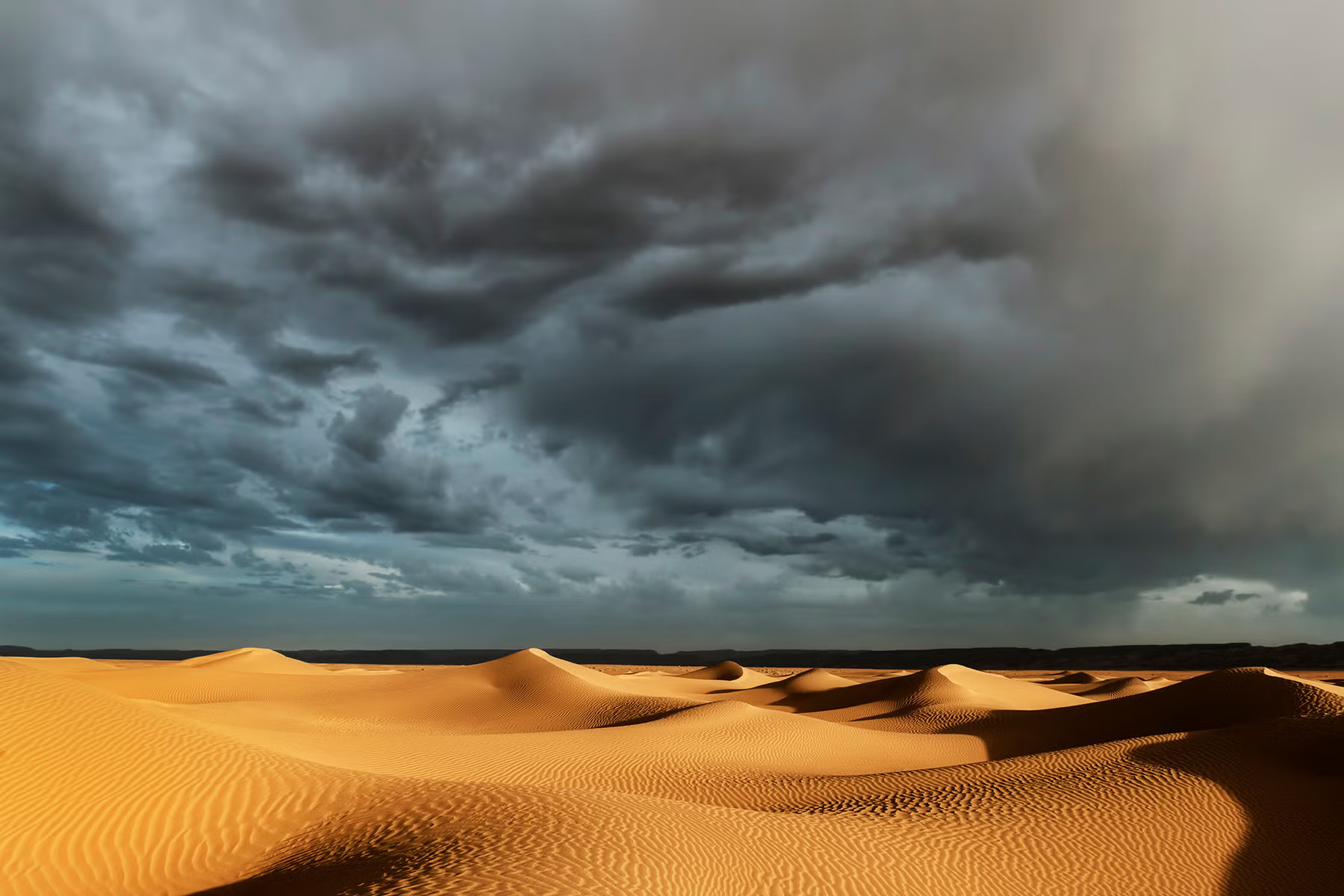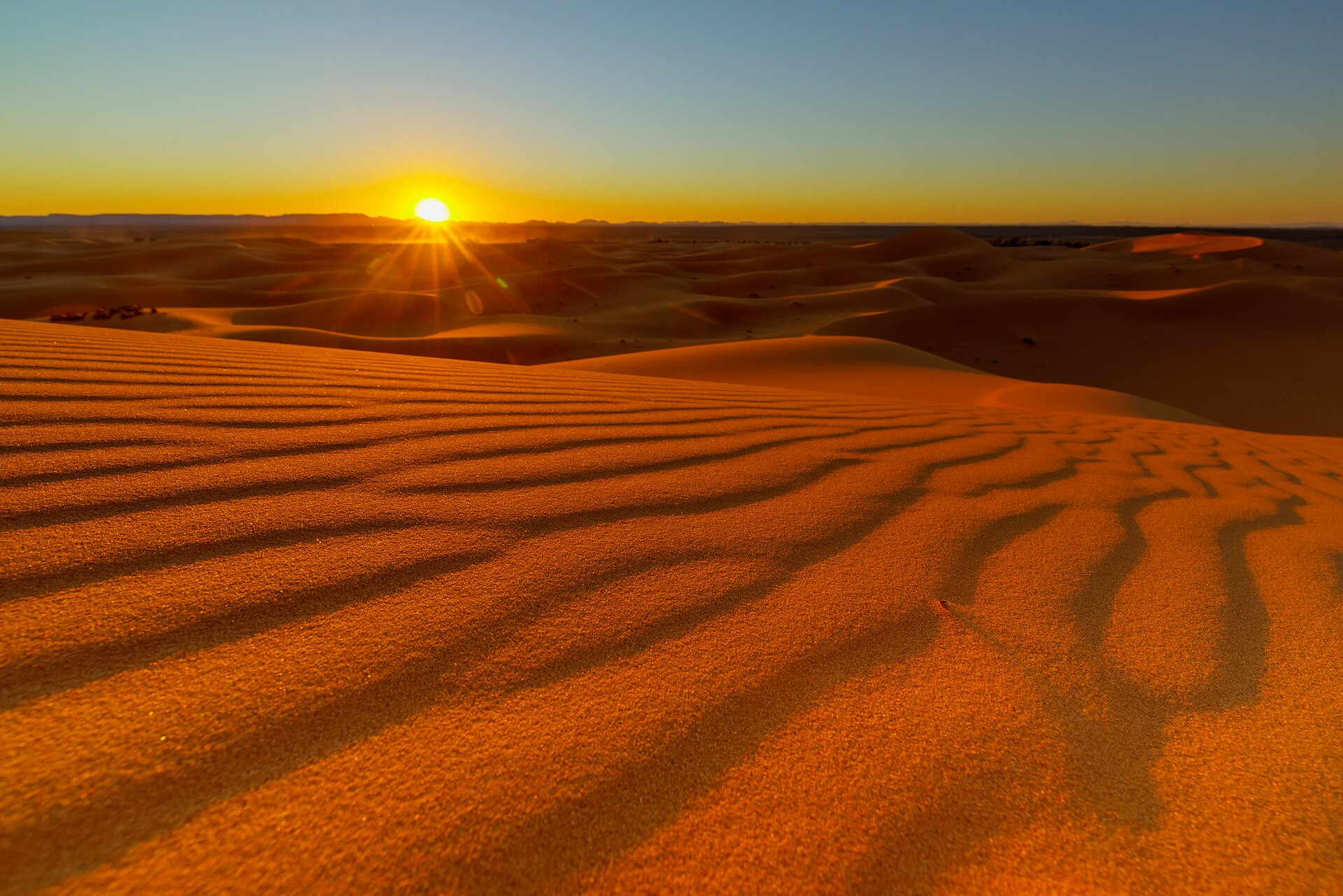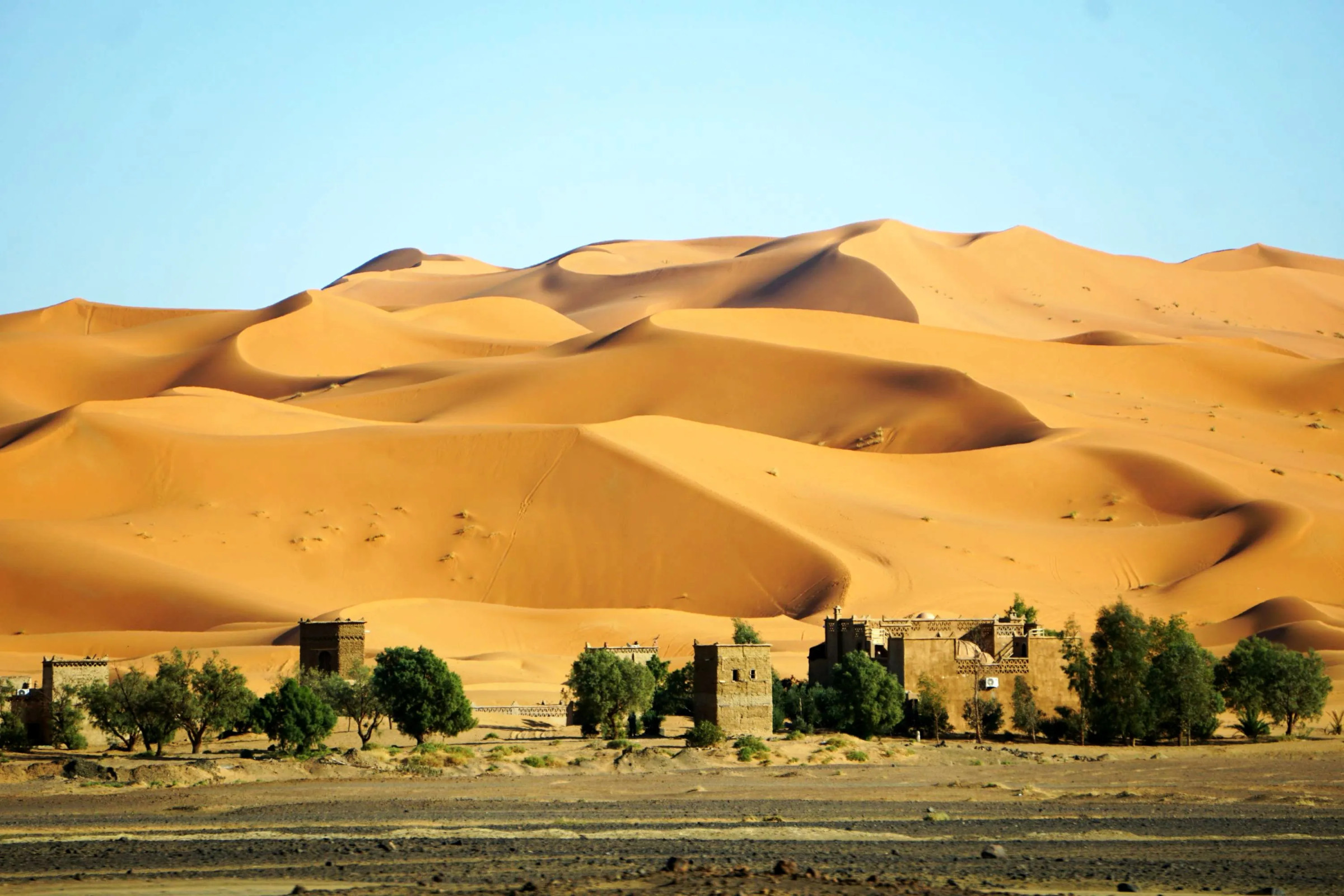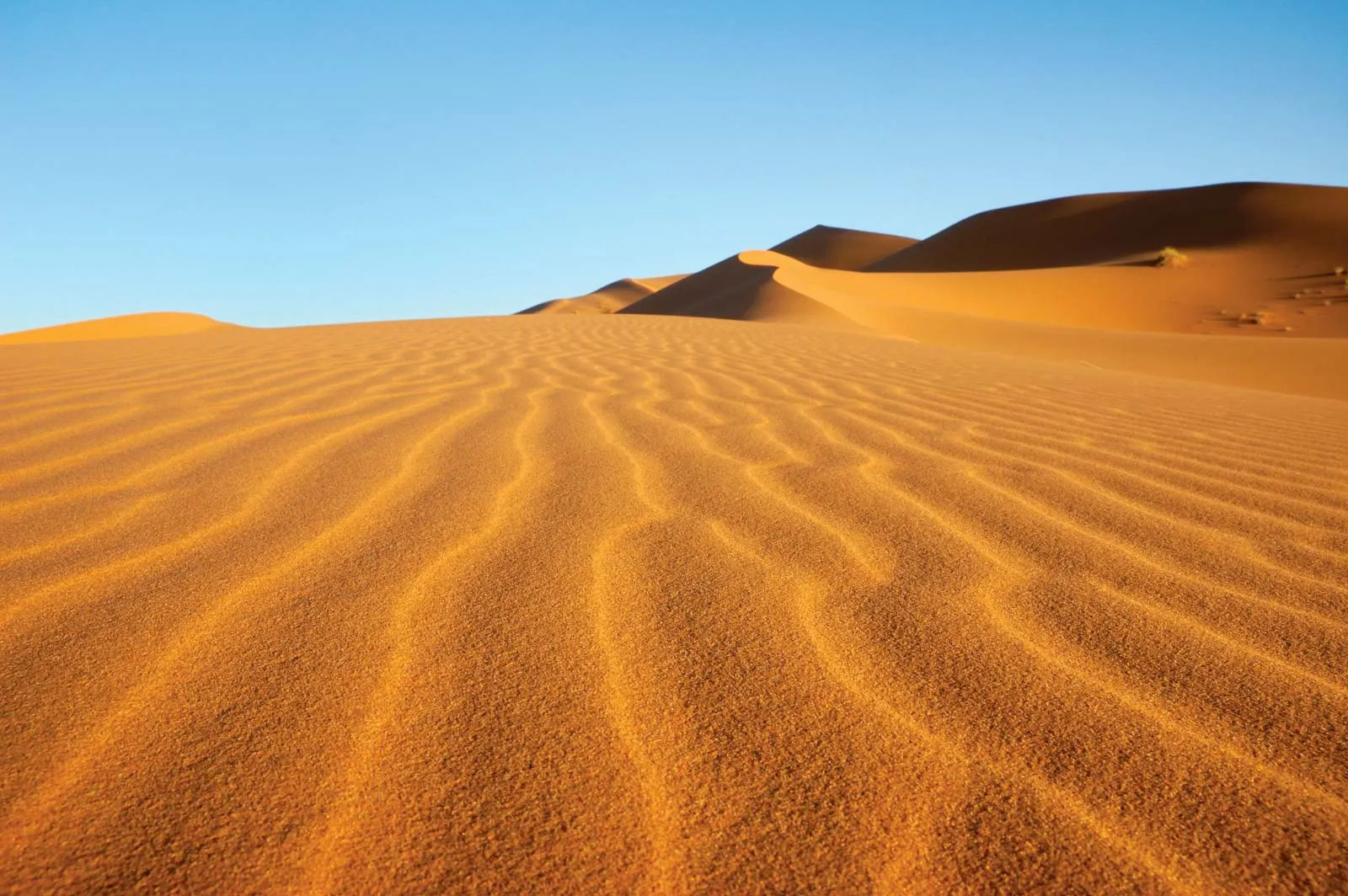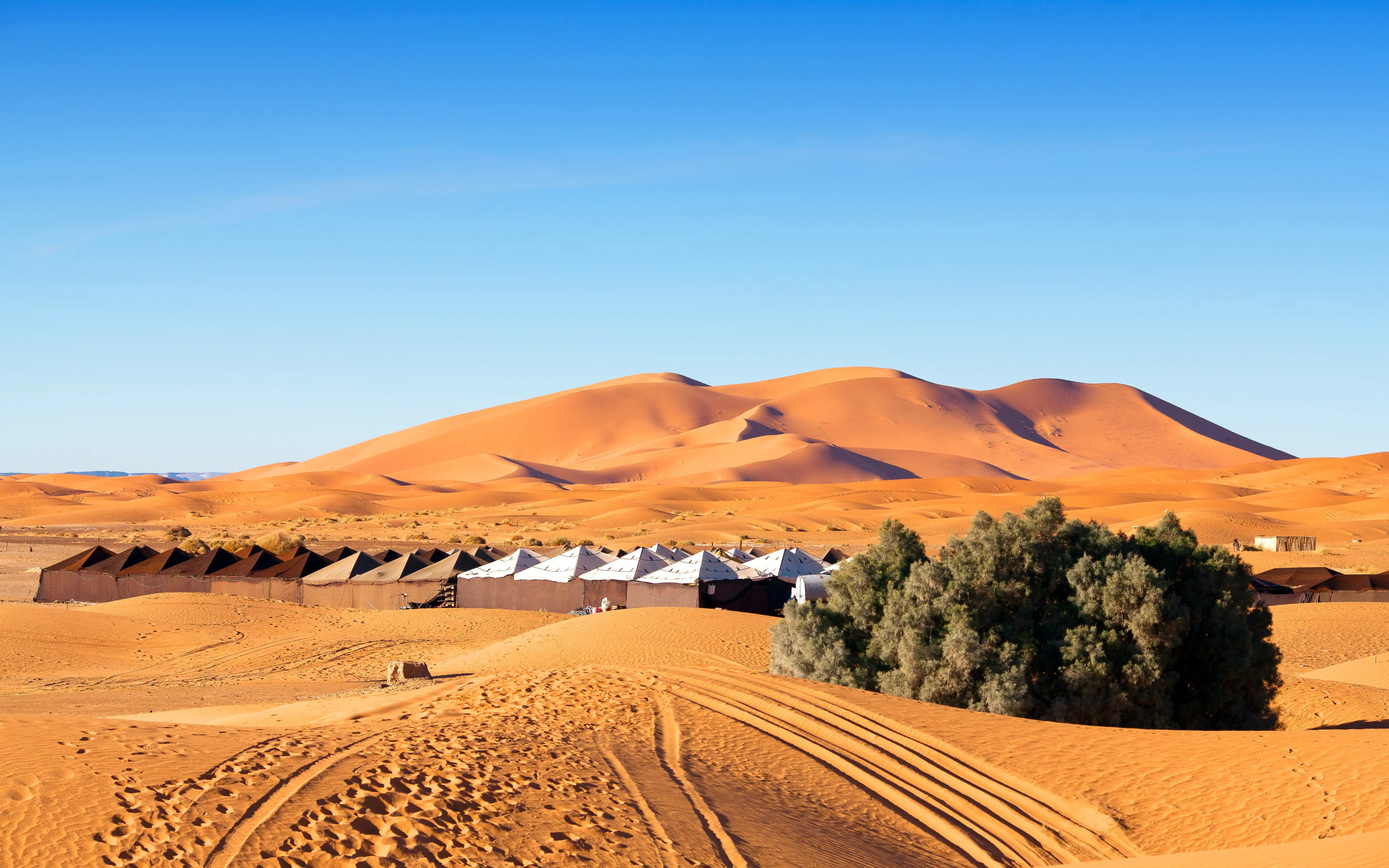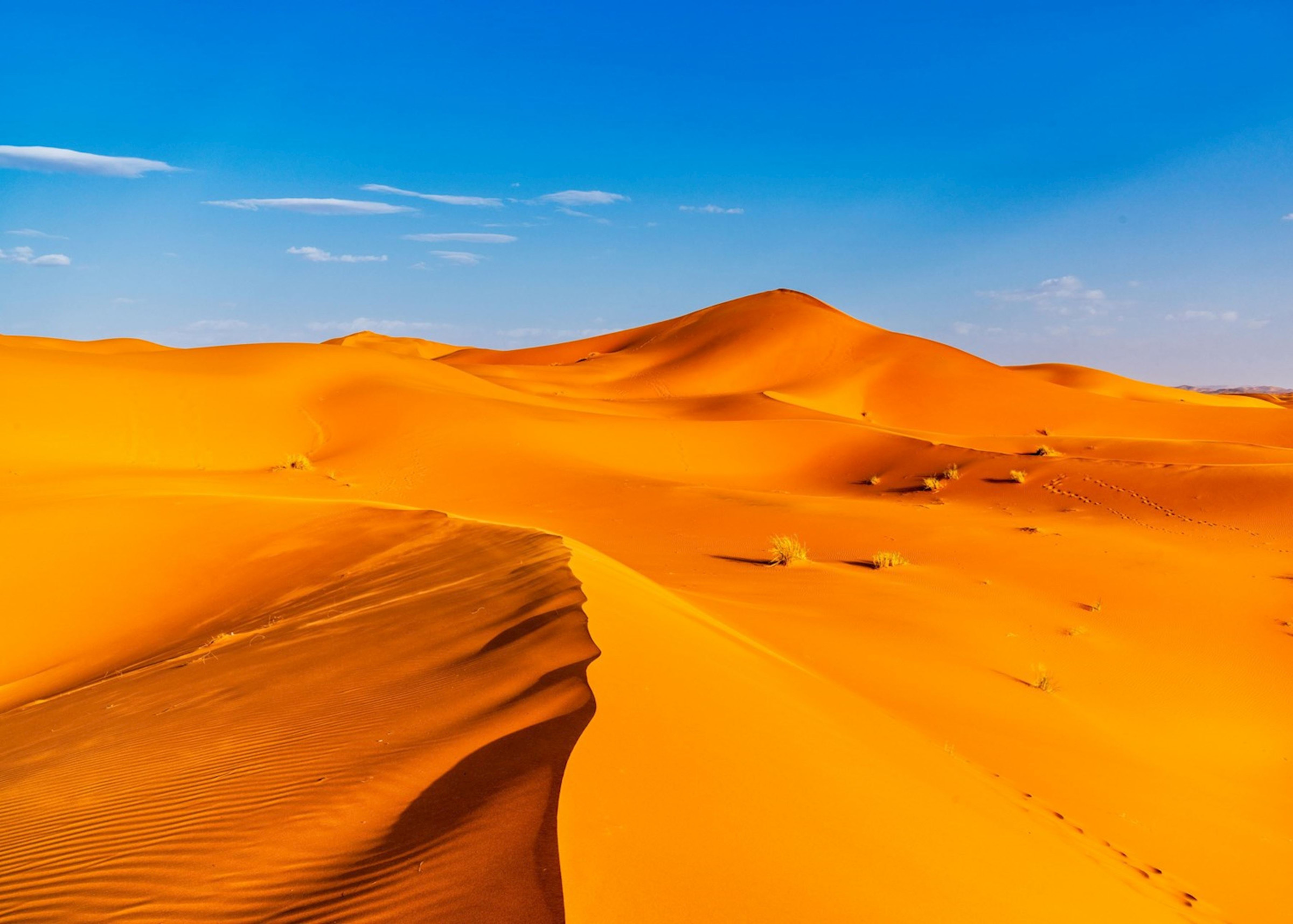
The Sahara is the largest hot desert on Earth, stretching across more than nine million square kilometers of North Africa, but for most travelers the desert has one unmistakable face: Erg Chebbi, a field of towering orange dunes rising abruptly from the flat, stony hammada near the Algerian border in southeastern Morocco. Where the rest of the Sahara often reads as endless gravel plain, Erg Chebbi delivers the postcard image people actually picture when they hear the word "desert" - dunes reaching over 150 meters, shifting constantly with the wind, glowing deep orange at sunrise and sunset.
Geologically, Erg Chebbi is young by desert standards, its sand accumulated over the last several thousand years by wind patterns funneling grains against the low Jebel Ougnat mountains to its east. The erg itself is relatively small, roughly 22 kilometers long and 5 to 10 kilometers wide, which is part of why it has become the most visited dune field in Morocco - compact enough to explore fully in a night or two, dramatic enough to feel like the whole Sahara distilled into one place.
Dunes like Erg Chebbi form through a patient, ongoing process: wind lifts loose sand from dried lakebeds and rock erosion elsewhere in the desert, carrying it until an obstacle, in this case the surrounding hills, slows the airflow and lets grains settle. Over centuries, that settled sand piles higher, and the dune's shape constantly reorganizes itself as wind direction shifts through the seasons, sometimes revealing older, compacted layers beneath softer surface sand.
The dunes are not static sculptures. A single strong wind event can visibly redraw a ridge overnight, and the crest lines that photographers chase at dawn may look completely different a week later. This restlessness is part of what makes Erg Chebbi feel alive rather than simply scenic, and it is also why local guides, not GPS, remain the most reliable way to navigate after dark.
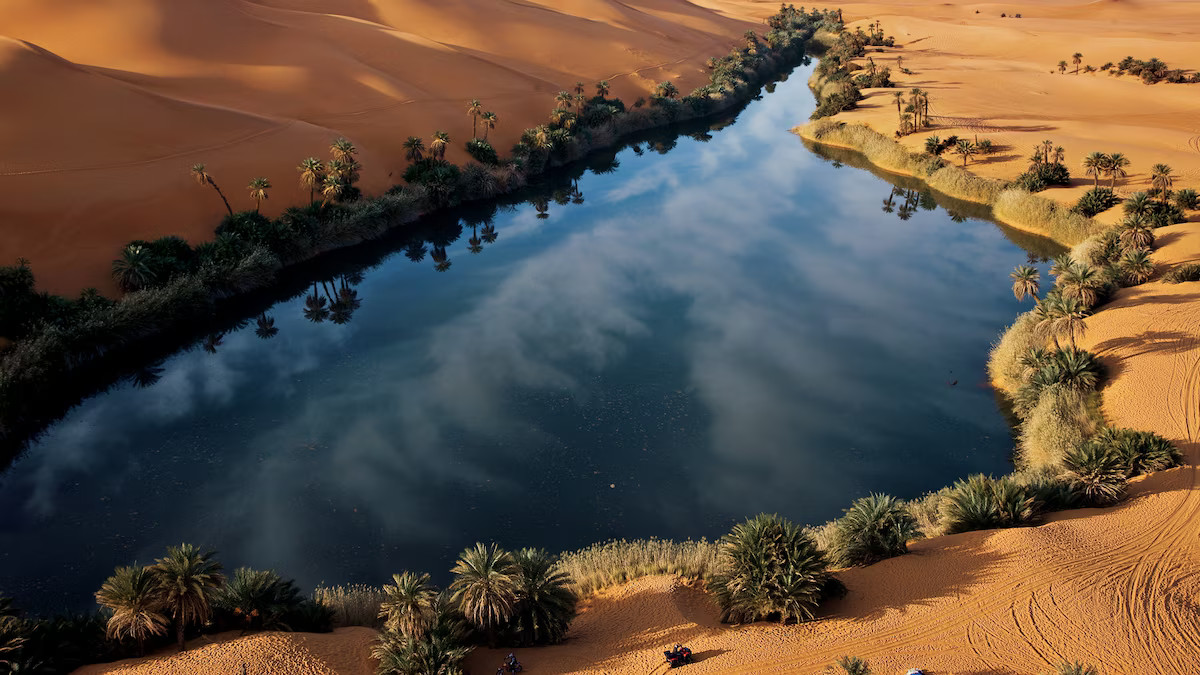
The oasis towns ringing Erg Chebbi, particularly Merzouga, exist because of a fragile network of underground water channels called khettaras, engineered centuries ago to carry groundwater from the mountains to date palm groves without losing it to evaporation. These oases supported trans-Saharan trade caravans moving gold, salt, and goods between West Africa and the Mediterranean coast for centuries before modern borders existed.
Amazigh (Berber) communities have lived at the desert's edge far longer than that trade history, developing herding and farming practices suited to extreme heat and water scarcity. Many of the guides and camel handlers working in Merzouga today come from these same families, and desert camps increasingly incorporate Amazigh music, particularly the hypnotic Gnawa and Berber drum traditions, into overnight stays.
Little in Erg Chebbi's landscape is neutral - local folklore attributes the dunes themselves to divine punishment, with one popular tale describing them as sand piled up to bury an inhospitable village that turned away a tired traveler. Whether or not visitors hear the legend from their guide, the emotional logic tracks: the desert here feels less like empty space and more like a landscape with a memory.
After dark, Erg Chebbi becomes one of the most effective stargazing locations in North Africa. With almost no light pollution for dozens of kilometers, the Milky Way is visible to the naked eye on clear nights, and many camps now build their evening programming, mint tea, drumming, storytelling, entirely around the transition from sunset color to star-filled sky.
Organized camel trekking into Erg Chebbi began modestly in the late 20th century and expanded rapidly once word spread among backpackers and, later, Instagram travelers that this compact stretch of Sahara delivered dune scenery without the logistics of Algeria's or Libya's far larger, harder to reach ergs. Merzouga transformed from a scattering of desert homes into a small tourism hub built almost entirely around one- and two-night camel or 4x4 excursions into the dunes.
Camps today range from simple shared Berber tents to increasingly elaborate "luxury desert camp" setups with private bathrooms and proper beds, but the core experience has changed little: a sunset camel ride to camp, dinner under stars, and an early wake-up to catch sunrise from a high dune before the heat sets in.
Despite its barren appearance, Erg Chebbi supports more life than it first suggests. Fennec foxes, desert monitor lizards, and a range of beetles and scorpions have adapted to the extreme temperature swings, active mostly at dawn, dusk, and night to avoid peak heat. Desert guides can often read fresh tracks in the sand to point out overnight animal activity that would otherwise go completely unnoticed by visitors.
Reading the dunes themselves is its own skill. Local guides judge wind direction, recent dune movement, and the position of the sun to navigate without landmarks, a form of expertise built over generations rather than something easily replicated with modern instruments alone in the featureless open sand.
Most visits begin in Merzouga or the smaller village of Hassilabied, both a long but manageable drive from Marrakech or Fes, often broken into a multi-day journey through the Atlas Mountains and Dades or Todra Gorges. From there, a camel or 4x4 transfer carries travelers into the dunes for an overnight camp, the single most popular way to experience Erg Chebbi properly rather than just viewing it from the roadside.
Sandboarding, quad biking, and sunrise dune hikes have all become standard add-ons, and a growing number of visitors combine the desert leg with a broader southern Morocco loop through Kasbahs, palm oases, and the pre-Sahara towns that have depended on this landscape for a thousand years.
Erg Chebbi sits close enough to the Algerian frontier that its trade history is tangled up with wider regional politics; salt caravans that once passed near here connected Saharan mining towns to markets as far south as Timbuktu, moving slabs of salt worth their weight in gold in some eras. That deep trans-Saharan trading network declined with the rise of coastal shipping routes and, later, colonial-era border enforcement, leaving Merzouga's economy dependent almost entirely on tourism by the late 20th century.
Climate change has added new pressure to this fragile balance. Increasingly erratic rainfall in the surrounding Atlas foothills has strained the khettara water channels that oasis agriculture depends on, and several nearby palm groves have shrunk noticeably over the past few decades - a reminder that even a landscape defined by extreme aridity is not immune to further drying.
Erg Chebbi succeeds as a destination because it compresses an entire idea, the vast, mythic Sahara, into a landscape that can genuinely be reached, walked, and slept in over a single trip. It rewards patience: the same dune that looks unremarkable at midday becomes sculptural at golden hour and otherworldly under a full sky of stars a few hours later.
For a desert this small relative to the Sahara as a whole, Erg Chebbi carries an outsized cultural and visual weight, anchoring Morocco's reputation as a country where mountains, coastline, and true desert all sit within a few days' drive of each other. Few places on the continent let a traveler go from snow-capped Atlas peaks to rippling dune crests in the span of a single week, and that contrast alone explains why Erg Chebbi keeps drawing visitors back, camel by camel, season after season.
No reviews yet. Be the first to share your experience!
Share your experience and help other travelers