
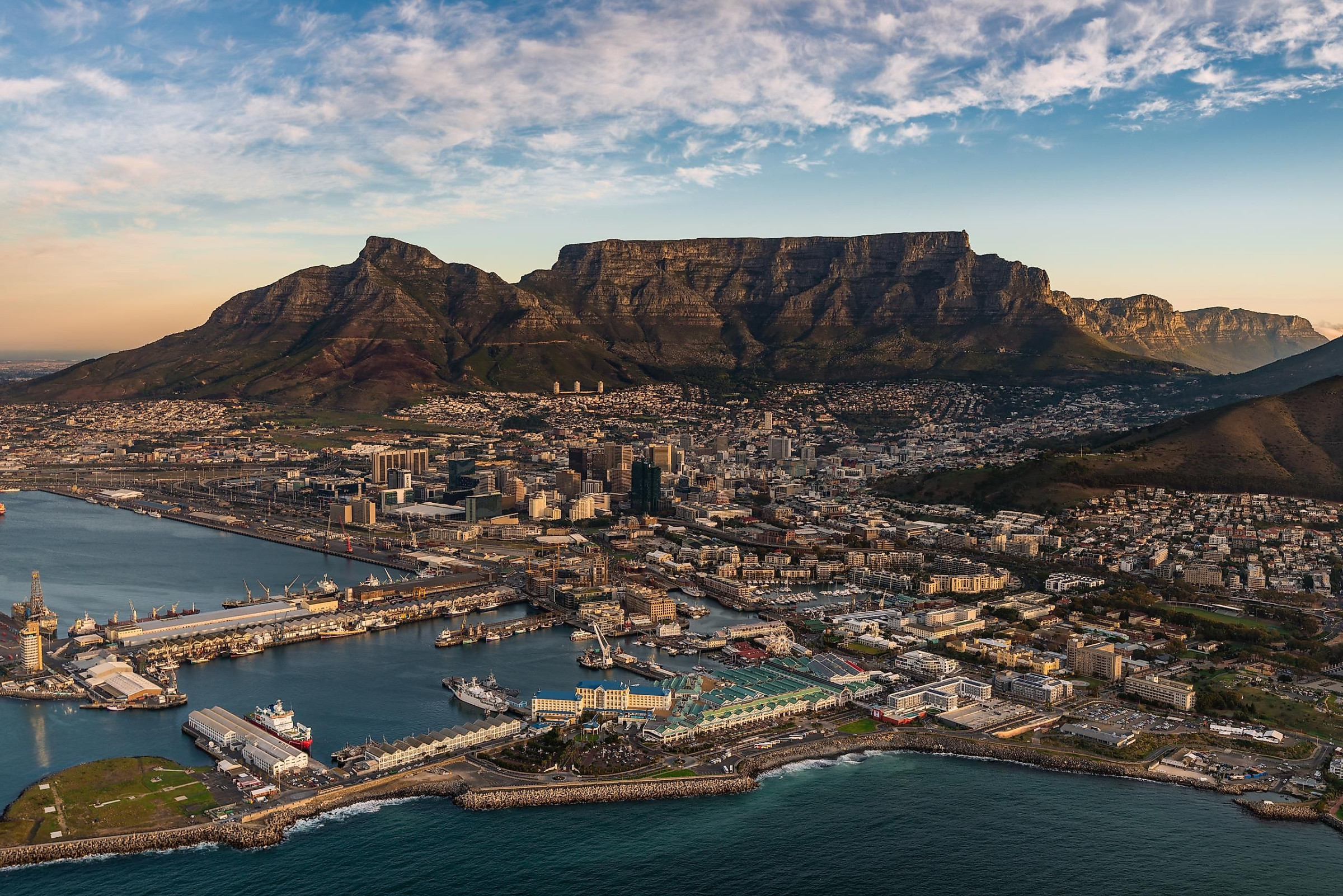
Table Mountain rises directly behind Cape Town, a flat-topped massif of sandstone that has served as a landmark for sailors and a backdrop for the city for centuries. Its summit plateau stretches roughly three kilometers from end to end, bounded on either side by the peaks known as Devil's Peak and Lion's Head, together forming the amphitheater of mountains that frames the city bowl. The highest point on the plateau, Maclear's Beacon, reaches 1,086 meters above sea level, named after the astronomer Thomas Maclear who used the summit for survey work in the nineteenth century. Unlike the jagged peaks typical of much younger mountain ranges, Table Mountain's silhouette is famously flat, a shape that has made it one of the most immediately recognizable natural landmarks in the world and a defining image of Cape Town long before the city itself existed in its modern form.
The flatness of Table Mountain is not an accident of erosion but a direct result of its geology. The summit is capped by a resistant layer of sandstone roughly 260 million years old, laid down as sediment and later uplifted, which has worn away far more slowly than the softer rock beneath and around it. Over vast stretches of geological time, erosion stripped away the surrounding land while the hard sandstone cap protected the plateau beneath it, leaving the mountain standing as a broad, level remnant of a much larger ancient landscape. This same sandstone appears across the wider Cape Fold Belt, giving many of the mountains in the region a similarly stratified, layered appearance. Geologists consider Table Mountain one of the oldest mountains in the world in terms of the age of its exposed rock, and its formation predates the breakup of the supercontinent Gondwana, a fact that adds a striking sense of deep time to what is, for most visitors, primarily a scenic backdrop and hiking destination.
One of the mountain's best-known phenomena is the so-called tablecloth, a thick layer of cloud that spills over the flat summit and cascades partway down the cliffs while leaving the base clear, an effect caused by moist south-easterly wind rising and condensing as it crosses the plateau. Capetonians treat the tablecloth as an informal weather signal, and it is common on windy summer days for the summit to be completely obscured in cloud even while the city below sits under clear skies. The phenomenon has entered local folklore in the story of a legendary smoking contest between the pirate Van Hunks and the devil, whose combined pipe smoke is said to have formed the mountain's cloud cover ever since. For visitors, the tablecloth is a practical consideration as much as a curiosity, since the cableway to the summit closes during high wind and heavy cloud, meaning trips to the top should ideally be planned with a flexible day or two in reserve.
The Table Mountain Aerial Cableway has carried visitors to the summit since 1929, making it one of the longer-running tourist cable cars in the world, though the original cars have been replaced multiple times as technology improved. Since 1997 the cableway has used Rotair cars, which rotate slowly during the ascent so that every passenger gets a full 360-degree view of the city, the coastline, and Robben Island during the roughly five-minute ride. The cableway's lower station sits at the base of the mountain and is reachable by road or the hop-on hop-off bus routes that serve most of Cape Town's attractions, while the upper station opens directly onto the plateau's network of short walking trails, viewpoints, and a restaurant. Because the service depends on weather, especially wind speed, it can close with little notice even on days that look clear from the city below, and checking the cableway's live operating status before setting out is standard advice for anyone planning a summit visit.
For visitors who prefer to walk rather than ride, several marked trails climb from the base of the mountain to the plateau, the most direct and popular being Platteklip Gorge, a steep but straightforward route that takes most hikers roughly two to three hours to ascend. The trail follows a deep cleft in the mountain's face that was also the route used by the first recorded European ascent of the mountain in 1503. More technical and scenic routes, such as India Venster, involve sections of scrambling and chain-assisted climbing and are recommended only for hikers with some experience and a head for exposure. Whichever route is chosen, hikers commonly descend by cableway rather than retracing their steps on foot, and rangers strongly advise starting early in the day, carrying sufficient water, and checking weather conditions, since temperatures and wind on the exposed plateau can differ sharply from conditions at the base.
Table Mountain sits within the Cape Floral Region, a UNESCO World Heritage Site inscribed in 2004 for its extraordinary botanical diversity, and the mountain itself is home to more than 2,000 recorded plant species, a number that exceeds the entire flora of countries many times its size. The dominant vegetation type is fynbos, a fire-adapted shrubland unique to the Cape region that accounts for roughly eighty percent of the mountain's plant cover and includes proteas, ericas, and restios found nowhere else on Earth. This concentration of endemic species has made the mountain a significant site for botanical research since the eighteenth century, when early naturalists began cataloguing plants later found to exist only on this single massif. The entire mountain and its surrounding slopes fall within Table Mountain National Park, which extends south along the Cape Peninsula and protects the fynbos ecosystem alongside the mountain's more famous scenic value.
From the summit plateau, the views extend across Cape Town's city bowl to Robben Island in Table Bay, along the Atlantic seaboard past Camps Bay, and south toward the chain of peaks known as the Twelve Apostles that runs down the spine of the Cape Peninsula. In 2011 Table Mountain was named one of the New7Wonders of Nature following a global public vote, an accolade that further raised its profile among international travelers, alongside natural sites such as Halong Bay and Iguazu Falls. The mountain has also served as a practical navigational landmark for sailors since the earliest European voyages rounded the Cape, and it remains a near-constant visual reference point throughout Cape Town, visible from most parts of the city and used informally by residents to judge weather and orient themselves. Its combination of geological age, biodiversity, and sheer visibility from a major city gives it a claim to being one of the most encountered natural landmarks in the world.
Table Mountain can be visited in any season, but the most reliable weather for cableway operation and clear summit views generally falls between November and March, the Southern Hemisphere summer, though this period also brings the strongest south-easterly winds that can force cableway closures. Winter months from June to August bring cooler temperatures and more rain but often calmer, clearer days between weather systems, and considerably thinner crowds than peak summer. Tickets for the cableway can be booked in advance online, which is recommended during the busy summer season and around public holidays when queues at the lower station can run long. Visitors intending to hike rather than ride should register their route where facilities allow and are generally advised against attempting the mountain alone, since weather can change quickly and several of the trails cross exposed, rocky terrain with limited phone reception.
No reviews yet. Be the first to share your experience!
Share your experience and help other travelers