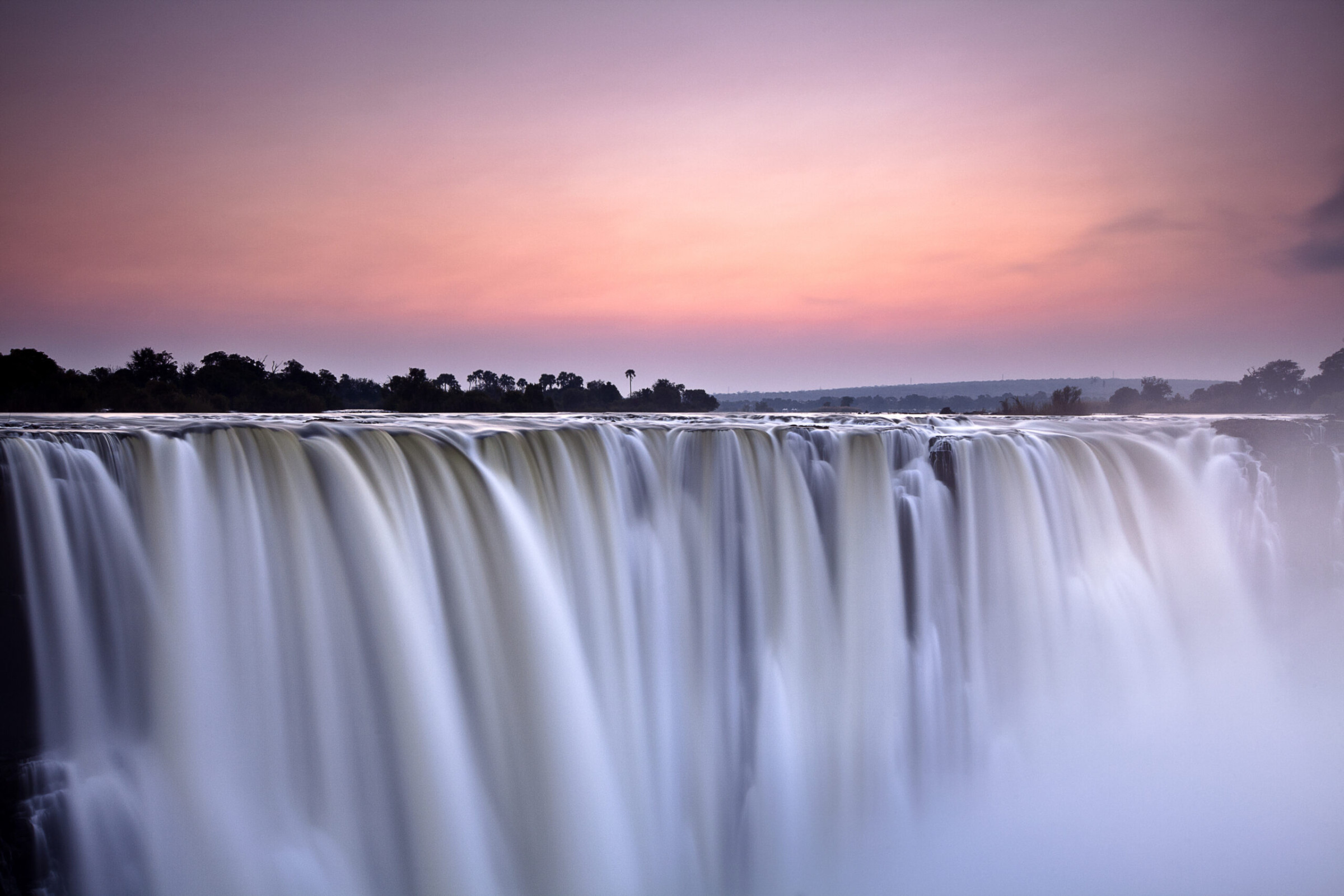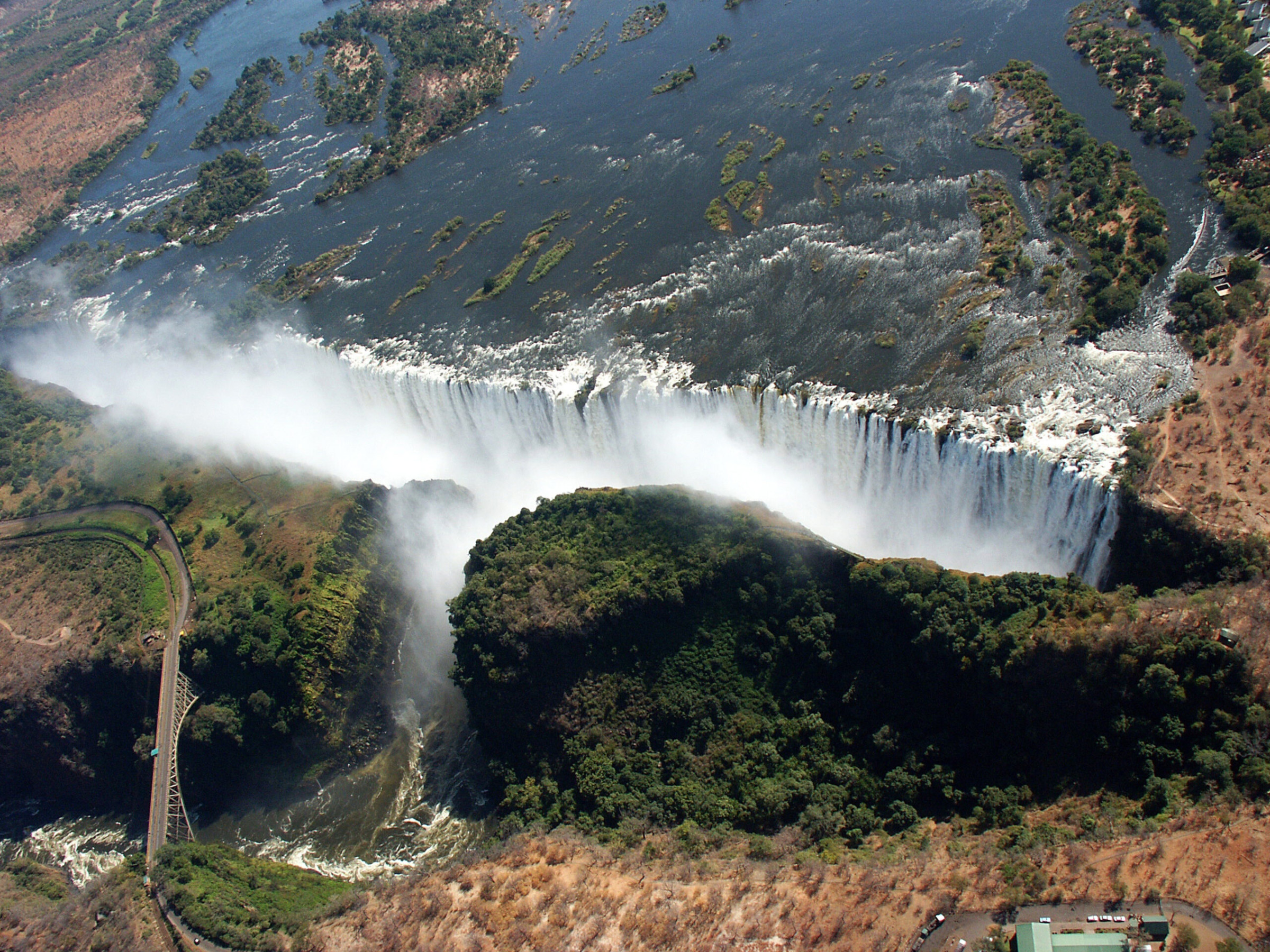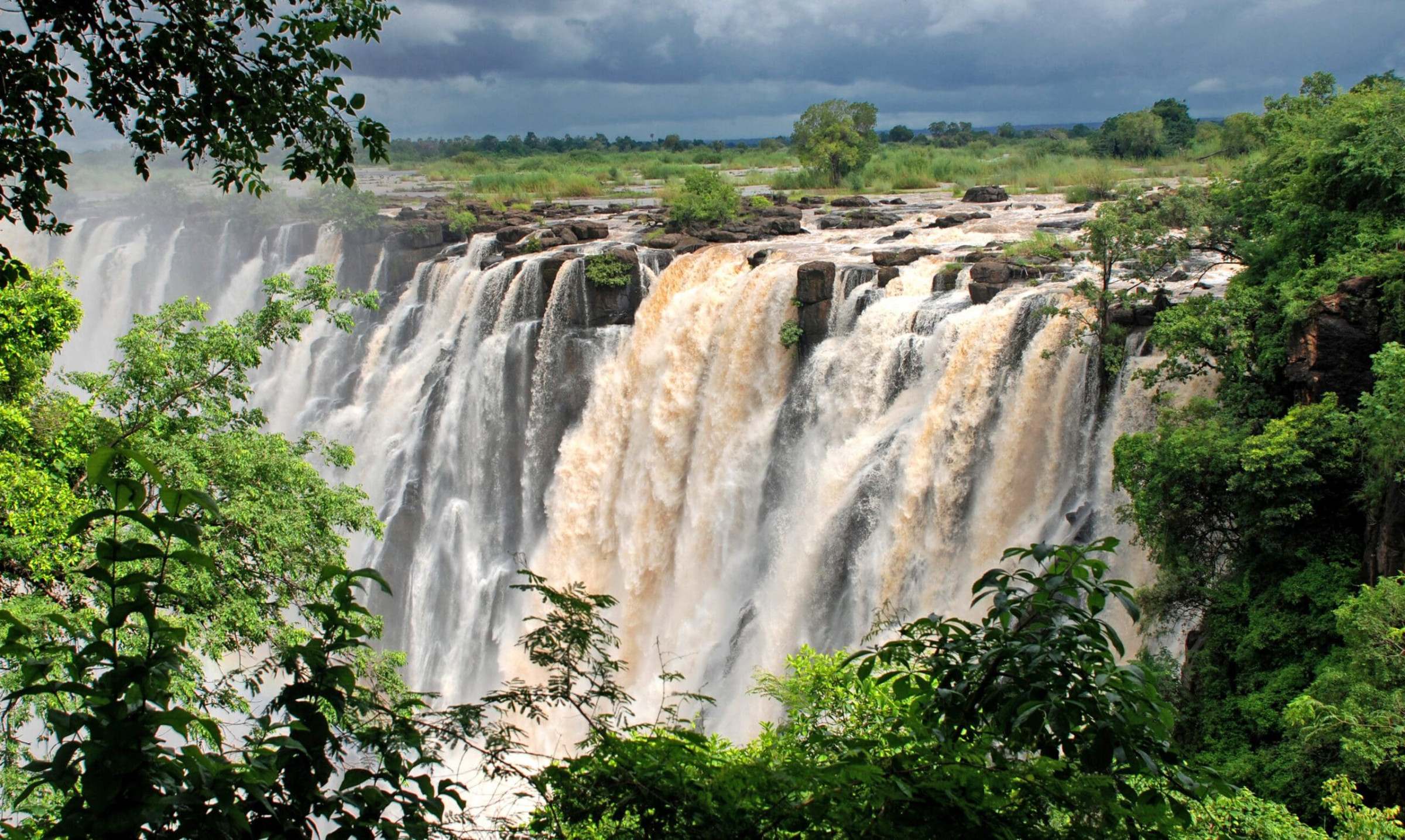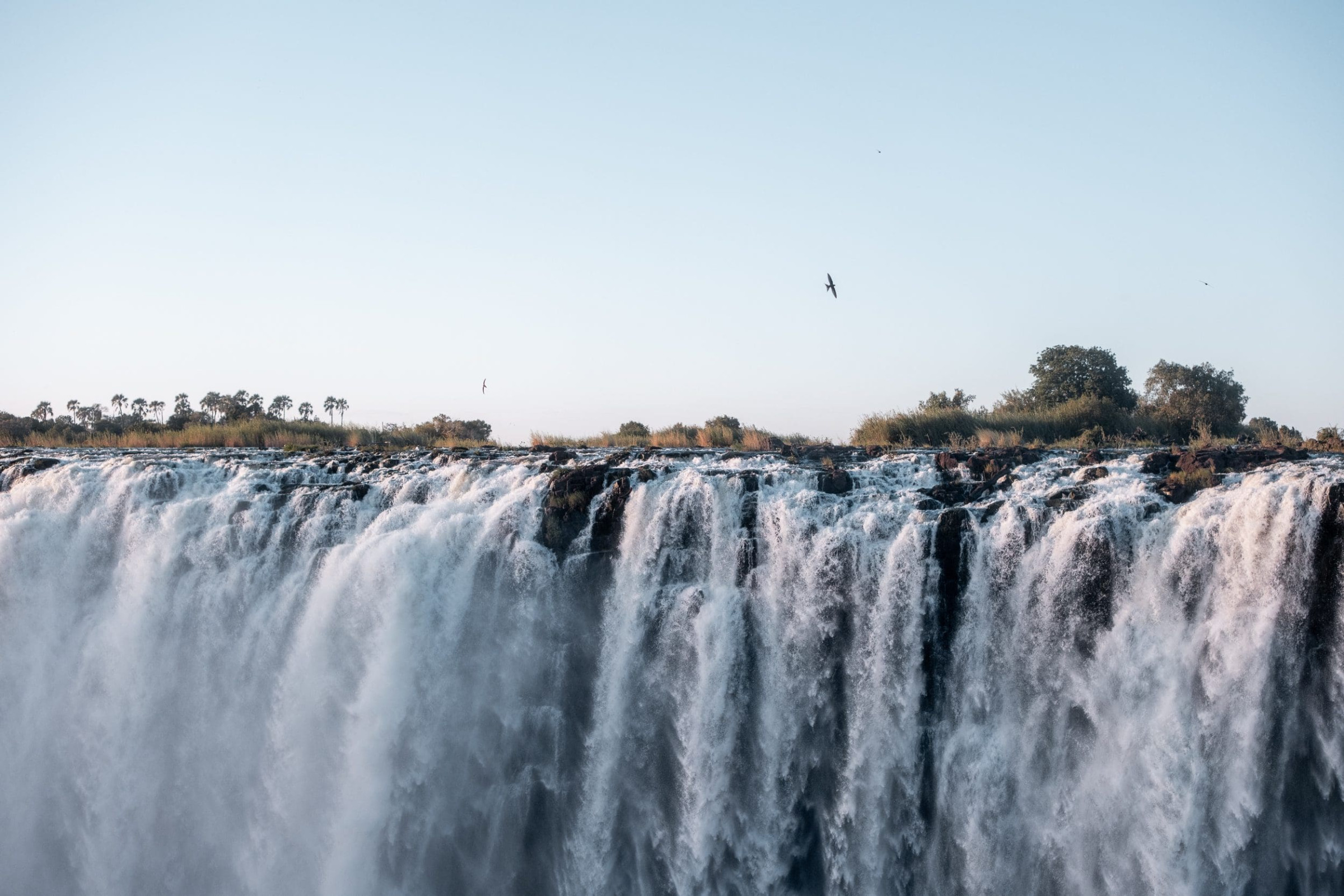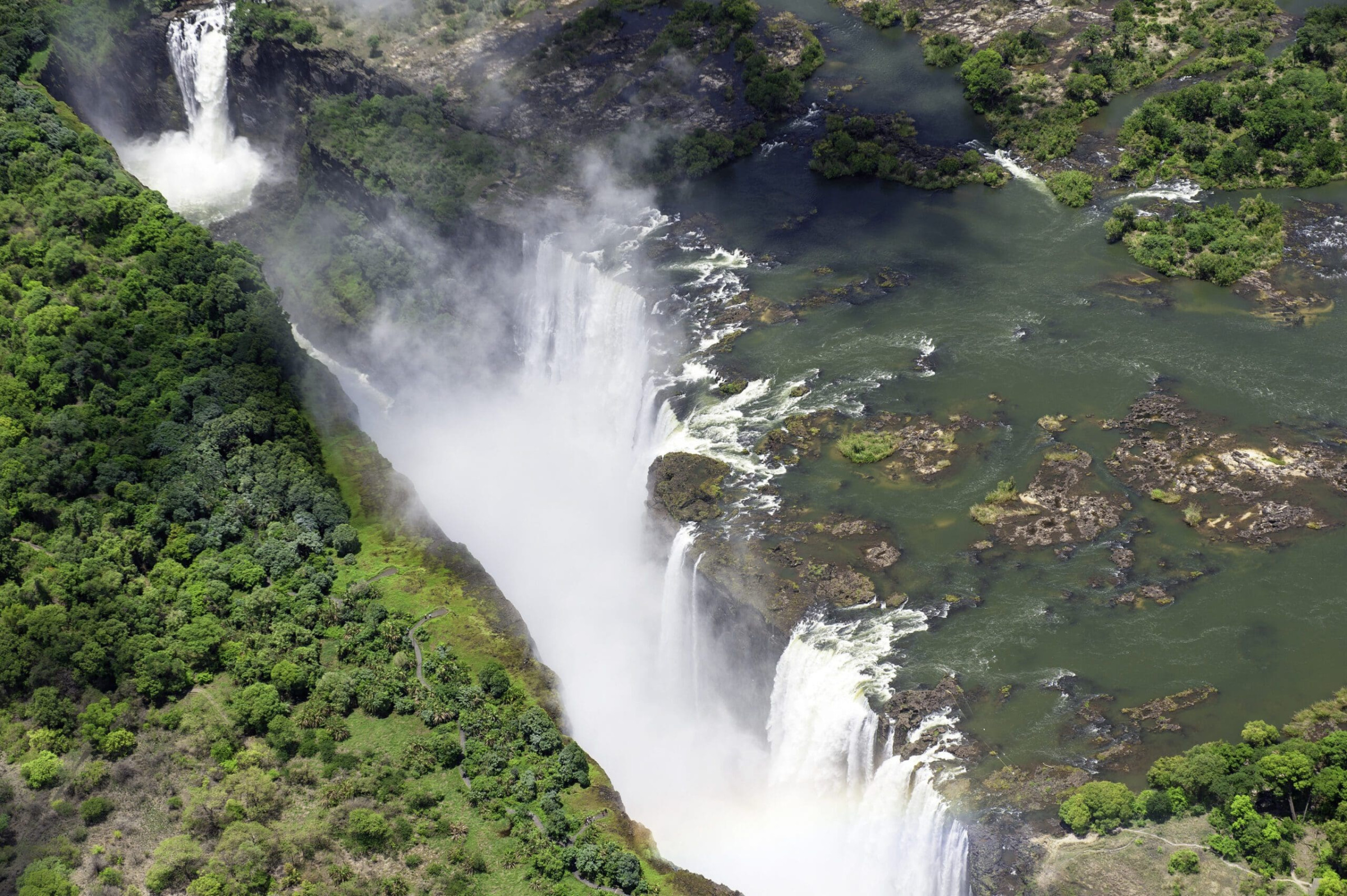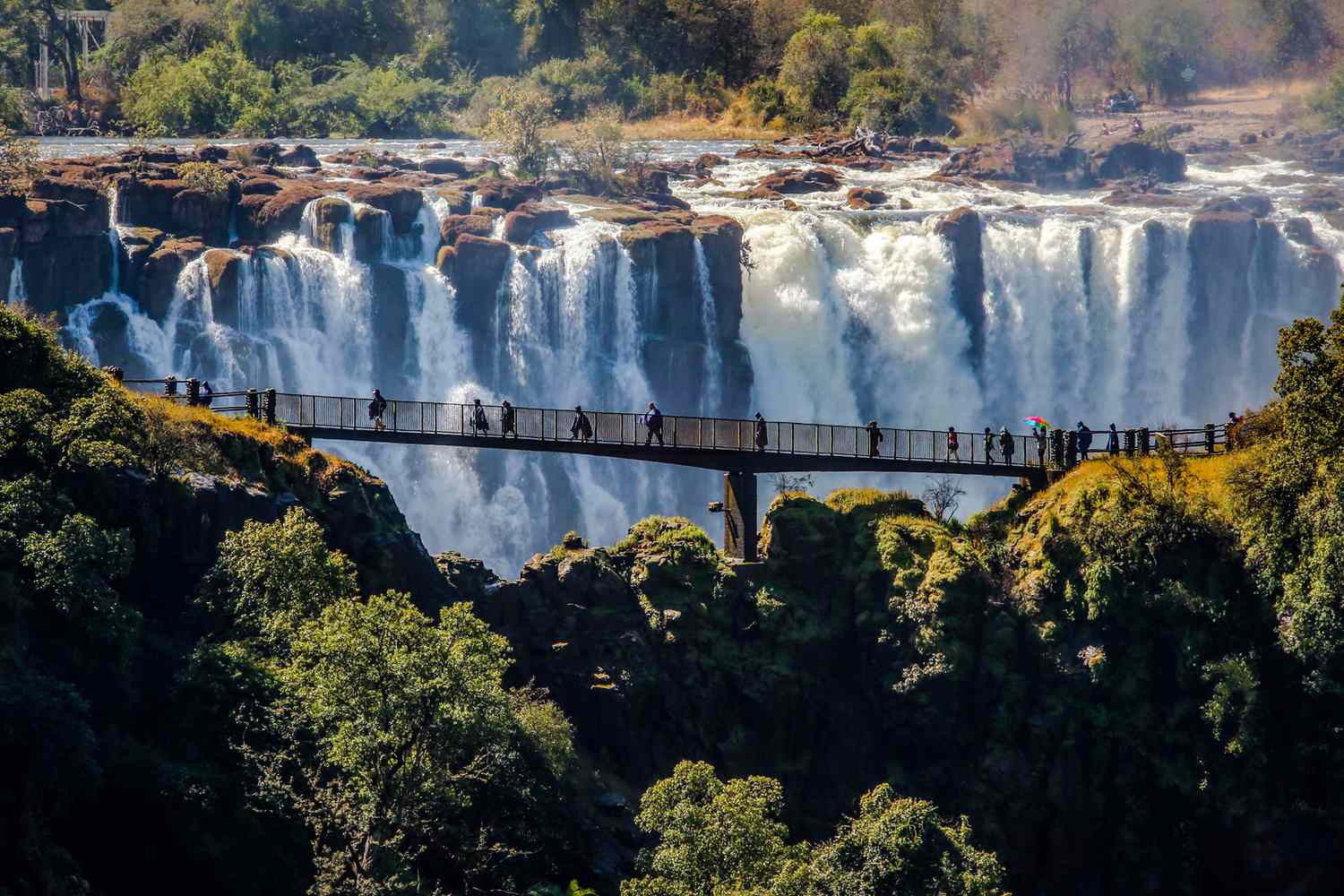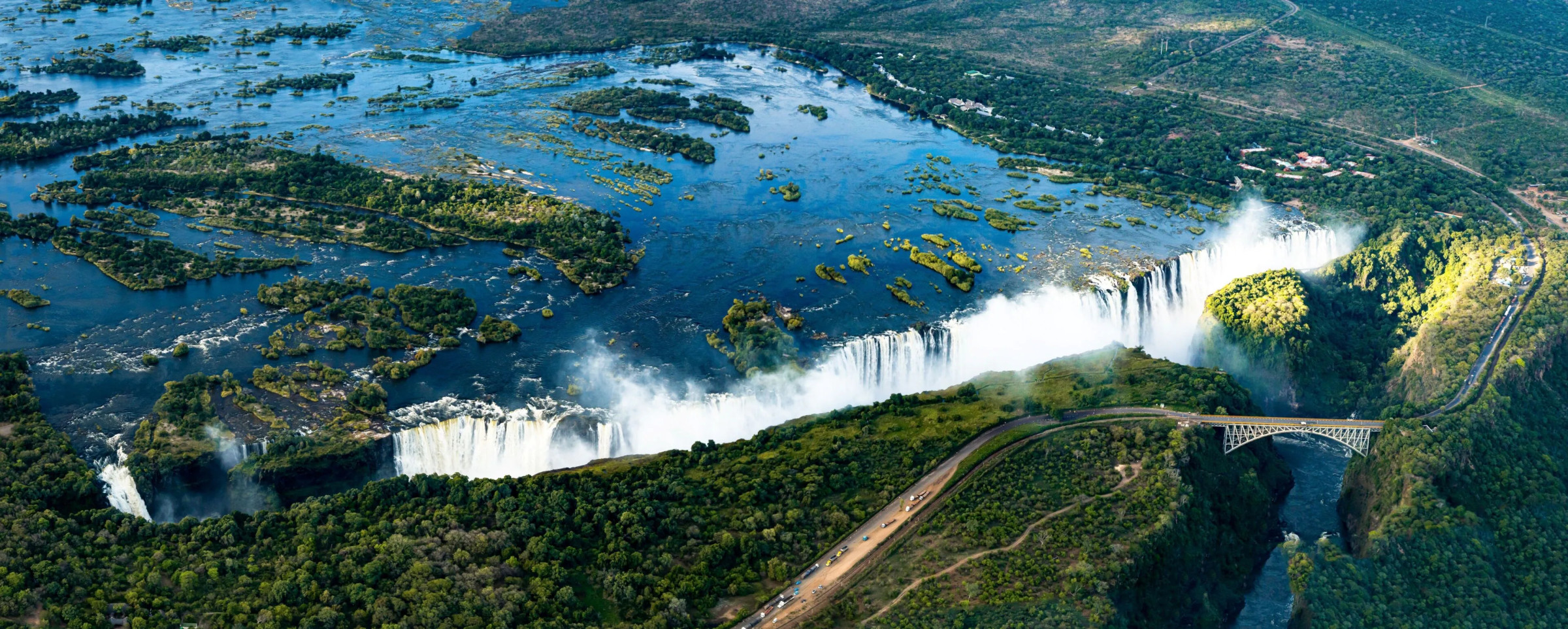
Victoria Falls sits on the Zambezi River along the border between Zambia and Zimbabwe, where the entire river, over a kilometer wide during peak flow, plunges roughly 108 meters into a narrow basalt gorge in a single unbroken curtain, producing a spray column visible from more than 20 kilometers away and a roar that gave the falls their local name, Mosi-oa-Tunya, "the smoke that thunders." Neither the tallest nor the widest waterfall on Earth individually, Victoria Falls is nonetheless classified as the largest single sheet of falling water in the world, a distinction based on the combined width and height of its curtain.
Scottish explorer David Livingstone became the first European to document the falls in 1855, naming them after Queen Victoria, though local Kololo and Ndebele communities had known and named the site long before his arrival. Livingstone's account, describing the spray as visible from miles off "like smoke rising," helped cement the falls' reputation in Europe as one of the natural wonders of the African continent.
The falls exist because the Zambezi River crosses a massive sheet of basalt rock riddled with fault lines running roughly perpendicular to the river's flow, and over geological time the river has cut a series of zigzagging gorges by eroding these weaker fault zones one after another, leaving Victoria Falls as merely the most recent in a sequence, with older, now-dry falls positions visible further downstream as evidence of the river's gradual retreat over hundreds of thousands of years.
This same process is actively ongoing today: geologists have identified the next fault line upstream where the falls will eventually migrate over an immense span of future geological time, meaning Victoria Falls' current position, however permanent it feels to visitors, is simply one stop in a very slow-moving natural process spanning hundreds of millennia.
Zambia and Zimbabwe both offer access to Victoria Falls, and each side provides a genuinely different visual experience: Zimbabwe's side offers the most extensive frontal views across roughly 75 percent of the falls' width, particularly dramatic during high water season, while Zambia's side, though showing less of the falls directly, offers closer proximity to the edge and access to unique experiences like the Devil's Pool, a natural rock pool right at the lip of the falls where swimmers can look over the edge during low water season.
Visitors with time and the right visas frequently cross between both sides via the Victoria Falls Bridge, itself a colonial-era engineering landmark completed in 1905 and now also home to bungee jumping and gorge swing activities suspended above the Zambezi far below.
Victoria Falls' character changes dramatically across the year: during peak flood season, roughly March through May, the sheer volume of water and resulting spray can actually obscure clear views of the falls themselves, drenching visitors on viewing platforms and creating near-constant localized rainfall from the rising mist. By contrast, the dry season from around August through December brings dramatically reduced flow, sometimes exposing bare rock sections of the falls entirely, while offering far clearer photography conditions and safe access to features like Devil's Pool.
This seasonal variability means the "best" time to visit genuinely depends on what a traveler wants most, maximum raw power and dramatic mist, or clearer views and unique low-water experiences unavailable any other time of year.
The near-constant spray from the falls sustains a small but genuine rainforest microclimate along the gorge's edge, an ecological anomaly amid the surrounding dry savanna woodland, supporting plant species found nowhere else in the immediate region. Mosi-oa-Tunya National Park on the Zambian side and Victoria Falls National Park on the Zimbabwean side both protect surrounding wildlife habitat, home to elephants, giraffes, and white rhinos among other species, alongside hippos and crocodiles in the calmer river sections upstream of the falls themselves.
This combination, dramatic waterfall scenery paired directly with classic African safari wildlife within the same short visit, makes Victoria Falls an unusually efficient stop for travelers combining multiple bucket-list experiences into a single regional trip.
Beyond simply viewing the falls, the surrounding gorge has become one of Southern Africa's major adventure tourism hubs, offering bungee jumping from Victoria Falls Bridge, white-water rafting through the Zambezi's Grade 5 rapids downstream, microlight flights over the falls for aerial views, and helicopter tours often nicknamed "flight of angels." This adventure economy has become as central to the local tourism identity as the natural landmark itself, drawing a younger, more activity-focused visitor demographic alongside traditional sightseers.
Both Livingstone, Zambia, and Victoria Falls town, Zimbabwe, have grown into dedicated tourism hubs built almost entirely around the falls and its associated activities, with the broader regional economy on both sides of the border remaining heavily dependent on continued visitor numbers.
Victoria Falls and the surrounding Mosi-oa-Tunya/Victoria Falls area were jointly inscribed as a UNESCO World Heritage Site in 1989, recognized for both their exceptional natural beauty and their geological significance as an active demonstration of ongoing waterfall migration. Climate change and upstream water usage across the wider Zambezi basin have raised periodic concerns about reduced dry-season flow in recent years, occasionally sparking international media attention when the falls have appeared unusually diminished during severe drought periods.
Conservation and water-management cooperation between Zambia and Zimbabwe, along with other Zambezi basin countries, remains an ongoing and increasingly important consideration for the falls' long-term ecological and tourism future.
Both Livingstone and Victoria Falls town have international airports with regular connections to regional hubs like Johannesburg, making the falls one of the more accessible major natural wonders in Southern Africa despite its relatively remote location. Most visitors choose one side as a base but cross for at least a day trip to experience the other country's distinct viewing angles and activities, provided visa requirements are handled in advance.
Whichever side travelers choose first, ponchos or waterproof gear are essential nearly year-round given the near-constant spray, and comfortable, quick-drying footwear makes the walking trails considerably more pleasant than typical closed shoes.
Livingstone and Victoria Falls town both grew up almost entirely around British colonial-era rail and tourism infrastructure connected to the falls, with the Victoria Falls Bridge originally conceived as part of Cecil Rhodes' ambitious, never-completed Cape-to-Cairo railway line. That colonial planning history still shapes the physical layout of both towns today, and ongoing renovation of heritage-era hotels on both sides has become part of a broader push to preserve early 20th-century architecture alongside the natural attraction that first drew rail investment to this remote stretch of the Zambezi more than a century ago.
Zimbabwe and Zambia have periodically discussed joint tourism marketing and shared visa arrangements to simplify cross-border travel for falls visitors, reflecting a recognition on both sides that the site functions best, economically and experientially, as a single shared attraction rather than two competing national ones.
No reviews yet. Be the first to share your experience!
Share your experience and help other travelers