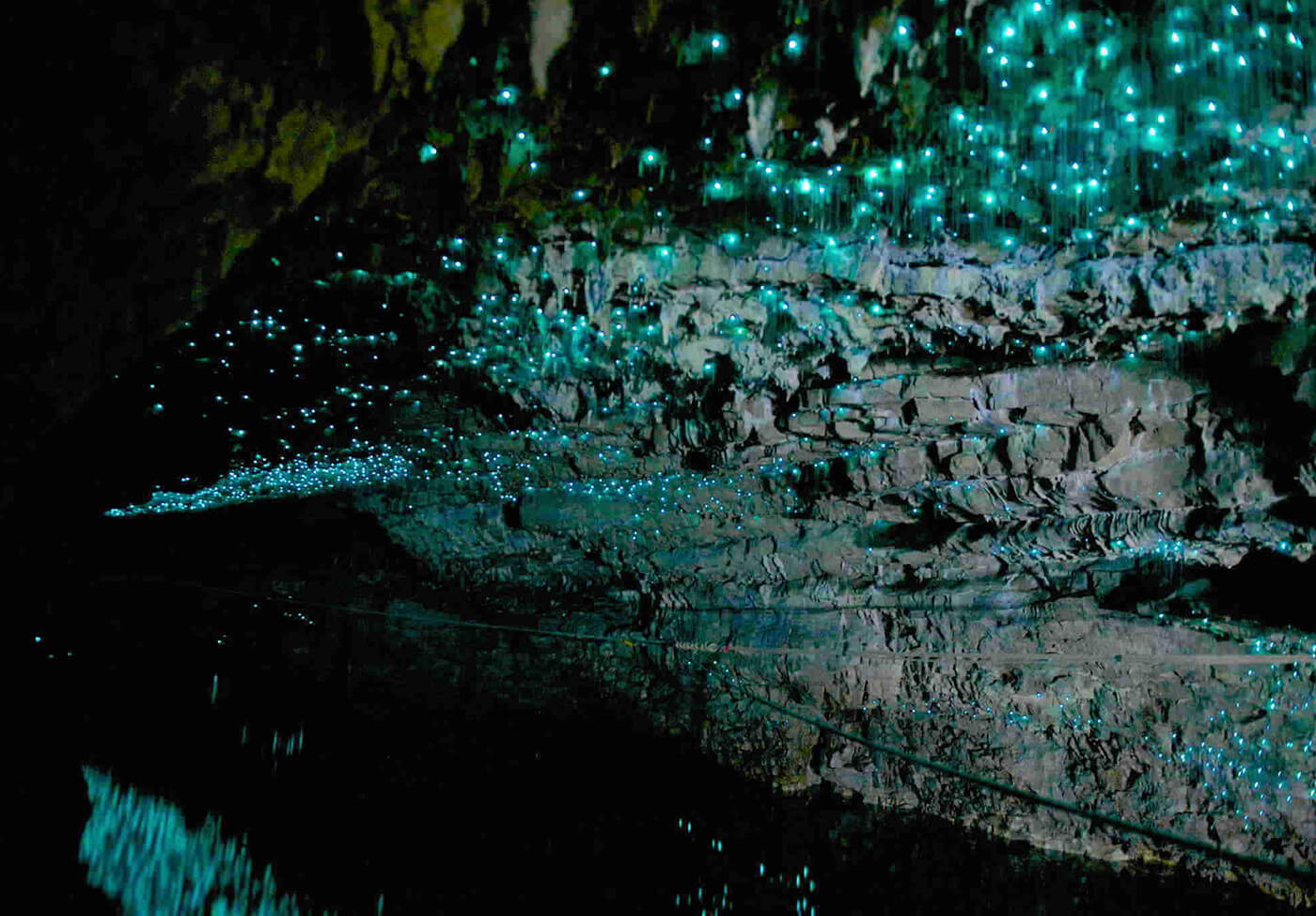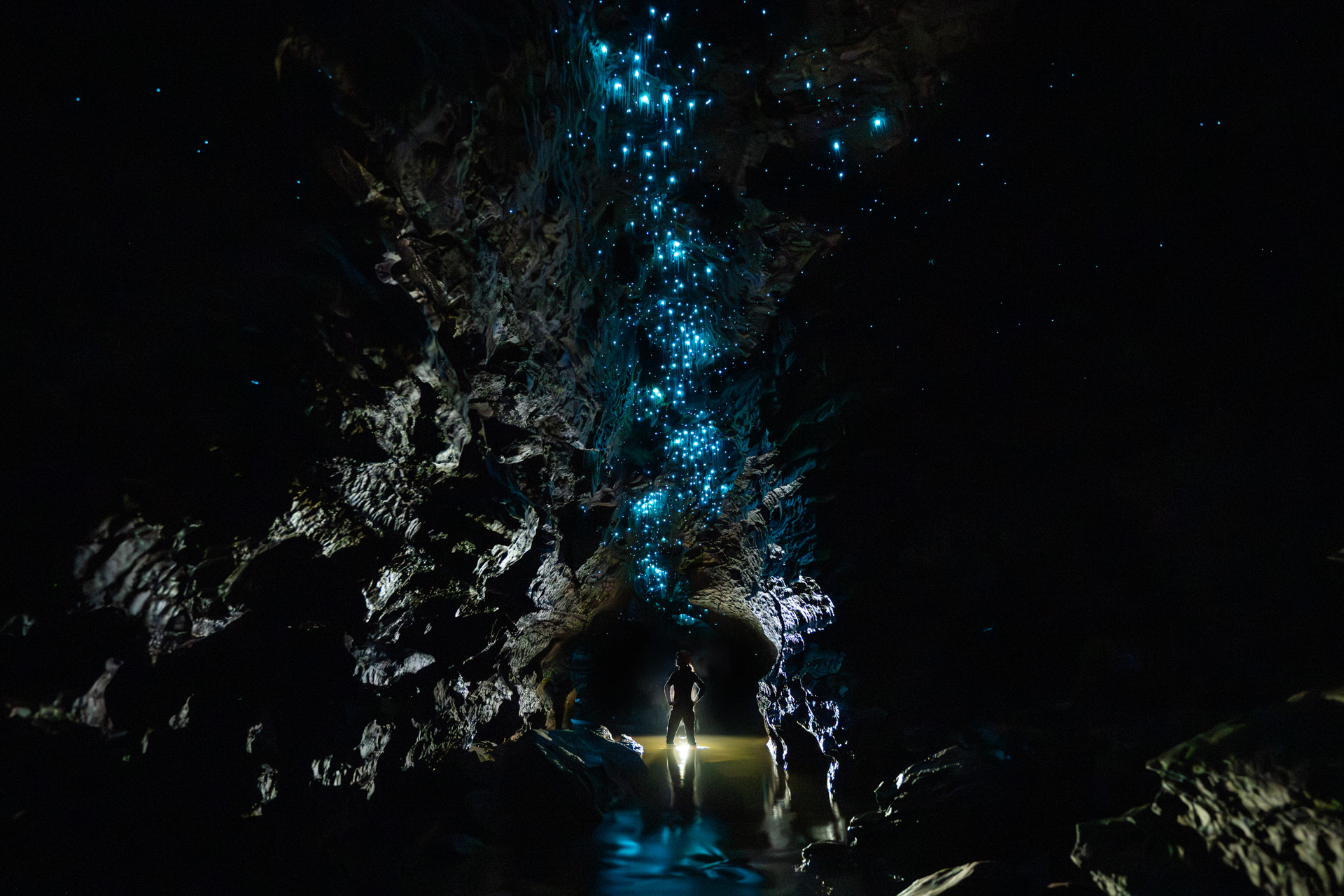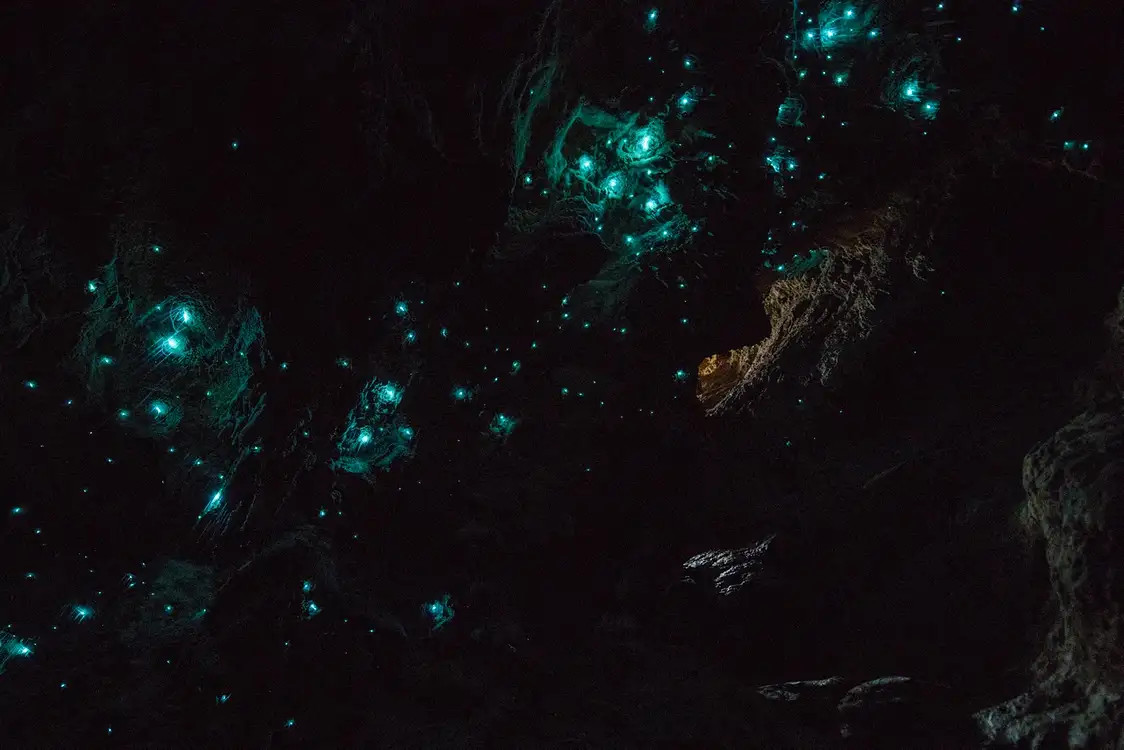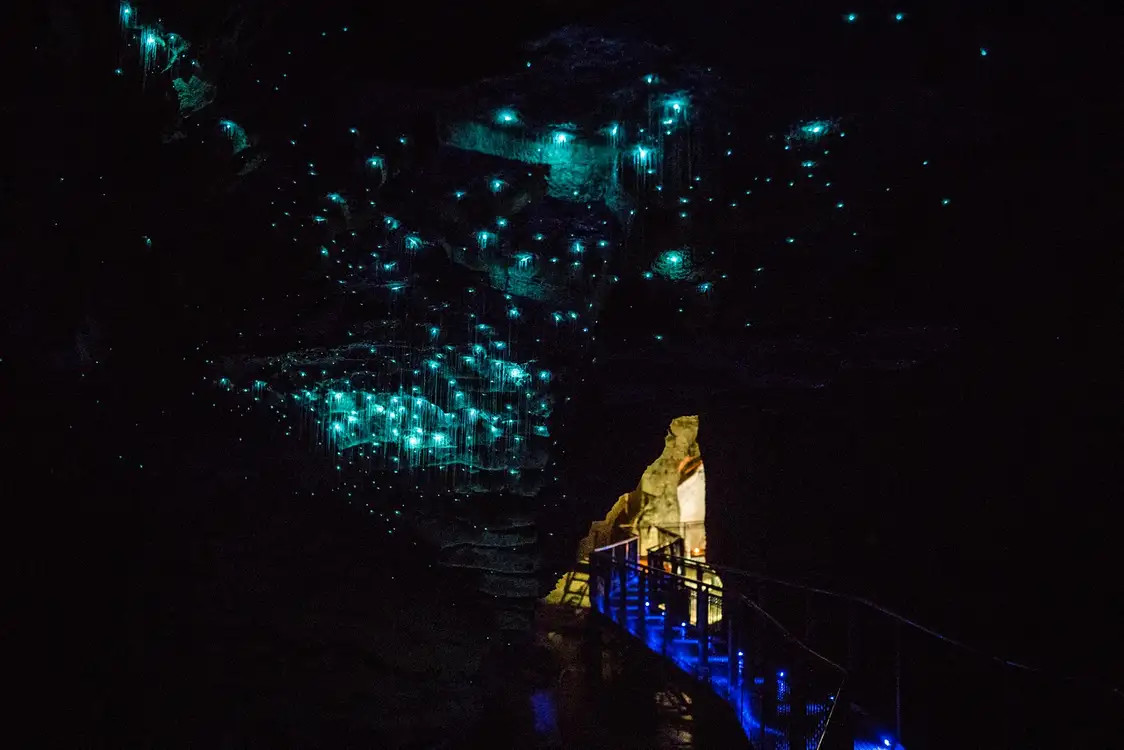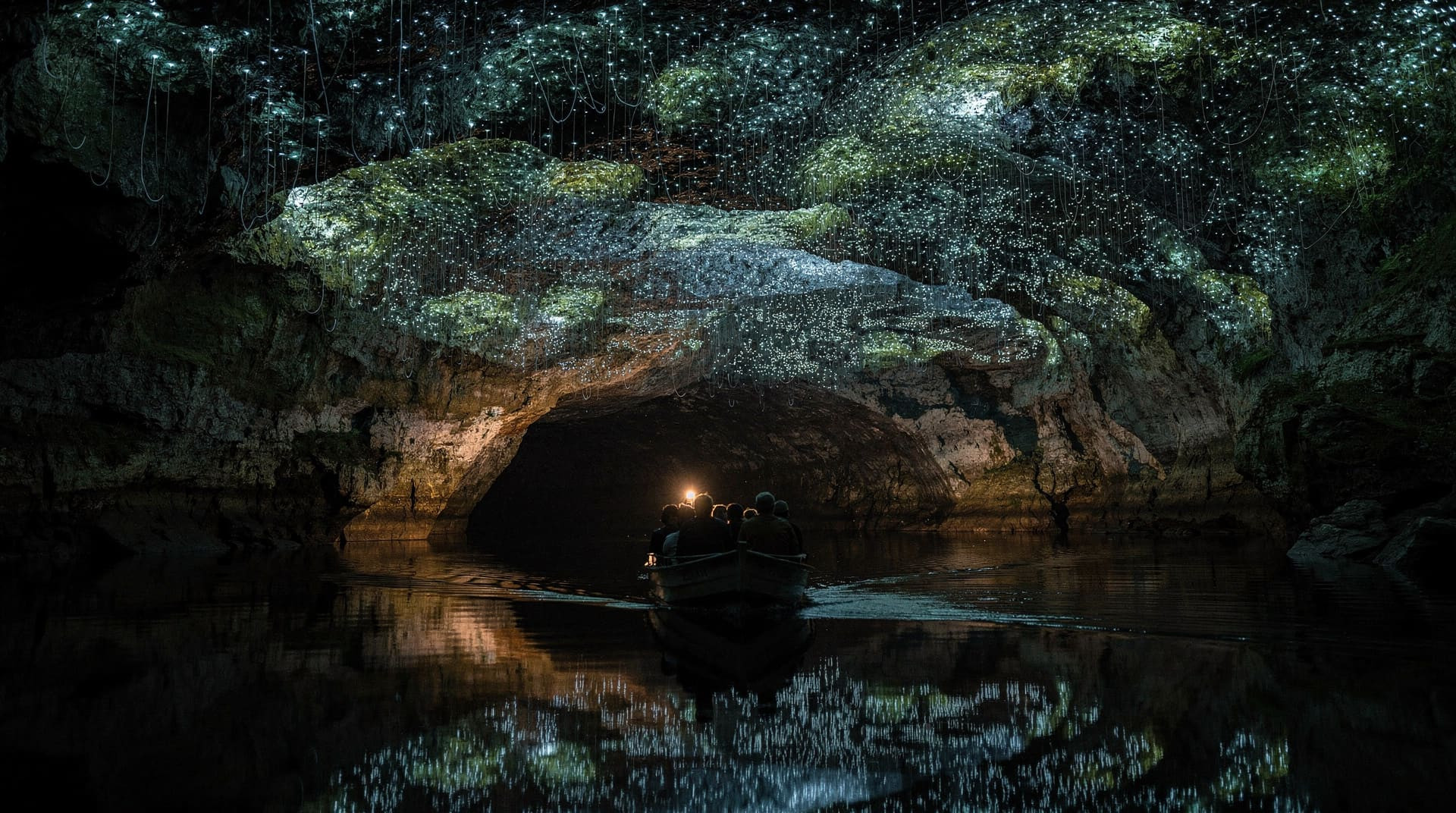
The Waitomo Glowworm Caves sit beneath rolling farmland on New Zealand's North Island, roughly two hours south of Auckland, and are famous for a single extraordinary sight: thousands of bioluminescent glowworm larvae, Arachnocampa luminosa, clustered across the cave ceiling, producing a soft blue-green light that transforms the dark limestone chamber into something resembling a star-filled night sky viewed from below. The species exists only in New Zealand, and Waitomo remains the most accessible and famous place to see it in significant numbers.
The glow is not decorative, it is a hunting strategy. Each larva builds sticky silk threads hanging from the ceiling and produces light through a bioluminescent chemical reaction in its tail, luring flying insects that mistake the glow for open sky and become trapped in the threads below. A single larva can maintain dozens of these snare lines simultaneously, and the combined effect across thousands of individuals is what produces the cave's signature starry-ceiling appearance.
Waitomo's cave system formed within limestone deposited roughly 30 million years ago when the region sat beneath a shallow sea, later uplifted and gradually hollowed out by underground rivers dissolving the soft rock over millions of years. The name itself reflects this watery origin: "wai" meaning water and "tomo" meaning hole or shaft in Maori, a fitting description for a landscape riddled with over 300 known caves and sinkholes across the wider district.
Stalactites, stalagmites, and flowstone formations line much of the accessible cave system alongside the glowworm grotto, and the region's soft, water-carved limestone continues to create new sinkholes and passages, meaning the full extent of Waitomo's underground network likely remains only partially mapped even today.
Local Maori of the Ngati Kinohaku hapu, part of the wider Waitomo iwi tradition, knew of the caves long before European settlers arrived, though the glowworm grotto specifically was first formally explored in 1887 by local Maori chief Tane Tinorau alongside English surveyor Fred Mace, who together rafted into the cave on a flax raft carrying only candles for light. Tane Tinorau began guiding visitors himself soon after, and members of his descendant family remained closely involved in the site's management for generations afterward.
This history matters considerably to how Waitomo operates today: much of the cave land remains under a co-governance arrangement recognizing Maori ownership and guardianship, and cultural context, rather than only geological explanation, is woven into most guided tours as a matter of policy rather than afterthought.
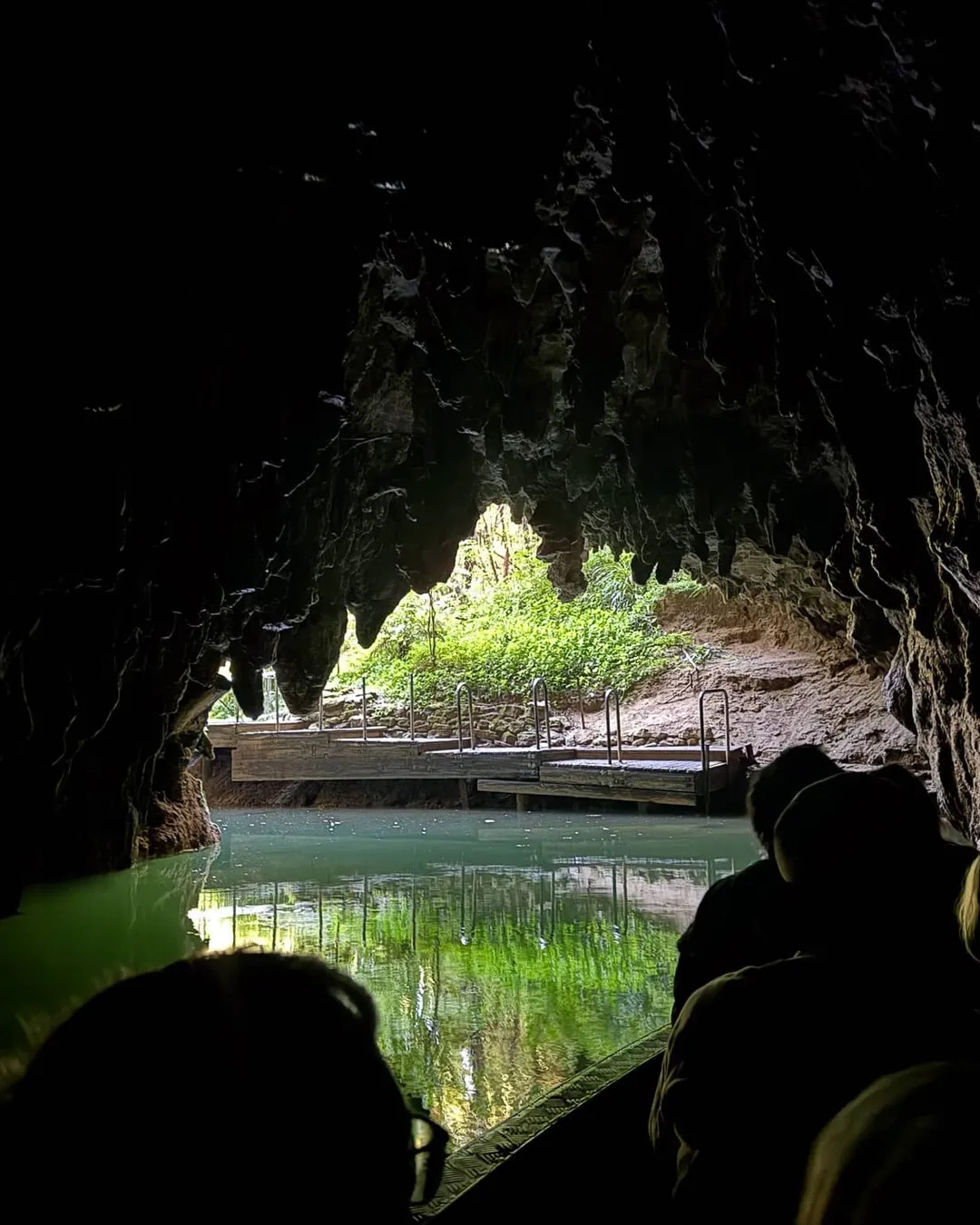
The signature visitor experience involves a guided walking tour through upper limestone chambers followed by a silent boat ride through the glowworm grotto itself, guides pull the boat along a fixed cable in complete darkness and near-total silence, since noise and light both disturb the glowworms and diminish the effect for other visitors. This deliberate quiet transforms what could be a simple sightseeing stop into something closer to a meditative experience, often cited by visitors as one of the most memorable parts of any New Zealand trip.
Because flash photography and any artificial light disrupt both the glowworms' hunting behavior and the visual effect for other visitors, cameras are prohibited inside the grotto section, a restriction enforced strictly by guides throughout the boat ride.
Beyond the standard glowworm boat tour, the wider Waitomo district has become a hub for adventure caving activities including black water rafting, floating through underground rivers on inner tubes, abseiling into vertical cave shafts, and multi-hour wild caving expeditions through undeveloped passages. These more physically demanding tours appeal to a different visitor segment than the family-oriented classic boat tour and have helped diversify the region's tourism economy considerably since the 1980s.
Several nearby caves, including Ruakuri and Aranui, offer glowworm viewing with different formation styles and access methods, giving repeat visitors reasons to explore beyond the original and most famous Waitomo grotto.
Glowworm populations are sensitive to changes in humidity, temperature, and carbon dioxide levels, all of which rise with visitor numbers, prompting strict caps on daily group sizes and total visitors alongside a firm no-flash-photography rule to protect long-term colony health. Cave operators monitor environmental conditions closely, since a decline in glowworm numbers would directly undermine the site's primary appeal as well as its ecological significance.
Ongoing research into Arachnocampa luminosa biology continues at Waitomo and nearby university partnerships, given that the species remains endemic to New Zealand and only partially understood in terms of its broader ecological role within cave ecosystems.
Waitomo village itself is small, built almost entirely around cave tourism, with day trips easily arranged from Auckland or Rotorua and overnight stays available for visitors wanting to combine the classic boat tour with adventure caving options the following day. Tours run year-round since the caves maintain a stable internal temperature regardless of surface season, though summer months bring noticeably higher visitor volumes.
Advance booking is strongly recommended during New Zealand's peak summer tourist season, from December through February, when tour slots for the most popular boat ride frequently sell out days ahead.
Waitomo's global reputation rests almost entirely on a phenomenon that exists nowhere else on Earth in comparable accessibility, a living, glowing cave ceiling created by an insect species found only in New Zealand. Combined with a genuine, still-active Maori guardianship tradition dating back to the 1880s, Waitomo offers something rare among show caves worldwide: a natural spectacle inseparable from the specific cultural history of the people who first shared it with the world.
Waitomo village itself has fewer than a few hundred residents, and its entire local economy revolves around the caves in a way few tourist towns anywhere else can match this directly, cafes, gift shops, and small guesthouses all cater specifically to cave-tour visitors rather than any broader local industry. This concentration has both benefits and risks: it means service quality and guide expertise around the caves tend to be exceptionally high, but it also leaves the town heavily exposed to any disruption in tourism, as became clear during pandemic-era travel restrictions when visitor numbers collapsed almost entirely for an extended period.
Recovery since has been steady, with international visitors gradually returning alongside a noticeable rise in domestic New Zealand tourism to the site, partly driven by renewed interest in supporting local and culturally significant attractions closer to home. That layered draw, a rare insect found nowhere else, a still-active Maori guardianship story, and a genuinely small-town New Zealand welcome, keeps Waitomo firmly on the North Island itinerary even for travelers who never venture underground anywhere else on their trip.
No reviews yet. Be the first to share your experience!
Share your experience and help other travelers